
Byword vs context grounded content tools for organic search
You've published 40 articles this quarter, but your organic traffic barely moved. The content reads fine, it just doesn't sound like your brand, doesn't link to your own pages, and gets zero citations from AI answer engines. That's the exact problem driving the Byword vs context grounded content tools comparison: bulk generation without site context produces words, not rankings.
You're right to be frustrated. Churning out templated articles that need heavy editing before they can go live defeats the purpose of automation. Here's the promise: by the end of this article, you'll understand exactly where Byword excels, where it structurally falls short, and how context grounded generation closes that gap, including one architectural limitation most comparison posts gloss over entirely.
Here's the roadmap. First, we'll map Byword's real strengths honestly. Second, we'll define what context grounding actually means, using a 4-level spectrum framework you won't find in competing posts. Third, we'll show what breaks when site context is missing. The surprising finding? Most tools in this category, including Byword, operate at Level 1 or Level 2 of that spectrum, which is why their output needs so much manual repair. A platform like BloGoose, which crawls your sitemap and extracts brand voice rules before drafting, operates at Level 3. Keep reading to see the difference that makes.
What Does Byword Actually Do Well?
Byword is an AI content generation tool that produces articles at scale from prompts and templates, with strong bulk generation speed and a low learning curve. It's genuinely good at what it does, the question is whether what it does matches what organic search now rewards.
Think of Byword like a high-volume printing press. You feed it a template, a title, a target keyword, maybe a tone instruction, and it prints article after article quickly. That's the simple level. For a solo publisher who needs 30 product roundups this month, that speed is real value. Stefan Georgi's Content Marketing App Review confirms Byword's bulk generation and template workflows are legitimate strengths, not marketing fluff.
At the intermediate level, Byword lets you build reusable templates with custom instructions. You can define a structure, intro, three subheadings, FAQ, and apply it across dozens of posts. This consistency is useful when you're scaling a content operation and don't want to re-prompt every time. The output is predictable, and predictable output is easier to edit in batches.
Here's the advanced-level limitation, though. Byword generates from prompts and templates, not from a crawled sitemap or brand context files. It doesn't know your existing pages, your internal link structure, your brand voice rules, or which topics you've already covered. Every article starts from zero context. That's the architectural gap: speed without site awareness. For a deeper breakdown of how this compares to sitemap-driven approaches, see our analysis of sitemap context extraction vs Byword. BloGoose closes this gap by crawling your domain first, so every draft already knows your site.
What Does Context Grounded Content Generation Actually Mean?
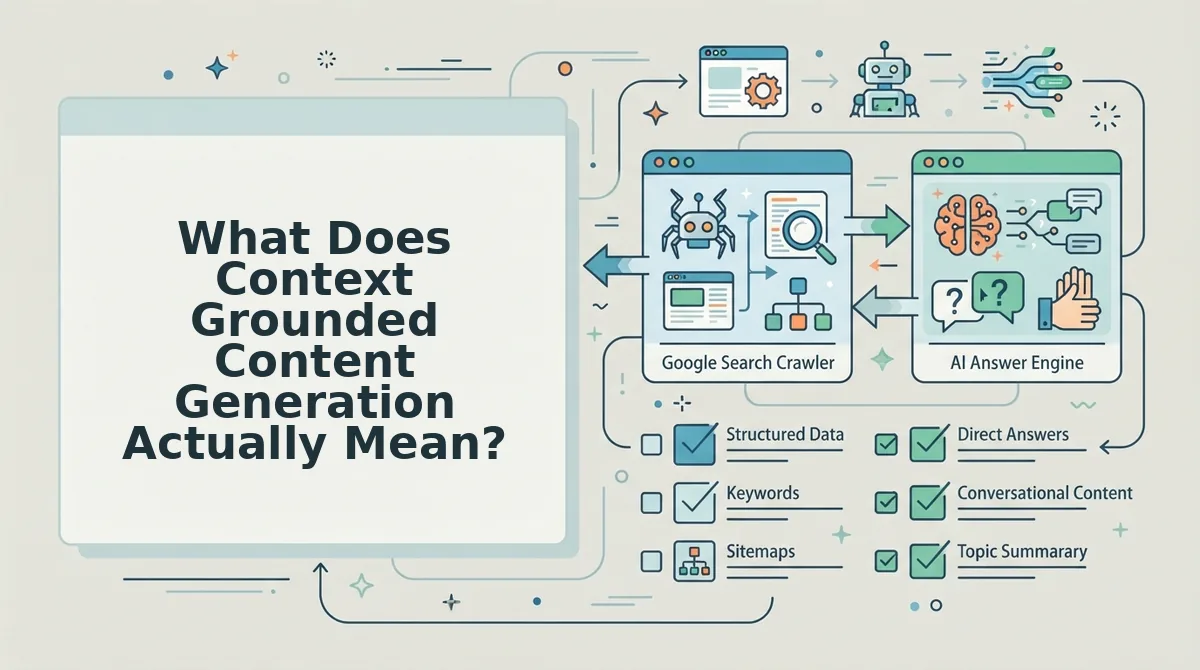
Context grounded content generation is the practice of feeding an AI model structured information about your website, its sitemap, existing pages, brand voice rules, and internal link map, before asking it to write, so every output is anchored to your actual site rather than a generic prompt. In short: the AI writes as if it has already read your website, because it has.
Think of it like hiring a freelance writer. A prompt-only tool is a writer who's never seen your site and gets a one-paragraph brief. A context grounded tool is a writer who gets your full site map, your style guide, your top 50 pages, and a note saying "link to these pages where relevant." Same writer, radically different output quality.
IBM Technology frames this as a distinct discipline: context engineering is separate from prompt engineering. Prompt engineering is about phrasing the instruction well. Context engineering is about curating what the model knows before it responds. Chroma's Hammad Bashir goes further, describing context as the emerging outer loop of AI systems, the layer that determines whether an AI produces generic answers or grounded, specific ones.
To make this concrete, here's the 4-level Context Grounding Spectrum:
- Level 0. Prompt-only: The model gets a title and keyword. No site data. Output is generic by definition.
- Level 1. Manual context pasting: You copy-paste a style guide or a few example pages into the prompt. Better, but inconsistent and time-consuming.
- Level 2. Partial crawl, keyword-only: The tool pulls keyword data or a few URLs, but doesn't map your full site structure or brand rules.
- Level 3. Full sitemap crawl + brand context files + internal link map: The tool crawls your entire site, extracts voice rules, maps internal links, and uses all of it to ground every draft.
Most AI writing tools. Byword included, sit at Level 1 or Level 2. They rely on you to supply context manually, or they pull only keyword-level data. A context grounded content engine like BloGoose operates at Level 3: it crawls your XML sitemap, inspects published pages, extracts brand voice rules, and builds an internal link map before drafting a single sentence. That's the difference between content that needs a full rewrite and content that ships.
That gap between Level 2 and Level 3 is where rankings are won or lost. Next, we'll look at exactly what breaks when site context is missing.
Byword vs Context Grounded Tools: What Breaks Without Site Context?
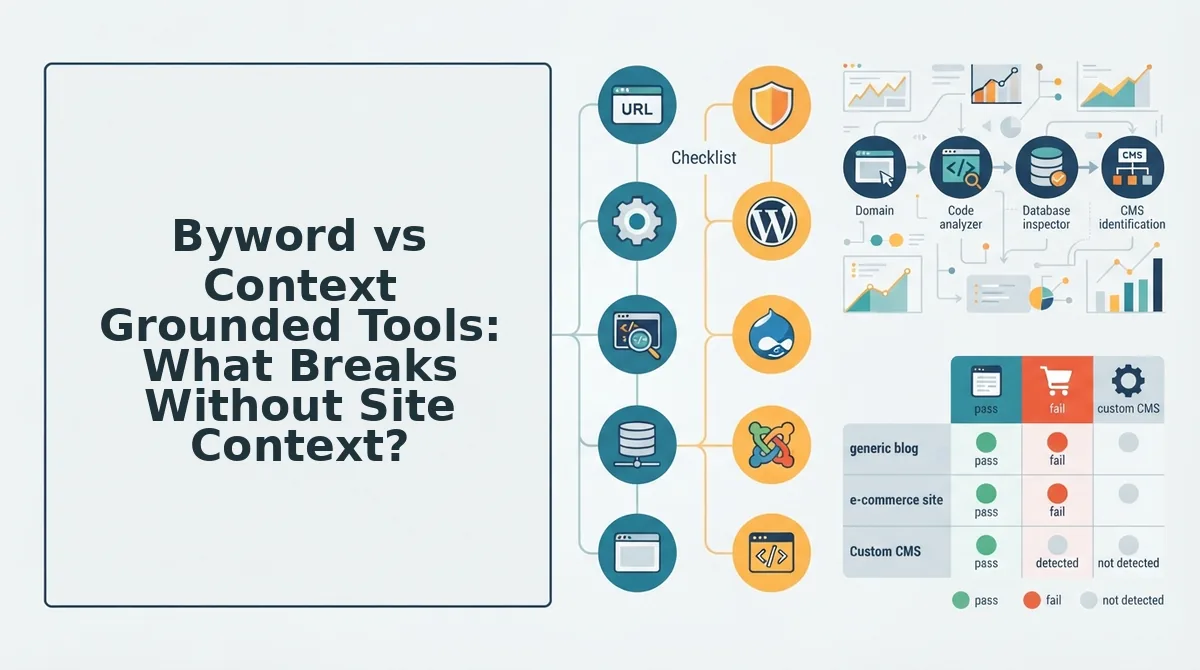
Byword generates articles from prompts and keywords, while context-grounded tools crawl your live site first to extract brand voice, existing URL structure, and internal linking patterns before drafting. The difference shows up in four failure modes: voice drift, orphan pages, broken anchor text, and duplicate topic cannibalization.
Failure Modes Compared
| Failure Mode | Byword (Prompt-First) | Context-Grounded Tools (Site-First) |
|---|---|---|
| Voice drift | Relies on manually pasted style notes or example text per prompt; voice consistency degrades as prompts vary across sessions and team members. | Extracts tone, terminology, and formatting rules from published pages automatically; every draft inherits the same detected voice profile. |
| Orphan pages | No awareness of existing site architecture; new articles may link to nothing and receive no internal links back, weakening crawl depth. | Maps the existing URL tree and inserts contextual internal links to relevant pillar and cluster pages during drafting. |
| Broken anchor text | Anchor text is generated from the keyword prompt only; it may point to non-existent URLs or use phrasing inconsistent with your site's conventions. | Anchor text references verified URLs from the crawl, matching the destination page's actual title and topic. |
| Topic cannibalization | No visibility into what you have already published; repeated prompts can produce near-duplicate articles competing for the same query. | Detects existing coverage and either skips redundant topics or differentiates the angle to protect ranking signals. |
Workflow Time-Cost
Byword's output requires manual export, then re-prompting or editing for voice, manual internal link insertion, and a separate CMS upload step. Context-grounded tools automate context extraction and ship finished articles directly to WordPress or a custom API, removing the re-prompting and manual linking loops.
Honest Strengths of Each
Byword is genuinely fast for bulk first drafts when you have a tight keyword list and a dedicated editor who enjoys polishing. Its simplicity is a feature: no crawl setup, no brand profile configuration, just prompt and generate. For teams that already have a strong editorial layer and only need raw material, that speed matters.
Context-grounded tools trade some setup time for compounding consistency. The initial site crawl takes minutes, but every subsequent article inherits voice rules, link structure, and publishing paths automatically. For teams publishing weekly or daily, that upfront cost pays back within the first content cluster.
Best For Recommendations
Best for Byword: Solo writers and lean teams generating high-volume short-form content, product descriptions, ad copy variations, or social snippets, where site architecture matters less and manual editing is already part of the workflow.
Best for context-grounded tools: Founders, growth leads, and content publishers building topical authority through interlinked content clusters, where voice accuracy, internal linking, and direct CMS publishing determine whether the content actually ranks. If you are weighing how BloGoose compares to other AI writing approaches, see how BloGoose compares to Jasper for a parallel breakdown.
Context grounding matters most when your site already has ranking pages. A tool that cannot see those pages will draft articles that compete with them instead of reinforcing them. The failure is not in the writing quality, it is in the missing relationship between the new article and the site it is supposed to strengthen.
Who Should Choose Which Tool?
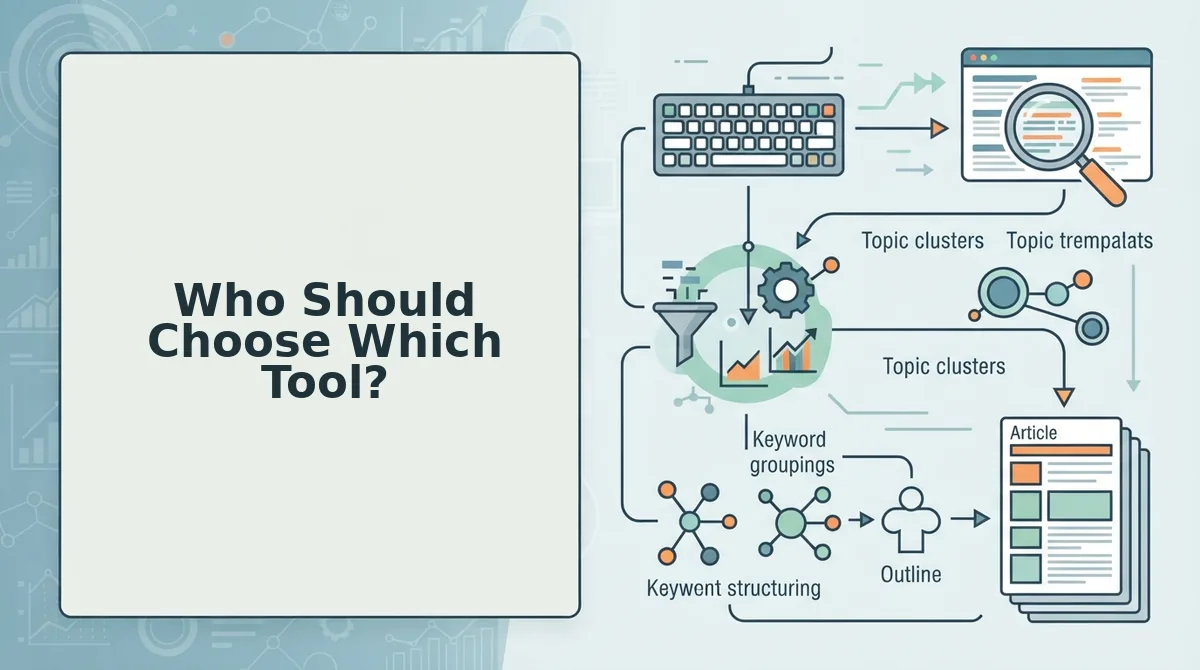
The right choice depends on whether you are optimizing for raw draft volume or for compounding organic search equity. Use this decision matrix to self-select before committing to a workflow.
- Choose Byword if you need bulk short-form drafts with a manual editing pass. Byword excels when volume is the primary constraint and a human editor already owns voice and linking decisions. Use it for product descriptions, category page copy, or ad variations where site architecture is irrelevant to ranking.
- Choose a context-grounded tool if you publish content clusters for organic search. Tools that crawl your site first produce voice-accurate, internally linked articles that reinforce pillar pages instead of cannibalizing them. Use this approach when topical authority and AI citation visibility are the goals.
- Choose Byword if your team has a dedicated editor and a documented style guide. When voice rules already live in a shared doc and someone manually applies them, prompt-first generation is sufficient. The editor becomes the context layer that the tool lacks.
- Choose a context-grounded tool if publishing speed includes the CMS upload step. Byword stops at the draft; you still export, format, link, and upload. Context-grounded platforms ship directly to WordPress or a custom API, which matters when publishing cadence is weekly or daily.
- Choose Byword if you are testing AI content for the first time with a small budget. A lightweight prompt-first tool lets you experiment without committing to a crawl-and-publish workflow. Start here to validate whether AI drafts fit your editorial standards.
- Choose a context-grounded tool if you have already published 20+ pages and want them to work together. Once a site has enough content to cannibalize itself, the cost of manual internal linking and voice enforcement exceeds the cost of automation. The crawl pays for itself by preventing ranking losses on existing pages.
- Choose Byword for one-off content with no strategic relationship to your site. Guest posts, newsletter intros, or standalone landing page copy do not need site context. Prompt-first generation is faster when the article will never link into your cluster.
If your workflow today involves generating a draft, editing for voice, manually adding internal links, and uploading to WordPress, you are already doing the work a context-grounded tool automates. The question is not which tool writes better, it is which tool removes the most steps between keyword and published, linked article.
Frequently Asked Questions About Byword and Context Grounded Tools
Does Byword actually ground content in my site's existing structure?
No. Byword generates articles from the prompts and keywords you provide, without crawling your site or reading your published pages. Any site-specific voice, terminology, or internal linking must be manually included in every prompt.
What do I lose if I pick a tool that doesn't crawl my site first?
You lose automatic voice consistency, verified internal links, and protection against topic cannibalization. Articles may orphan themselves from your existing architecture, compete with pages you have already published, and drift from your brand voice across multiple prompts.
How does Byword handle the actual publishing step?
Byword does not publish directly. You export the generated text, then manually format, add internal links, and upload it to your CMS. Context-grounded tools automate this by shipping finished articles directly to WordPress or a custom API.
Is context grounding worth the extra cost?
It depends on your publishing volume and existing site size. If you publish weekly or daily and already have 20+ pages, the time saved on voice editing, manual linking, and CMS upload typically exceeds the price difference within the first content cluster.
Can I use Byword for content clusters and just add links manually?
You can, but the manual linking step becomes the bottleneck. Each article requires you to know which existing pages to link to, verify the anchor text, and insert links consistently, work that context-grounded tools perform automatically during drafting.
Why does voice drift happen with prompt-first tools?
Voice drift occurs because each prompt is an isolated instruction set. Without a persistent brand profile extracted from your published pages, tone, terminology, and formatting shift across sessions, team members, and prompt variations.
Choose Your Architecture, Not Just a Tool
The Byword versus context-grounded debate isn't really about writing quality. It's about where the intelligence lives. Byword puts intelligence in the prompt window. Context-grounded tools put it in your site itself.
That distinction compounds. Bulk generation without site context produces volume fast, but every article starts from zero. Context-grounded engines crawl your sitemap, extract brand voice rules, and publish directly, so article fifty benefits from everything articles one through forty-nine taught the system.
Here's the decision framework in one breath:
- Speed without guardrails: Byword works when you need raw drafts fast and have editors to fix voice drift.
- Voice consistency plus publishing automation: Context-grounded tools win when articles must sound like you and ship without manual loops.
- AI citation readiness: Only context-grounded content carries the structural signals answer engines extract for quotes.
If you're publishing weekly and manually pasting from a generator into WordPress, you're already paying the hidden tax context-grounded tools eliminate. The next step is straightforward: see BloGoose pricing and compare it against the hours you currently spend stitching tools together.
Volume gets you indexed. Context gets you quoted. The tools that win organic search in 2026 are the ones that do both without making you choose.