How to Check AI Drafts Against SEO Guidelines
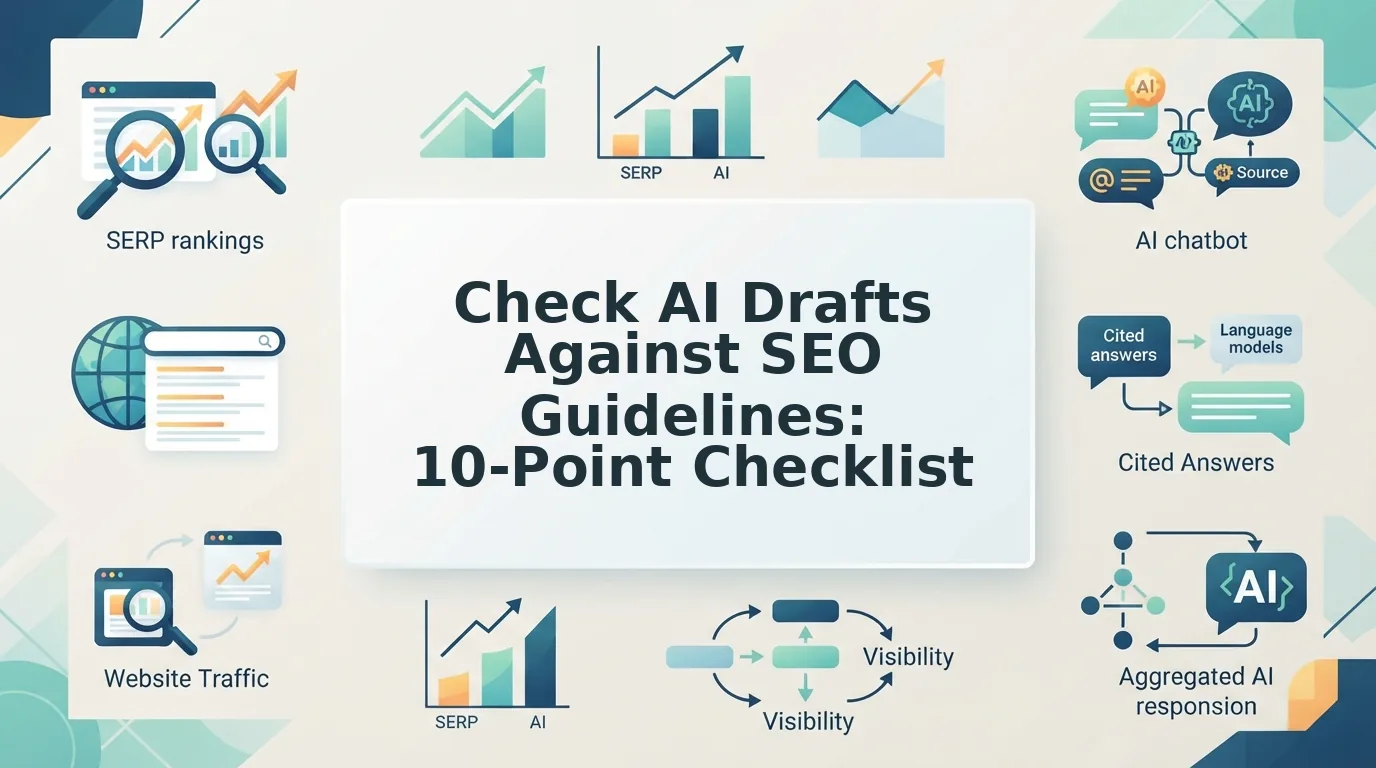
Your AI just produced a 1,800-word draft in 90 seconds, it reads smoothly, hits every keyword you asked for, and still fails your SEO review because nobody checked the heading hierarchy or internal link targets. Sound familiar? Most teams stop checking AI drafts against SEO guidelines after scanning meta titles and keyword density, leaving structural failures that quietly suppress rankings.
You're right to be cautious. Google's guidance is explicit: content quality, not production method, determines ranking. But quality means more than readable prose, it means your draft follows the same technical, content, and answer-engine rules you'd apply to human writing.
This guide walks you through a three-pass review system that catches what surface checks miss. You'll learn exactly which technical elements to verify first, how to audit content quality and E-E-A-T signals, and how to optimize for AI answer engines. Along the way, you'll see why one specific failure mode, heading mismatches, slips past most reviews yet directly impacts rankings. A platform like BloGoose automates these checks at scale, but the framework below works whether you're reviewing one draft or fifty.
What Is the Three-Pass Review Method for AI Drafts?
The three-pass review method is a structured workflow for checking AI drafts against SEO guidelines in three sequential passes: technical SEO, content quality and E-E-A-T, and answer engine optimization. Each pass catches failures the previous one misses.
Think of it like inspecting a house before purchase. A buyer who only checks the paint color misses the cracked foundation. A buyer who checks the foundation but skips the roof misses leaks. Only a buyer who walks through three times, structure, systems, and livability, catches everything. AI drafts work the same way.
Pass 1: Technical SEO. This is the foundation check. You verify meta titles and descriptions match your conventions, keyword placement is front-loaded rather than stuffed, heading hierarchy follows a logical H1 to H2 to H3 structure, slug formats match your rules, and internal links point to the correct pages. These are binary checks, either the draft passes or it doesn't. Most teams stop here, which is why Pass 2 and Pass 3 matter.
Pass 2: Content quality and E-E-A-T. This pass asks whether the draft demonstrates experience, expertise, authoritativeness, and trustworthiness. You audit factual claims against sources, check whether the draft includes first-hand experience or original observations, and assess whether it adds information gain, content that goes beyond what competitors already published. An AI draft can pass every technical check and still fail this pass because it regurgitates generic information without adding anything new.
Pass 3: Answer engine optimization. This pass prepares the draft for AI chatbots and featured snippets. You verify that direct-answer passages appear early, entity definitions are self-contained, and question-based headings match how users actually phrase queries. A draft can pass Pass 1 and Pass 2 yet fail Pass 3 because it buries answers in narrative prose that answer engines can't extract cleanly.
Each pass requires a different mindset: Pass 1 is mechanical, Pass 2 is editorial, Pass 3 is structural. Running them in order prevents the most common failure mode, polishing prose before fixing broken foundations.
Pass 1: Technical SEO Checks for AI Drafts
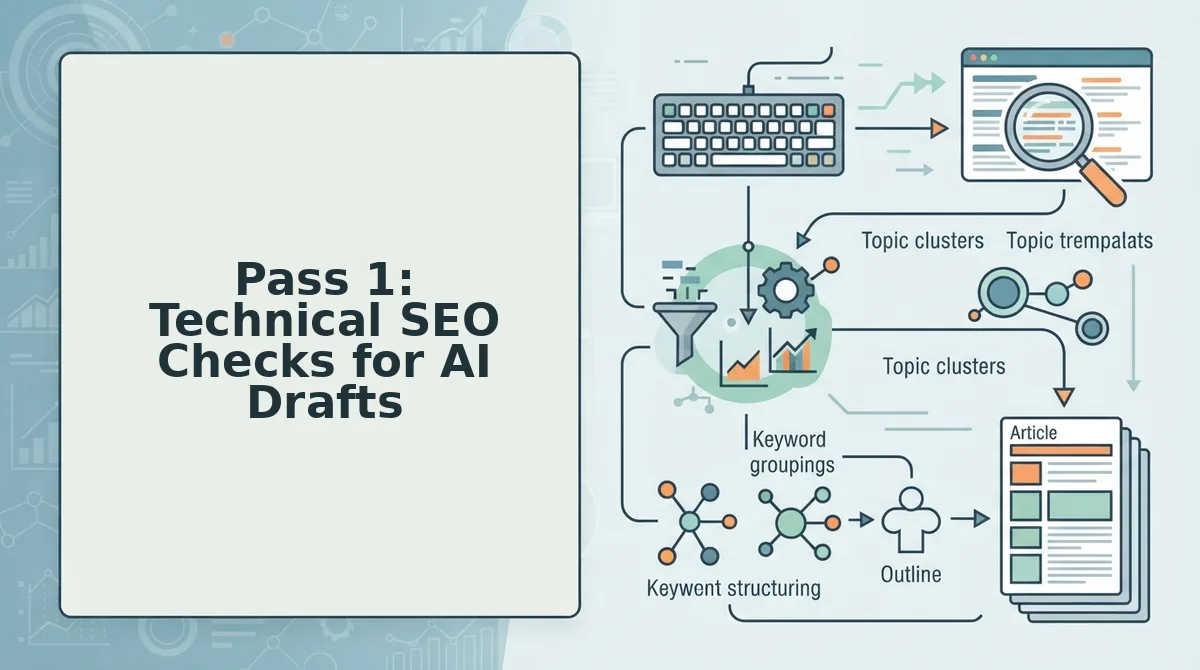
Technical SEO checks verify that your AI draft follows your site's structural conventions before you invest time in content quality review. You'll need your seo-guidelines.md checklist, your target keywords file, and your internal link map open in separate tabs.
- Open your seo-guidelines.md checklist and verify the meta title and description. Compare the draft's meta title against your conventions for length, format, and brand suffix. Check that the meta description includes the primary keyword and a call to action. Expected outcome: both fields match your documented rules exactly, with no truncation risk.
- Open your target keywords file and check keyword placement. Confirm the primary keyword appears in the first 100 words, in at least one H2, and in the meta title, but not repeated unnaturally. Expected outcome: keyword density feels natural, with the primary term front-loaded in the opening paragraph.
- Review the heading hierarchy against your seo-guidelines.md rules. Verify the draft uses exactly one H1, that H2s follow a logical sequence, and that no heading level is skipped (no H2 jumping directly to H4). Check the slug format matches your convention, lowercase, hyphenated, keyword-inclusive. Expected outcome: a clean outline that mirrors your site's established structure.
- Cross-reference every internal link against your internal link map. Click each link in the draft and confirm it points to the intended page, uses the correct anchor text, and doesn't redirect. Expected outcome: every internal link resolves to the mapped URL with descriptive anchor text.
The most common technical failure in AI drafts is heading hierarchy mismatch, an H3 appearing under an H2 where the topic doesn't logically nest, or a slug that doesn't match the H1. These pass surface checks because the draft still reads well, but search engines use heading structure to understand content relationships. A broken hierarchy signals poor organization and weakens topical authority. Internal link mismatches are equally damaging: a link that points to the wrong page sends confusing relevance signals and wastes crawl budget.
Platforms like BloGoose automate these four checks against your existing site conventions, so every draft ships with verified meta fields, keyword placement, heading structure, and internal links. Once Pass 1 clears, move to Pass 2: Content Quality and E-E-A-T Checks.
Pass 2: Content Quality and E-E-A-T Checks
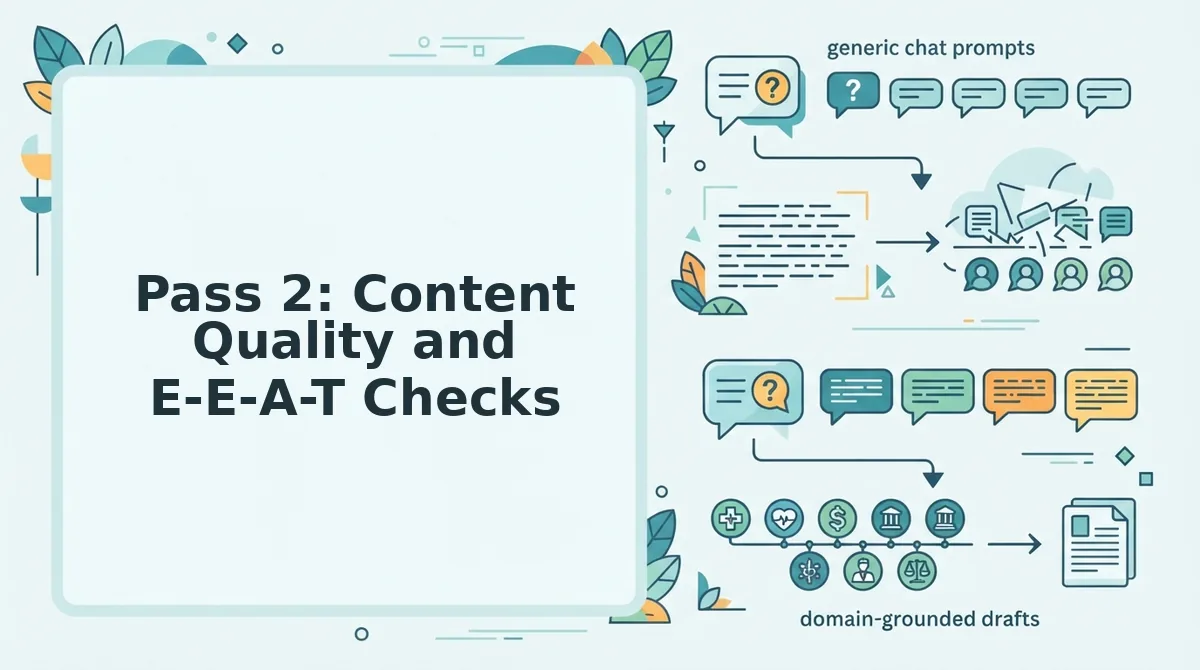
Pass 2 verifies that your AI draft demonstrates experience, expertise, authoritativeness, and trustworthiness, the signals Google uses to separate useful content from filler, regardless of whether a human or machine wrote it.
Prerequisites: A completed Pass 1 technical review, access to the original research notes or source URLs, and 15-20 minutes per 1,000 words.
- Open the draft and highlight every factual claim, statistic, or named source. Work top to bottom and mark each claim with a yellow highlight. You should end with a complete inventory of claims that need verification.
- Click each highlighted claim and trace it to a primary source. For every statistic or named fact, open the original study, official documentation, or first-party announcement. If no primary source exists, cut the claim or rewrite it as an opinion. You should see a source URL next to every surviving factual claim.
- Type "first-hand" into your document search and scan for experience language." If the draft reads like a textbook summary with zero practitioner insight, add one concrete example from your own process. You should find at least one first-person observation per 500 words.
- Select the information gain check: compare the draft against the top 3 ranking pages for your target query. Open each competitor in a new tab and note what they all cover. Then identify what your draft adds, original data, a contrarian angle, a step competitors skip, or a fresher example. If the draft adds nothing new, rewrite one section to include your unique angle. You should be able to name the specific information gain in one sentence.
- Run the worked example test on your weakest claim. If your draft says "the Google Indexing API speeds up indexing" without a source, replace it with the documented version: "Google's Indexing API documentation states that it is designed for job postings and livestream content, not general web pages." You should see every unsourced claim either sourced, qualified, or deleted.
Google's guidance is explicit: AI content is not penalized for being AI-generated, but it is evaluated against the same quality standards as human content. Low-quality AI drafts fail on E-E-A-T, not on origin. For a deeper walkthrough on verification workflows, see our guide to citing sources in SEO content.
Pass 3: Answer Engine Optimization Checks
Pass 3 prepares your draft for AI answer engines like ChatGPT, Perplexity, and Google AI Overviews by verifying that every section contains extractable, quotable passages structured the way users actually ask questions.
Prerequisites: A Pass 2-approved draft, your target keyword list, and 10-12 minutes per 1,000 words.
- Open each H2 section and check for a direct-answer passage of 80-120 words. The passage must state the core answer in the first sentence, with no throat-clearing. If a section lacks one, write it. You should see a self-contained answer under every H2 that an AI can lift verbatim.
- Select the first mention of any key term and verify it includes a clear entity definition. For example, "Answer Engine Optimization (AEO) is the practice of structuring content so AI systems can extract and cite it as a direct answer." You should see a quotable definition for every entity your article targets.
- Type each H2 and H3 into Google and compare against autocomplete and PAA results. If your heading says "Optimizing for AI Overviews" but users search "how do I get in AI overviews," rewrite the heading to match real query phrasing. You should see question-form headings that mirror actual search language.
- Run the passage test on one section. A 90-word direct answer under an H2 about AI content penalties might read: "Google does not penalize content for being AI-generated. The search engine evaluates all content against the same quality standards: helpfulness, expertise, authoritativeness, and trustworthiness. AI drafts that are thin, inaccurate, or duplicative fail these standards and rank poorly. AI drafts that add original insight, cite sources, and demonstrate first-hand experience can rank as well as human-written content." You should see a passage an AI can extract without editing.
For a complete checklist, see our answer engine optimization checklist. If your goal is to get cited in AI answers, Pass 3 is the step that makes extraction possible, and BloGoose automates these checks on every draft before it ships to WordPress.
FAQ: Checking AI Drafts Against SEO Guidelines
Does Google penalize AI content?
No. Google penalizes low-quality content regardless of whether it was written by a human or generated by AI. The search engine evaluates all content against the same standards: helpfulness, expertise, authoritativeness, and trustworthiness. AI drafts that are thin, inaccurate, or duplicative fail these standards and rank poorly.
How long should an AI draft be?
Word count is not a ranking factor. Match the intent and depth of the top-ranking pages for your target query. If competitors publish 2,000-word guides with original data, a 500-word summary will not compete. If the query needs a 300-word answer, padding to 2,000 words adds no value.
Can I publish AI content without editing?
No. Even high-quality AI drafts need human review for factual accuracy, brand voice, and information gain. AI models can hallucinate sources, miss first-hand experience signals, and produce generic summaries. A three-pass review, technical SEO, E-E-A-T, and answer engine optimization, is the minimum before publishing.
How do I check if my AI draft will rank?
Compare it against the top three ranking pages for your target keyword. Check technical elements like title tags and heading structure, verify every factual claim against a primary source, and confirm the draft adds information gain, something competitors do not already cover.
What is the fastest way to check AI drafts against SEO guidelines?
Use a structured three-pass review: technical SEO checks first, content quality and E-E-A-T second, and answer engine optimization third. Each pass takes 10-20 minutes per 1,000 words and catches different failure modes that a single read-through misses.
Make the Three-Pass Method Your Publishing Gate
The three-pass method catches failures that surface-level checks miss. A keyword-stuffed draft can pass a technical crawl yet fail E-E-A-T review. A polished article can pass both and still get zero AI citations because no answer engine can parse it. The sequence matters: technical first, quality second, answer-engine third.
Here's the payoff: after running all three passes, you'll know whether a draft is rank-ready, quote-ready, or needs a rewrite, before it hits your CMS.
Your next step depends on where you are:
- Soft start: Pull your last AI draft and run only Pass 1. You'll likely find at least one fixable technical issue.
- Medium commitment: Work through the full 10-point checklist on your next three drafts. Track which checks fail most often, that's your workflow gap.
- Strong move: Stop checking manually. An AI SEO content engine like BloGoose automates verification against all 8 context files, brand voice, sitemap structure, keyword map, E-E-A-T signals, and answer-engine formatting, before anything publishes.
Manual checking works until volume breaks it. The moment you're publishing more than two AI-assisted articles per week, the three-pass method becomes a bottleneck, not a safeguard. Automation isn't about skipping judgment, it's about reserving your judgment for the checks that actually need human eyes.
Every AI draft is a draft until it passes all three gates. Rank-ready is a decision, not a default.