
How to Detect Outdated Content in SERP Results
Your competitor published a 900-word article last Tuesday, and it just leapfrogged your 3,000-word pillar page that took two weeks to produce. The difference isn't depth, it's freshness. Google's ranking systems increasingly reward pages that reflect the current year's reality, and pages that fail to detect outdated content in SERP results before their competitors do end up watching their rankings bleed out slowly.
You're not imagining the pattern. YouTube creator Josiah Roche has documented how outdated content keeps otherwise strong pages off page 1 of Google, even when the writing quality and backlink profile are superior to the pages ranking above them. The frustrating part is that most of these pages don't look broken, they just quietly stop matching what searchers actually need today.
This guide gives you a repeatable framework for spotting freshness gaps before they cost you rankings. You'll learn what "outdated" actually means in a SERP context, then walk through a four-signal audit you can run on any ranking page in under 30 minutes. Along the way, you'll see why the most dangerous outdated pages aren't the ones with old dates, they're the ones hiding in plain sight with a structural problem most audits completely miss.
If you're managing content clusters across a site, an AI SEO content engine can flag these freshness gaps automatically during research, but the manual audit below works on any page you're competing against.
What Does Outdated Content Actually Mean in a SERP Context?
Outdated content is a ranking page whose information, format, or entity coverage no longer matches what searchers need in the current year. Old content that remains accurate is not outdated, and treating the two as the same thing wastes hours of unnecessary rewrites.
Think of a SERP like a grocery store shelf. A can of soup from 2019 isn't automatically expired, if the recipe hasn't changed and the can is intact, it's still a valid purchase. But if the soup company reformulated the recipe in 2024 and your shelf still shows the old ingredient list, that's outdated. The searcher picks the can with the current label, and your old can stays on the shelf.
This distinction matters because many content teams overcorrect. They see a publish date from three years ago and assume the page needs a full rewrite, when the actual problem might be a single expired statistic or a missing entity mention. Conversely, they leave pages alone because the topic is "evergreen," missing the fact that the format, heading structure, schema markup, UI screenshots, has aged badly.
A practical way to sort this is the Old vs. Outdated decision matrix, a 2x2 framework:
- Old but accurate: Leave it alone. The information still matches current reality.
- Old and wrong: Attack it. Facts, stats, or claims no longer hold up.
- New but thin: Outwork it. The competitor published recently but shallowly, you can beat them with depth plus freshness.
- New and strong: Avoid it. Don't burn resources fighting a page that's both fresh and comprehensive.
Most teams only fix the "old and wrong" quadrant because it's the most visible. But the "new but thin" quadrant is where the fastest ranking wins hide, a competitor's recent publish date doesn't mean their content actually answers the query better than yours does.
One more layer: outdated content isn't just about facts. A page can have perfectly accurate information but still be outdated if it's missing entities, tools, features, competitors, or industry players, that have emerged since publication. A guide to email marketing tools written in 2022 might have zero factual errors, but if it doesn't mention the platforms that launched in 2024 and 2025, searchers will bounce to a page that does.
The 4-Signal Freshness Audit for Any Ranking Page
This audit checks four signals, date, claims, format, and entities, in roughly 30 minutes per page. You'll need the target URL, a current-date search of the same query, and access to at least one authoritative source for fact-checking.
- Date Check. Find the publication and last-updated stamps. Open the page and look for a visible date near the title or byline. Then check the HTML source for
datePublishedanddateModifiedschema fields. If the page shows no date at all, or the last-updated stamp is more than 18 months old for a fast-moving topic, mark it as a freshness risk. You should see a clear, recent modification date on healthy pages, a missing date is itself a signal. - Claim Check. Verify facts, stats, and screenshots against current sources. Pull every statistic, percentage, dollar figure, and named product feature from the page. Search each claim individually and compare against the most recent authoritative source you can find. Expired claims are the most common freshness gap: a "top 10 tools" list from 2023 that still lists a product discontinued in 2025 fails this check immediately. You should end this step with a list of claims marked verified, expired, or unverifiable.
- Format Check. Identify structural patterns that reveal age. Look at the heading hierarchy, the presence of schema markup, and any screenshots or UI examples. Old pages often use flat heading structures, lack FAQ or HowTo schema entirely, and show screenshots of interfaces that no longer exist. A page about a SaaS tool with screenshots from a 2022 dashboard redesign is visually outdated even if the text is accurate. You should be able to spot at least one structural tell on pages older than two years.
- Entity Check. Find missing tools, features, and players that have emerged since publication. This is the signal most audits miss. List every tool, platform, person, or feature the page mentions. Then search for what has launched or changed in that space since the page's last update. A page about AI writing tools that doesn't mention any product released in the last 18 months is entity-outdated, even if every claim on the page is factually correct. You should end with a list of missing entities that a refreshed version would need to include.
One caveat before you trust your findings: SERP results themselves can be manipulated or inconsistent, as iPullRank has documented. Always cross-check what you see in the live results with a manual search from a clean browser session, and treat the SERP as one signal among several rather than ground truth. Running a live SERP analysis alongside this audit gives you a second data point for what Google is actually rewarding right now.
An automated content engine can run these checks at scale across your entire site, flagging pages where the date, claims, format, or entity coverage has drifted. But the manual version above works on any competitor page you need to assess before committing to a rewrite.
Once you've audited the pages you're competing against, the next move is turning that same lens inward, here's how to find outdated content on your own site first.
How to Find Outdated Content on Your Own Site First
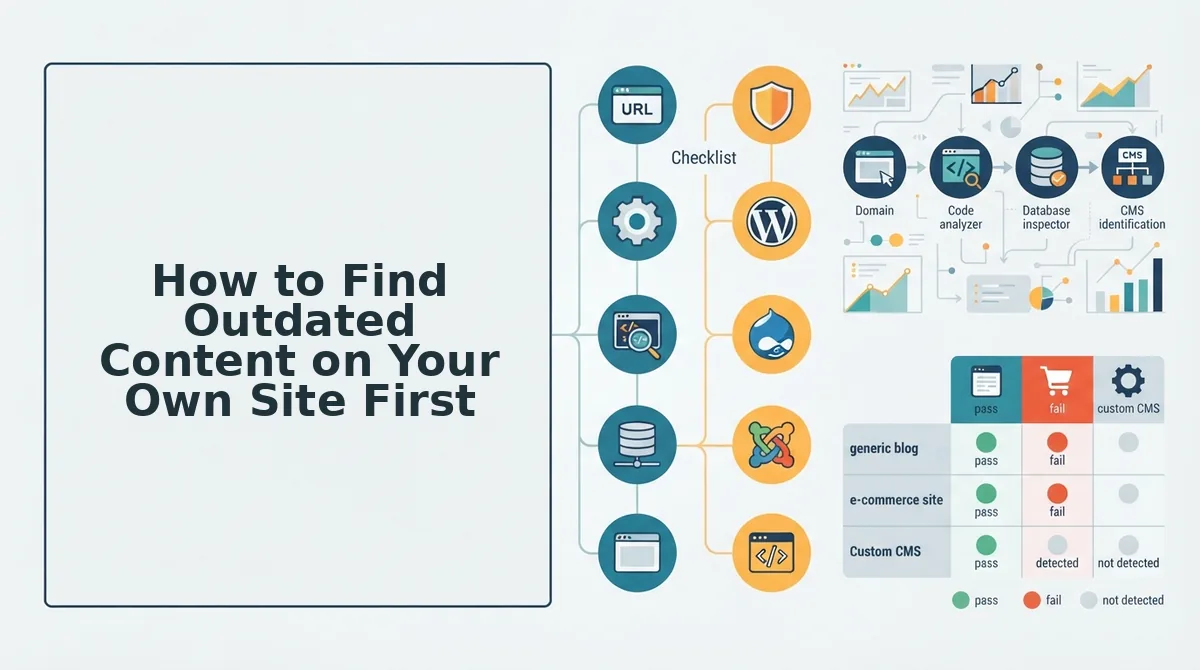
Before auditing competitors, run the same freshness checks on your own domain, your decaying pages are the fastest ranking wins you can reclaim. Start with Google Search Console access and a working sitemap, then follow these steps.
- Open Google Search Console and click Performance, then set the date range to Compare the last 6 months against the previous 6 months. Filter to pages with declining clicks and impressions over that window. Josiah Roche's method surfaces exactly which URLs Google is already losing confidence in, those are your decay candidates. You should see a list of pages with negative click deltas, typically 10-30% drops.
- Type
site:yourdomain.com 2024into Google's search bar, replacing the year with each of the last 3-4 years. This Morningscore SEO trick reveals pages that still reference old years in titles, URLs, or visible content. You should see a list of pages that haven't been touched since that year, each one is a freshness gap. - Upload your sitemap URL into BloGoose's setup wizard and let sitemap context extraction inventory every published page automatically. This removes manual URL gathering and gives you a complete audit list in minutes, not hours. You should see a full page inventory with publish dates and last-modified signals.
- Cross-reference the three lists and mark any URL that appears in two or more as a priority refresh. Open your SEO refresh checklist and score each flagged page against the 4-signal freshness audit from Section 3. You should end with a ranked refresh queue ordered by traffic potential and decay severity.
Turning Freshness Gaps Into Ranking Opportunities
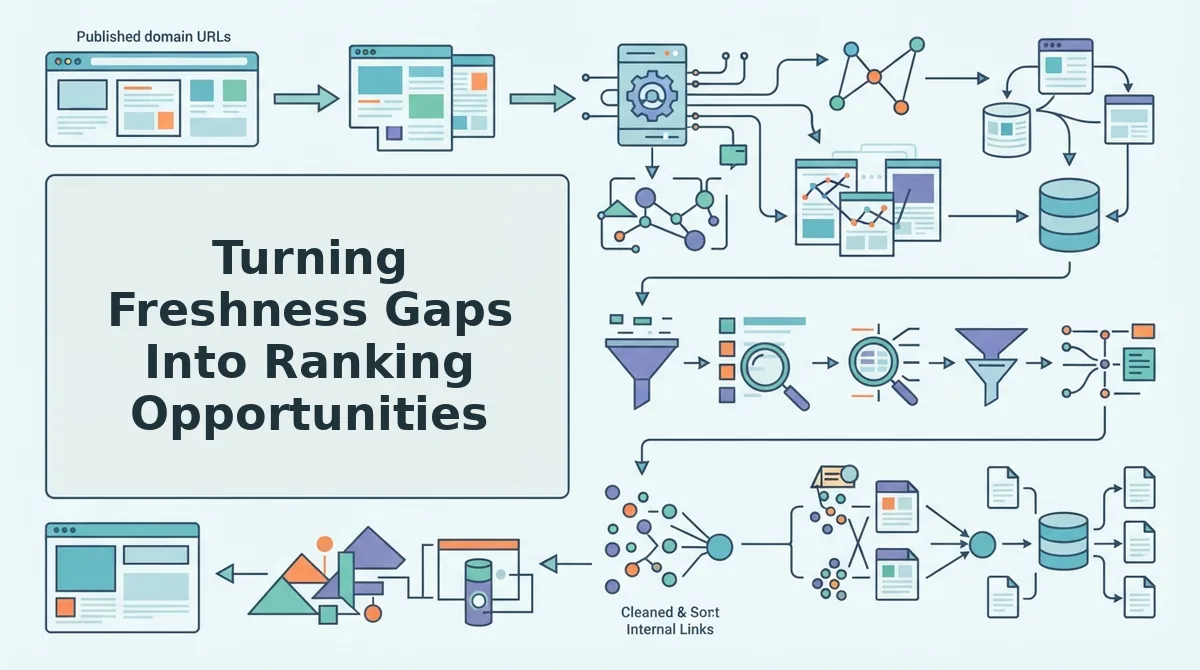
Detecting stale content is only half the job, the ranking gains come from systematically replacing weak pages with better answers. Use this three-step loop to convert every freshness gap into a measurable content win.
- Document the gap in a spreadsheet or your content tracker. Record the URL, the specific outdated signal (expired claim, missing entity, old date), and the exact information that's now wrong or absent. You should have a row per page with a clear "what's missing" column.
- Benchmark the weakness before rewriting. Note the outdated page's word count, heading structure, and entity coverage so you can define what "better" looks like in concrete terms. You should see a clear spec: target length, required entities, and structural improvements.
- Publish the better answer as citation-optimized content that is current, complete, and structured for AI answer engines. Queue the rewrite in an autopilot content calendar so freshness fixes ship on schedule instead of sitting in a backlog. You should see the refreshed page reclaim impressions within 2-4 weeks for QDF queries.
Run this loop monthly and freshness gaps stop being emergencies, they become a repeatable publishing cadence.
FAQ About Detecting Outdated Content in SERPs
How do I detect outdated content in SERP results?
Run the 4-signal freshness audit: check publication and last-updated dates, verify factual claims against current sources, assess whether the format matches current user expectations, and look for missing entities that newer content covers. Any page failing two or more signals is outdated.
What is query deserves freshness?
Query deserves freshness (QDF) is a Google concept where certain searches, news, trends, product updates, seasonal topics, require fresher content to rank, regardless of a page's overall authority. An evergreen guide can rank for years, but a "best AI tools" query needs monthly updates.
How often should I refresh content?
Refresh when a freshness signal fails, not on a fixed schedule. High-QDF queries may need monthly updates, while evergreen pages can go years between refreshes. Monitor click and impression trends in Search Console to trigger refreshes based on actual decay.
Can outdated content hurt my rankings?
Yes, especially for queries that deserve freshness. Stale pages lose clicks and dwell time as users bounce back to the SERP, and Google interprets that behavior as a relevance failure. Rankings drop within weeks for QDF queries when content goes stale.
Why does Google still rank old content for some queries?
Google ranks old content when the query has low freshness demand and the page retains strong backlinks, entity coverage, and user satisfaction signals. Age alone doesn't disqualify a page, outdated information, missing entities, and format decay do.
Freshness detection is a loop, not a one-time audit
The four signals, dates, statistics, references, and feature claims, work the same way on competitor pages as they do on your own. Run the audit once and you have a snapshot. Run it monthly and you have a compounding moat. Every pass surfaces new decay because the web keeps moving: tools change pricing, studies get superseded, and APIs deprecate endpoints.
Detection alone changes nothing. The value lives in the loop: document the gap, benchmark the current SERP, publish the refreshed version, then re-check rankings. Pages that complete this cycle consistently outrank static competitors within two to three update windows.
Here's the pattern interrupt: most teams audit competitor SERPs but never their own site. That's backwards. Your decaying pages are already indexed, already earning impressions, and already leaking trust. Fixing them costs a fraction of acquiring new rankings.
Start with BloGoose's live SERP research to automate freshness gap detection across any keyword set, it flags stale dates, outdated stats, and superseded claims before you manually review a single page.
Freshness is not a content quality metric. It is a ranking signal you can engineer.