
How to Draft Long Blog Posts Without Generic AI Phrasing

YouTube creator Mckayla titled a video "AI Blogging is Dead" after watching yet another draft collapse into the same hollow phrases readers scroll past. Her frustration is shared by thousands of publishers who tried to draft long blog posts without generic AI phrasing and ended up with content that sounds like every other AI-generated article on page two of Google.
You're right to be frustrated. The problem isn't that AI can't write long-form content. The problem is that most workflows hand AI the wrong job and then blame the tool when the output reads like a committee of clichés.
This guide walks you through a five-step drafting protocol that keeps your voice intact while letting AI handle the heavy lifting it's actually good at. You'll learn why generic phrasing happens at the token-prediction level, which layer of the writing process you should never automate, and how to structure long posts section by section without losing specificity. One of these steps produces a result that surprises most publishers, and it has nothing to do with prompt engineering. Platforms like BloGoose, an AI SEO content engine that extracts brand voice rules from your existing site, already bake this distinction into their publishing workflow.
Why Does AI Drafting Sound Generic? The Token Probability Trap
The token probability trap is the mechanism by which large language models (LLMs) select statistically common words and phrases over contextually specific ones, producing text that reads as generic because it mirrors the most frequent patterns in training data rather than the unique details of your topic.
LLMs don't think about what you mean. They predict what word most likely comes next based on billions of examples. When the model sees a sentence about exploring a topic, "delve into" ranks high because it appeared constantly in academic and business writing across the training corpus. The phrase isn't wrong. It's just statistically safe.
Think of it like a GPS that always routes you through the highway. The highway is predictable, well-traveled, and rarely surprising. But every reader has driven that highway a thousand times. The scenic route, the one with the unexpected turn and the roadside diner, is where attention lives. Generic AI output is the highway. Specific, voice-driven writing is the scenic route.
Here's the trap in action. A generic draft might say: "In today's fast-paced digital landscape, businesses must delve into innovative strategies to stay ahead of the competition." A specific draft says: "A Shopify merchant with 40,000 monthly visitors doesn't need innovation theater. She needs a publishing schedule that survives her Tuesday inventory crisis." Same intent, different signal. The second sentence carries evidence, judgment, and a concrete scenario. The first carries probability.
This happens because LLMs optimize for statistical likelihood, not specificity. Every token prediction is a bet on what usually comes next. When you ask for a long blog post without providing grounded context, the model fills the gap with its highest-probability bets, which are by definition the most common phrasings in its training data. The longer the draft, the more these bets compound, and the more the output drifts toward the center of the bell curve.
One self-contained answer: Why does AI writing sound generic? AI writing sounds generic because language models generate text by predicting the most statistically probable next word based on patterns in their training data. This favors common phrases like "delve into" or "in today's fast-paced world" over context-specific language. Without grounded input such as specific examples, data points, or brand voice rules, the model defaults to high-probability phrasing, which reads as generic because it is the average of millions of documents rather than a response to your unique topic.
Fixing this requires more than better prompts. It requires changing what layer of the writing process you automate. Learn more about how to automate brand voice in AI blog posts without flattening your tone into the statistical middle.
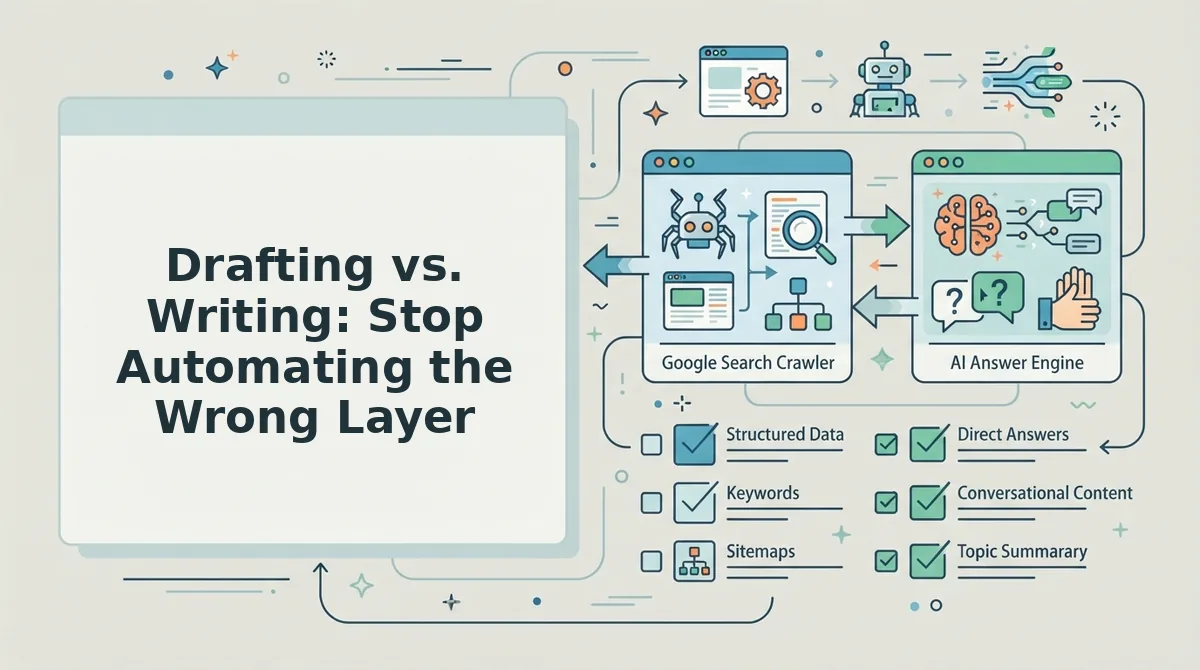
Drafting vs. Writing: Stop Automating the Wrong Layer
Drafting is the structural act of assembling a post's skeleton: section order, transitions, and scaffolding. Writing is the expressive act of filling that skeleton with evidence, examples, judgment, and claims that only you can make.
Most publishers automate the wrong layer. They ask AI to write, meaning they hand over the expressive work, the part that requires lived experience, customer conversations, and editorial taste. Then they wonder why the output reads like a template. The fix is to flip the assignment: let AI draft the structure, and you write the substance.
Think of it like building a house. AI is excellent at framing: it can put up the walls, mark where the windows go, and run the electrical conduit. But framing is not a home. The home is the paint color your grandmother would have hated, the bookshelf with the cracked spine, the kitchen counter where your kid does homework. That's writing. If you ask the framer to decorate, you get beige walls and builder-grade fixtures.
Wordiva's video hints at this distinction but never defines it operationally. The middle path between abandoning AI entirely and using it as a full writer is drafting section by section with grounded context. You supply the specific claim, the real example, the number from your own analytics. AI supplies the connective tissue: the transition sentence, the section heading, the logical bridge between your point and the next one.
One self-contained answer: What is the difference between drafting and writing with AI? Drafting with AI means using the model to produce structural elements: outlines, section headings, transition sentences, and paragraph scaffolding. Writing means producing the substantive content: specific claims, evidence, examples, data points, and editorial judgment. The distinction matters because AI is reliable at structure and unreliable at substance. When you automate drafting and write the substance yourself, you get speed without sacrificing specificity. When you automate writing, you get volume without voice.
An AI content engine that crawls your site and extracts your brand voice rules before drafting makes this split automatic. It handles the framing; you handle the furniture. For a deeper comparison of workflows, see AI content engine vs chat window workflows.
Once you accept that drafting and writing are separate jobs, the next question is practical: how do you actually run a section-by-section draft without losing your voice in the process?
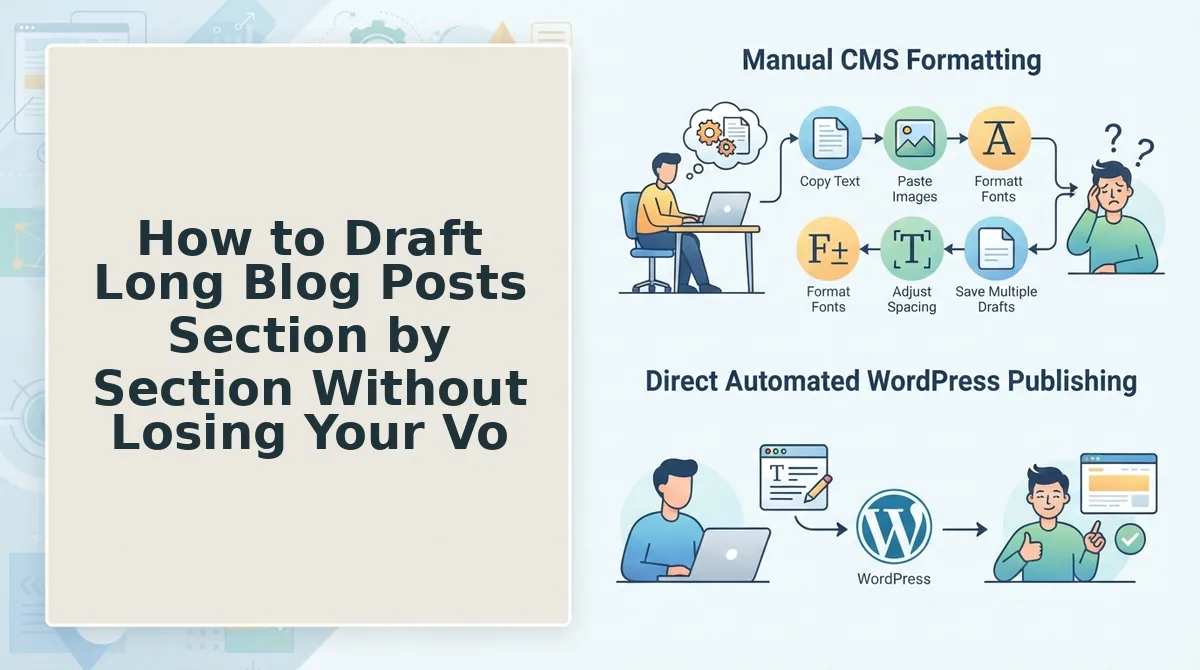
How to Draft Long Blog Posts Section by Section Without Losing Your Voice
Draft one H2 section at a time, feeding each approved section back as context before drafting the next. This sequential protocol keeps your brand voice consistent across a 2,000+ word post because the AI never has to guess what "your voice" sounds like beyond the last thing it wrote.
Prerequisites: A completed brand context file (voice rules, tone examples, banned phrases, audience notes), your article outline with H2/H3 structure, and a generic-phrase blacklist you can paste into every prompt. If you skip the brand context step, you will get generic output no matter how good your section prompts are, brand context extraction mistakes are the most common root cause of voice drift.
- Upload your brand context file and outline into the drafting tool. Paste your voice rules, tone examples, and the article outline into the system prompt or context window. You should see the tool acknowledge the voice constraints before you ask for any prose. Expected outcome: the first draft attempt already avoids your known banned phrases.
- Draft only the introduction and first H2 section. Type a prompt that includes the section heading, the target word count, the specific question the section must answer, and the instruction "match the brand voice file exactly." Do not ask for the full post. Expected outcome: a 150-300 word section that reads like a person who knows your product wrote it, not a template.
- Run the section through your generic-phrase blacklist. Search the draft for the 10 phrases in your blacklist (see the full list in the next section). Delete or rewrite every hit before moving on. Expected outcome: zero blacklist matches remaining in the section.
- Approve or edit the section, then paste the approved text back into the context window. Add a line like "Here is the approved introduction and first section. Match this voice exactly for the next section." This is the step most people skip, and it is why long posts drift generic by the halfway point. Expected outcome: the AI now has concrete examples of your voice, not just abstract rules.
- Repeat steps 2-4 for each remaining H2 section, one at a time. Each prompt should reference the approved sections as context plus the specific section you want next. Budget 10-15 minutes per section including review. Expected outcome: a full draft where section 8 sounds like the same author as section 1.
The BloGoose workflow automates exactly this protocol: it crawls your site, extracts eight brand context files, then drafts H2 sections sequentially with review checkpoints between each. The AI Puppy Playbook documents the same pattern from the beginner side, new users lose their voice when they ask AI to write a full post at once, because the model averages out every stylistic signal into a generic middle. Sequential drafting with review checkpoints prevents that averaging.
The Generic-Phrase Blacklist: 10 AI Phrases to Cut and What to Replace Them With
Generic AI phrasing is a pattern-recognition problem with a pattern-recognition solution: keep a blacklist of the 10 most common offenders and replace each with a concrete, voice-specific alternative. No competitor publishes an actual list, they say "make it sound human" without showing you what to cut.
- "Delve into". Nobody says "delve" out loud. Replace with a specific verb: "walk through," "break down," or "test." Example: "We'll walk through the exact prompt sequence" instead of "We'll delve into prompt engineering."
- "In today's fast-paced world". This opener signals the AI had nothing specific to say. Delete it entirely and start with the concrete claim or question your section answers. Your first sentence should carry information, not throat-clearing.
- "Game-changer". A claim without evidence. Replace with the specific mechanism: "cuts publishing time from 4 hours to 40 minutes" instead of "is a game-changer for content teams." If you cannot name the mechanism, cut the claim.
- "Unlock the power of". Marketing filler that means "use." Replace with the literal action: "Use the API to publish directly" instead of "Unlock the power of automated publishing."
- "In the ever-evolving landscape of". Another empty opener. Replace with a dated, specific observation: "Since Google's 2024 helpful content update" or "As of 2026." Specificity is the antidote to landscape talk.
- "It's important to note that". If it is important, just state it. Delete the phrase and keep the sentence that follows. The sentence gets shorter and stronger every time.
- "Seamlessly". A word that describes nothing measurable. Replace with the integration detail: "publishes to WordPress via REST API in one click" instead of "seamlessly integrates with WordPress."
- "Elevate your content". Vague aspiration. Replace with the measurable outcome: "increase average time on page" or "earn AI citation snippets." If you cannot measure it, you cannot claim it.
- "Whether you're a beginner or an expert". Audience hedging that dilutes the point. Pick one reader and write to them. Your brand voice writing examples file should already define who that reader is.
- "In conclusion". A sign the AI ran out of things to say. Replace with a forward-looking action: "Start with section one and run the blacklist before you draft section two."
The fastest way to spot generic AI text is to read the draft out loud and flag any phrase you would never say in a meeting. If it sounds like a press release from a company that does not exist, it is on the blacklist.
How to Build a Quality Review Loop That Catches Generic Phrasing Before You Publish
A quality review loop is a five-point checklist you run on every section in under five minutes, before the post goes anywhere near your CMS. The loop only works if it is fast, a 30-minute rewrite pass per section will make you skip it after one post.
Prerequisites: Your drafted sections, your generic-phrase blacklist from the previous section, and your SEO guidelines markdown checklist open in a second tab for the final pass.
- Open the first drafted section and run the specificity check. Read every sentence and ask: does this contain a number, a named tool, a dated event, or a concrete example? Flag any sentence that could appear on any competitor's blog unchanged. Expected outcome: you identify 2-4 sentences per section that need concrete details added. Time: 60 seconds.
- Run the voice-match check against your brand context file. Compare the section's sentence length, vocabulary, and tone to your approved voice examples. Flag sentences that sound like a different author. Expected outcome: a short list of voice breaks to rewrite. Time: 60 seconds.
- Run the evidence-density check. Count the claims in the section and count the supporting details, stats, examples, steps, or named sources. Every claim needs at least one supporting detail in the same paragraph. Expected outcome: you find any unsupported claims before a reader does. Time: 60 seconds.
- Run the transition-logic check. Read the last sentence of the previous section and the first sentence of this one. Does the reader know why the topic changed? If not, add a one-sentence bridge. Expected outcome: the post reads as one argument, not a stack of disconnected sections. Time: 60 seconds.
- Run the claim-verification check. Open your SEO guidelines checklist and verify every factual claim, product capability statement, and statistic against a source. Flag anything you cannot verify in 30 seconds for removal or rewording. Expected outcome: a publish-ready section with zero unverifiable claims. Time: 60 seconds.
No competitor publishes a repeatable review loop like this, they describe the symptoms of generic AI text but never give you a system to catch it. A five-minute pass per section is fast enough to run on every post, and that consistency is what separates blogs that read human from blogs that read generated.
Here is the self-contained answer if you are skimming: a quality review loop for AI-drafted content is a five-point checklist, specificity, voice match, evidence density, transition logic, and claim verification, applied to each section for five minutes before publishing. Specificity means every sentence contains a number, named tool, dated event, or concrete example. Voice match means comparing sentence length, vocabulary, and tone against your approved brand examples. Evidence density means every claim has a supporting detail in the same paragraph. Transition logic means the last sentence of one section connects to the first sentence of the next. Claim verification means every factual statement is checked against a source before the post goes live.
BloGoose builds this review loop into the drafting workflow itself, each section is drafted, checked, and approved before the next one starts, so you never face a 2,000-word wall of generic text at the end. Next, the most common questions about drafting long posts without generic AI phrasing.
FAQ: Drafting Long Blog Posts Without Generic AI
Generic AI phrasing comes from token probability, not prompt quality, the fix is section-by-section drafting with brand context files and a human review loop that supplies evidence and judgment.
Why does ChatGPT sound generic even with a detailed prompt?
ChatGPT predicts the most statistically likely next token, so detailed prompts still converge on high-frequency phrasing. Without brand-specific examples, tone rules, and source material in the context window, the model defaults to the linguistic average of its training data.
How do I draft long blog posts without generic AI phrasing?
Draft one section at a time, feeding the model your brand voice rules, real data points, and a specific structural outline per section. Then run each draft through a review loop that flags high-probability phrases and replaces them with evidence-backed, voice-specific language.
Can AI draft long-form content without losing brand voice?
Yes, when brand voice is extracted into a structured context file, sentence patterns, banned phrases, tone markers, and example passages, and passed to the model with every draft request. Voice loss happens when prompts describe tone abstractly instead of demonstrating it.
What is the difference between AI drafting and AI writing?
AI drafting produces structural scaffolding: section outlines, argument flow, and placeholder prose. AI writing produces final publishable copy. The operational difference is that drafting leaves room for humans to insert evidence, judgment, and voice; writing attempts to replace that layer entirely.
Why do my blog posts lose their voice when I use AI for long-form content?
Long-form generation compounds token probability drift: each paragraph influences the next, and without checkpoints the model slides toward generic phrasing. Breaking the draft into sections with individual prompts and review gates prevents the drift from accumulating across a 2,000-word post.
The Middle Path: Drafting With AI, Writing With Judgment
The binary choice between abandoning AI and letting it write everything is a false one. The workflow that actually produces rank-ready, voice-accurate long-form content sits in the middle: AI drafts sections from structured brand context, and a human review loop supplies the evidence, judgment, and phrasing decisions that token probability cannot.
That middle path is what separates content that ranks from content that merely exists. Generic phrasing is not a prompt problem to be solved with better instructions, it is a workflow problem solved by drafting in sections, feeding brand context at every step, and running sequential review checkpoints before anything reaches publish.
Start with one section. Extract your brand voice rules, draft a single H2 with real data and a specific structural outline, then run it through a review loop that flags high-probability phrasing. Once that section reads like you, scale the same workflow across your content calendar.
When you are ready to automate the drafting layer without losing the voice layer, the BloGoose AI SEO content engine handles site crawling, brand context extraction, and section-by-section drafting with review checkpoints built in, so your long posts ship with your voice intact and your evidence in place.