How to Find Competitive Content Gaps From Live SERP Results

You copy the top 10 results, match every heading, and publish. Google ranks you #11. To find competitive content gaps from SERP results, you need to read what the ranking pages leave out instead of rebuilding what they already share.
The method has five steps. Pull the live SERP, including People Also Ask and the AI Overview. Extract every H2 from the top 10, then map searcher questions against those headings. Build a gap matrix that shows missing topics and thin coverage, and validate each gap before you write.
The result is a short list of angles the current top 10 cannot match. You need a target query, a spreadsheet, and access to live SERP results with PAA and the AI Overview visible.
The research for this article shows the method in action. Social research returned 0 Reddit threads and 5 YouTube videos, and every video was tool-specific. None offered a tool-agnostic method, so that missing method became the gap this guide fills. Most gap tools also find the wrong gaps, and you'll see why below.
What Is a Competitive Content Gap?
A competitive content gap is a question, angle, depth level, or format that searchers need and the ranking pages fail to deliver. It sits inside a SERP you already target, so closing it gives your page something the current top 10 cannot offer.
Think of a street lined with burger restaurants and no place that serves breakfast. The opportunity is not another burger. It is the meal people walk the street looking for.
A keyword gap lists the search terms competitors rank for and you don't, pulled from a keyword database. A content gap lists what searchers need that the pages ranking for one query fail to say, such as an unanswered question, a shallow explanation, a missing format, or a mismatched intent. Keyword-gap tools show keywords you don't rank for, not what ranking pages fail to say, so you can close every keyword gap and still publish a page identical to the ten above it.
| Keyword gap | Content gap | |
|---|---|---|
| Unit | Search term | Question, angle, depth, or format |
| Source | Keyword database | Live SERP pages and features |
| Output | Terms to target | What your page must say differently |
Existing tutorials reflect this split. The Ahrefs Content Gap video, presented by Travis Wilkie, works at the keyword level. The SERP Topic Gap Monitor by Joe Slade works at the topic level and relies on pre-fetched SERP data. Neither one compares what each ranking page leaves unsaid.
| Gap type | Detection signal |
|---|---|
| Topic | A PAA or social question that no top-10 H2 answers |
| Depth | A shared topic covered in a line or two, with no steps or examples |
| Format | The SERP shows video or tables, but ranking articles have none |
| Intent | Ranking pages pitch a tool while the query asks for a method |
| AEO | No ranking page gives a short direct answer under its headings |
Your own pages may have the same blind spots. Start with an SEO content audit. BloGoose crawls your sitemap and published pages before it plans anything new.
How to Find Content Gaps From Live SERP Results in 5 Steps
Pull the live SERP, extract every H2 from the top 10, map searcher questions against those headings, build a SERP Gap Matrix, and shortlist gaps for validation. Plan on roughly 90 minutes for one query.
Before you start, have one target query, a blank spreadsheet, and a browser that shows live results with People Also Ask (PAA) and the AI Overview. Use a private window so your personal search history doesn't skew the results.
- Pull the top 10 results and SERP features (15 minutes). Search your query and paste each organic URL into column A. Below the URLs, record every PAA question, every source the AI Overview cites, and any video results. You should have 10 URLs plus a feature list.
- Extract every H2 and mark consensus topics (30 minutes). Open each URL and copy its H2 headings into its row. Merge headings with similar wording under one topic label. Mark a topic as consensus when 3 or more of the top 10 results cover it. You should end with a list of shared topics, which is the baseline every ranking page treats as required.
- Map PAA and social questions against those headings (15 minutes). Add Reddit threads, YouTube titles, and forum questions to your PAA list. Match each question to the consensus topic that answers it. Highlight any question with no matching heading as an orphan. Skipping this step is one of the classic topic research mistakes.
- Build the SERP Gap Matrix (20 minutes). Put results in the rows and consensus H2s in the columns, then mark each cell Covered, Thin, or blank. Blank cells are depth gaps. Orphan questions are topic gaps.
- Shortlist gaps for validation (10 minutes). Rank each gap by how many results miss it and whether a PAA or AI Overview signal supports it. Keep three to five. Success is a shortlist you can turn into brief H2s and later expand into topic clusters.
| Result | Consensus H2 A | Consensus H2 B | Consensus H2 C | Orphan questions |
|---|---|---|---|---|
| #1 URL | Covered | Thin | List here | |
| #2 URL | Covered | Covered | ||
| #3 to #10 URLs |
Now apply the matrix to the 5 YouTube videos from this topic's research. The Ahrefs video covers keyword gaps. The Apify actor covers topic gaps from pre-fetched SERP data. Nodus Labs covers discourse gaps.
None of the videos combines these approaches, and none shows a tool-agnostic method. That leaves one column blank in every row, and that blank column is the gap this article fills.
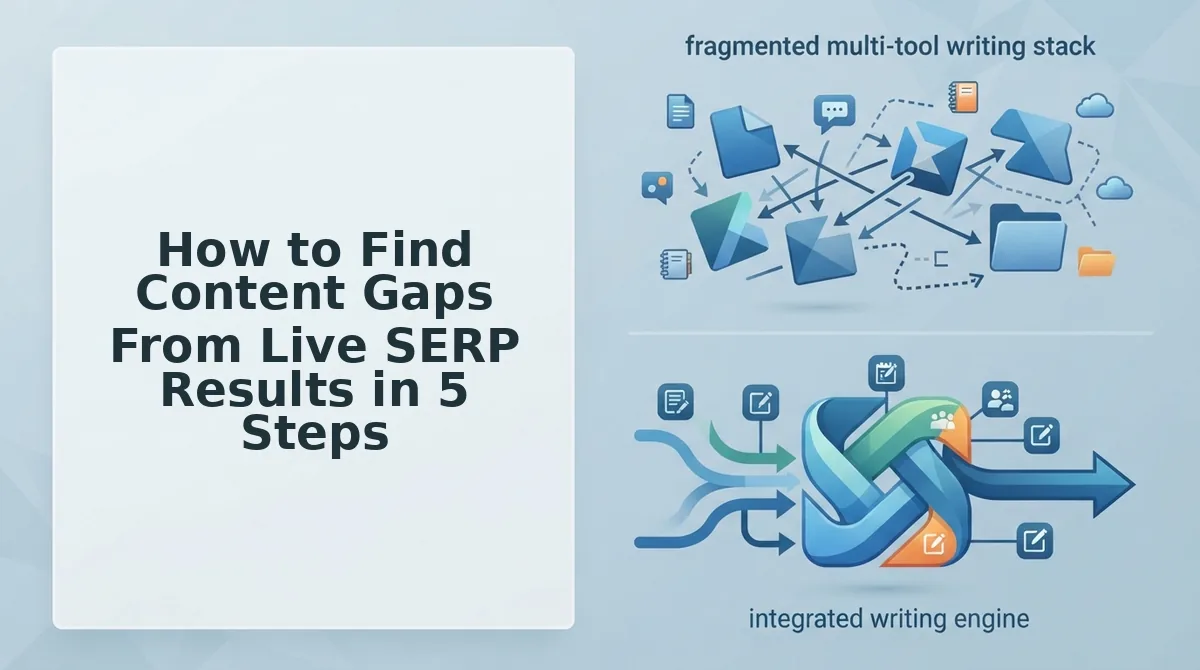
Running this by hand for every post on a 30-day calendar adds up quickly. BloGoose runs live SERP and social queries in one pass and feeds the gaps it finds into briefs written in your site's brand voice.
A gap on paper is still a hypothesis, so the next step is checking whether it is worth writing.
How to Check a Content Gap Is Worth Writing
A content gap is worth writing only when it passes three tests: real demand, clear absence from top results, and fit with your niche. Run this checklist before you commit any gap to a brief.
- Demand: a real question exists. Confirm the gap appears as a People Also Ask question or a recurring social thread. Without visible demand, you fill a hole nobody searches for.
- Absence: 3 or more top results miss it. Count how many ranking pages skip the subtopic. If only one page misses it, you have found a weak page, not a market gap.
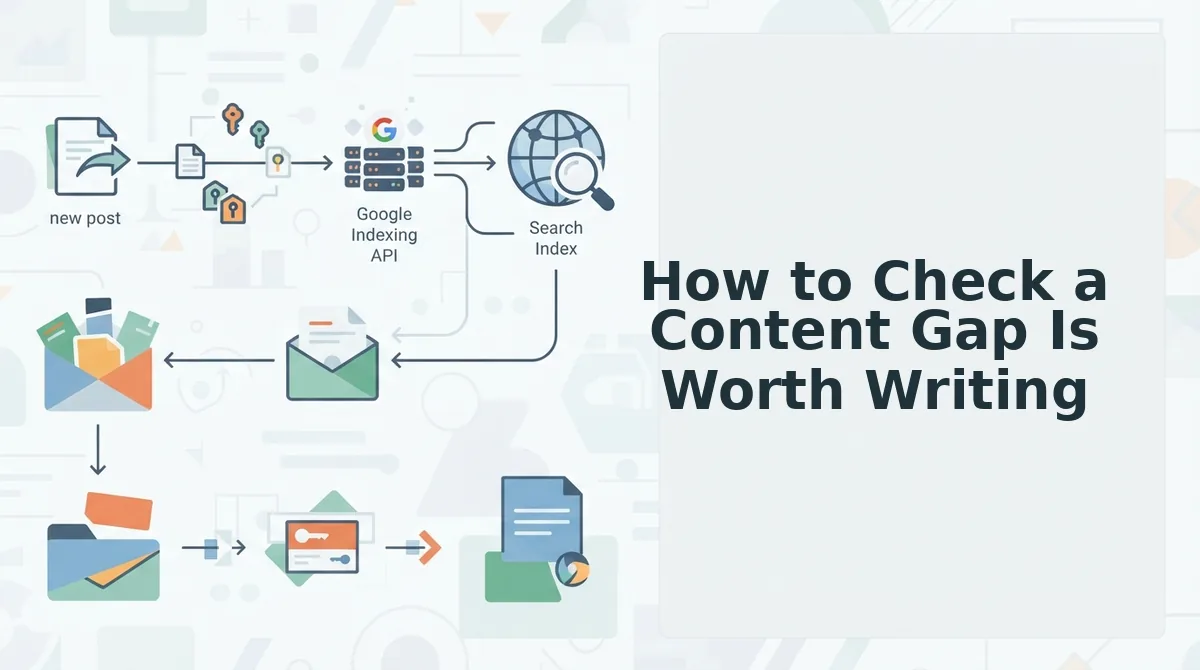
- Fit: it matches your detected niche. Check the gap against topics you already cover. In BloGoose, the crawl reads your sitemap and generates competitor-analysis.md and target-keywords.md, so the fit test checks each gap against those files.
To validate a content gap, use the 3-Test Gap Validation: demand, absence, and fit. Demand means a People Also Ask or social question proves people are asking. Absence means three or more top-ranking results fail to answer it. Fit means the gap matches the niche your site already covers, so the article strengthens an existing cluster. A gap that passes all three tests earns a place in your SEO content brief. A gap that fails any one test goes back to the backlog, however easy it looks to rank.
Then run an AEO content optimization check, flagging pages that show:
- No direct-answer lead: the section opens with context, not the answer.
- No entity definition: the core term never gets a one-sentence definition.
- No quotable passage: no self-contained 80-120 word block an engine can lift.
Content Gap Analysis FAQ
These answers cover the questions the steps above leave open.
Can I automate SERP content gap analysis?
Partly. Automate the SERP pull and H2 extraction, then judge intent and fit yourself. The SERP Topic Gap Monitor Apify actor by Joe Slade requires pre-fetched SERP data, which shows the data pull is the automatable part. Deciding which gaps matter still needs judgment.
How often should I rerun a content gap audit?
Rerun a gap audit whenever the SERP for your target query shifts, because live results change as competitors publish and rankings reshuffle. A gap that passed the absence test months ago may already be filled, so recheck it before writing each brief.
Do AI Overview gaps differ from Google ranking gaps?
Yes. Answer engines cite quotable passages, so an AEO gap is about structure, not topic. Tutorials like Data-driven WoW's video raise SEO plus AIO only at a high level. In practice, follow the outlines answer engines cite: answer-first leads and definitions.
What is the difference between a content gap and a keyword gap?
A keyword gap is a term competitors rank for and you do not. A content gap is a subtopic, format, or answer the ranking pages miss. Keyword gaps show where to compete, while content gaps show how to beat what already ranks.
Turn Your First Validated Gap Into a Brief
A validated gap becomes rankable only when the brief names the fix its gap type demands. That is the real payoff of live SERP analysis: not a longer topic list, but a short list you can win.
Pick one query, build the matrix, and keep only the gaps that pass all three tests. Then map each gap to its fix:
- Topic gap: add a new H2.
- Depth gap: expand the thin section.
- Format gap: add a table or video.
- Intent gap: write a new angle.
- AEO gap: lead with an answer-first passage.
Your next step: run a live SERP and social research pass in BloGoose, which builds briefs grounded in your detected niche. Every article you ship from here starts with proof, not a guess.