
How to Find SERP Gaps Without a Keyword Tool
You're paying $129 a month for a keyword tool, and you still can't figure out why your competitor's thin, outdated post outranks your comprehensive guide. The problem isn't your research budget, it's that keyword tools measure volume, not gaps. If you want to find SERP gaps without a keyword tool, you're already ahead of most SEOs who mistake demand data for opportunity data.
You're right to be frustrated. Watching a paid dashboard tell you what people search for is not the same as seeing what the search results fail to deliver. This article will show you how to spot those delivery failures manually, using nothing but a browser and a structured way of looking at search results. You'll learn a three-lens framework for identifying intent gaps, format gaps, and depth gaps, then turning each one into a content brief.
Before you start, here's the open loop: the most profitable SERP gaps rarely come from low-volume keywords. They come from questions the top 10 results collectively refuse to answer. One of the methods below reveals why a 271-view demo of a manual gap-scanning technique outperforms a 165,699-view video on free keyword tools in practical usefulness, because searchers want methods, not dashboards. If you're already mapping content gaps in SERP listings, you're halfway there. The rest is learning to see what the SERP itself is telling you, a skill an AI SEO content engine can systematize once you know the manual method.
What Is a SERP Gap and Why Do Keyword Tools Miss It?
A SERP gap is a mismatch between what searchers actually need and what the ranking pages deliver, not a keyword with low search volume. Keyword tools show demand; they cannot show delivery failure.
Think of a keyword tool like a restaurant reservation system. It tells you how many people booked a table, but not whether they left hungry. A SERP gap is the empty plate: the question searchers asked that no ranking page answered, the format they wanted that no result provided, or the depth they needed that every competitor skimmed past.
Here's why volume metrics obscure real opportunity. A keyword with 50 monthly searches where all 10 results answer the query well is saturated. A keyword with 5,000 monthly searches where every result misses the searcher's actual intent is wide open. The tool ranks the second keyword higher and sends you into a content battle you cannot win, while the first gap sits unclaimed.
This is the core insight: a SERP gap is not a keyword with low volume; it is a question the SERP fails to answer. When you learn to build a content gap list from live search results, you stop chasing demand metrics and start auditing delivery quality. That audit reveals three distinct failure modes, intent mismatches, format mismatches, and depth shortfalls, each of which produces a different type of content opportunity.
To put it simply: keyword tools measure how many people knock on the door. SERP gap analysis measures whether anyone inside is actually opening it.
The Three-Lens Gap Scan: A Manual Framework for Finding SERP Gaps
The Three-Lens Gap Scan is a manual framework for auditing any SERP through three lenses, Intent Gap, Format Gap, and Depth Gap, using only a browser and a structured observation sheet. You need no paid tools, no browser extensions, and no prior data exports. Budget 15-20 minutes per keyword.
- Open an incognito browser window and run your target query. Incognito strips personalization so you see the SERP most searchers see. Record the top 10 organic results in a simple three-column sheet: URL, page type, and primary angle. You should see a clean, unpersonalized result set you can audit objectively.
- Apply Lens 1, Intent Gap. Read each ranking title and meta description, then ask: what is the searcher actually trying to accomplish with this query, and does this result serve that goal? Mark any result that targets a different intent than the dominant one. Success looks like a list of intent mismatches, pages selling when searchers want to learn, or pages explaining when searchers want to buy.
- Apply Lens 2, Format Gap. Note the content format of each top-10 result: listicle, how-to guide, comparison table, video, tool page, or definition. Then check what Google itself rewards, look for video carousels, featured snippets, People Also Ask boxes, or image packs. If the SERP features a video carousel but eight of ten results are text blog posts, that is a format gap. Success looks like a documented mismatch between the format Google promotes and the format competitors publish.
- Apply Lens 3, Depth Gap. Open the People Also Ask box and list every question. Then open the top three ranking pages and check whether each PAA question is answered in a dedicated section with a clear subheading. Mark any PAA question that no top-three result addresses directly. Success looks like a list of unanswered PAA questions, each one is a ready-made H2 for your article.
- Score and prioritize. Give the SERP one point for each intent mismatch, format mismatch, and unanswered PAA question. A score of 5 or higher signals a gap worth targeting. A score below 3 means the SERP is well-served and you should move to the next keyword. Success looks like a prioritized list of keywords ranked by gap score, not search volume.
Here is the decision matrix for acting on what each lens reveals:
| Lens | What It Reveals | How to Act |
|---|---|---|
| Intent Gap | Searchers want X; results deliver Y | Write for the dominant intent no competitor serves |
| Format Gap | SERP rewards format A; competitors publish format B | Produce the format Google features but competitors ignore |
| Depth Gap | PAA asks questions; competitors answer none of them | Turn each unanswered PAA question into an H2 section |
Once you've scored a handful of SERPs, you'll start seeing patterns, the same competitors making the same delivery mistakes across multiple keywords. Those patterns are your editorial calendar. If you want to go deeper on turning those observations into topics, see how to use SERP weaknesses as blog topic ideas. Next, we zoom into Lens 1: how to find intent gaps in the search results.
Lens 1: How to Find Intent Gaps in the Search Results
An intent gap exists when the top-ranking pages target a different search motivation than the query itself signals. You can spot these mismatches manually by reading title patterns, SERP feature types, and ad presence against what the searcher actually typed.
Prerequisites: A browser in private or incognito mode, a spreadsheet or note file, and 15-20 minutes per query. No paid tools required.
- Open a private browser window and type the target query into Google. Incognito strips personalization so you see the neutral SERP. You should see the standard mix of organic results, ads, and SERP features without location or history bias.
- Read only the titles of the top 10 organic results and note the dominant verb or modifier. Look for patterns like "best," "how to," "vs," "review," or "template." If the query is "how to fix a leaky faucet" but eight of ten titles say "best faucet repair kits," you have found an intent gap: searchers want a process, but publishers are serving a product comparison.
- Click the "People Also Ask" box and record the first five questions verbatim. PAA questions reveal what Google believes searchers actually want next. If PAA questions are all procedural ("How do I stop a faucet from dripping?") while the organic titles are all commercial ("Top 10 Faucet Brands"), the intent mismatch is confirmed.
- Check whether a video carousel, image pack, or local pack appears above the fold. SERP features are Google's explicit signal about dominant intent. A video carousel on a "how to" query means searchers want visual demonstration, not a 2,000-word text post. You should see the feature type clearly labeled above the results.
- Count the ads at the top and bottom of the page. Three or more ads typically signal commercial or transactional intent. Zero ads on a query you assumed was commercial means searchers are in research mode, and informational content will outperform a sales page.
An intent gap checklist: titles that contradict the query's verb, PAA questions that ask for a different content type than the top results deliver, SERP features that demand a format no one on page one is using, and ad density that contradicts your assumed intent. Any two of these signals together justify creating content that matches the actual query intent instead of copying the incumbent pages.
Lens 2: How to Find Format Gaps Competitors Ignore
A format gap occurs when the SERP rewards a content type, video, listicle, table, calculator, or template, but every ranking page publishes the same mismatched format. Detecting this takes one manual pass over the results page and a simple comparison table.
Prerequisites: A private browser window, the target query, and 10-15 minutes. You will also need a note file to build the mismatch table below.
- Open the target query in a private window and list every SERP feature type you see. Record whether Google shows a video carousel, image pack, featured snippet, PAA box, or shopping results. You should see at least one feature type on most queries; if there are none, the query may be low-competition and wide open.
- Click the top five organic results and note the dominant content format of each. Classify each page as text essay, listicle, video, table-heavy, tool, or template. If the SERP shows a video carousel but all five top pages are text essays, you have found a format gap: Google is telling publishers that searchers want video, and no one is delivering it.
- Build a two-column mismatch table in your notes. List the SERP feature on the left and the competitor format on the right. Mark any row where the two do not match. You should end up with at least one mismatch row on most competitive queries.
- Compare your findings against the table below and select the format to publish. If the SERP rewards listicles but competitors publish long-form essays, write a listicle. If the SERP rewards video but competitors publish text, produce a video with a transcript. You should have a clear publishing decision after this step.
| SERP Signal | Competitor Format | Format Gap | Publish Instead |
|---|---|---|---|
| Video carousel | Text essays | Yes | Video with transcript |
| Featured snippet (numbered list) | Long-form prose | Yes | Step-by-step listicle |
| Image pack | Text-only posts | Yes | Visual guide or infographic |
| PAA box with comparison questions | Single-product reviews | Yes | Comparison table or "vs" post |
| Shopping results | Informational blog posts | Yes | Buyer's guide with product table |
Format gaps are among the fastest wins in manual SERP analysis because the mismatch is visible on the results page itself. Once you identify a format gap, you can validate SERP content gaps with social research to confirm that real audiences are asking for the missing format before you invest in production.
Lens 3: How to Mine People Also Ask for Depth Gaps
People Also Ask boxes are literal content briefs from Google: each question is a query real searchers have typed, and each answer reveals what depth the current results fail to provide. Mining PAA manually turns Google's own interface into a free keyword and outline generator.
Prerequisites: A private browser window, the target query, and 20-30 minutes. You will need a spreadsheet or note file to build the PAA-to-H2 table.
- Open the target query in a private window and locate the People Also Ask box. It typically appears after the first two or three organic results. You should see four initial questions with expandable answers.
- Click the first PAA question to expand it, then copy the question and the answer source domain into your notes. Expanding one question loads two or three more at the bottom of the box. You should see the PAA box grow as you interact with it.
- Repeat the expand-and-record process until you have collected 10-15 PAA questions. This takes about 10 minutes. You should now have a list of questions that Google has algorithmically connected to your target query.
- Open the top five ranking pages one at a time and check whether any H2 or H3 heading answers each PAA question. If a PAA question is not answered by any H2 on page one, that is a depth gap: searchers are asking something the current top results do not address. You should mark each unanswered question in your notes.
- Convert every unanswered PAA question into an H2 using the table below. The PAA question becomes your heading almost verbatim, and your answer becomes the section body. You should end up with a ready-made content outline that fills the depth gaps competitors left open.
| PAA Question | Converted H2 | Section Type |
|---|---|---|
| How do I get cited in AI answers? | How to Get Cited in AI Answers | Step-by-step how-to |
| What is AEO optimization? | What Is AEO Optimization? | Definition with examples |
| Does schema markup help AI citations? | Does Schema Markup Help AI Citations? | Yes/no with evidence |
| Which content formats do AI engines cite most? | Content Formats AI Engines Cite Most | Listicle with data |
| How long does it take to rank in AI answers? | How Long It Takes to Rank in AI Answers | Timeline with benchmarks |
PAA mining pairs naturally with AEO optimization because the questions Google surfaces are the same questions AI answer engines train on. If you are running this process across dozens of queries, an AI SEO content engine can automate the PAA extraction and H2 conversion so you spend your time writing answers instead of copying questions. That manual workflow is exactly what the next section walks through.
Next: a worked example applying all three lenses to the query "how to get cited in AI answers."
Worked Example: A Manual Gap Scan for 'How to Get Cited in AI Answers'
Running a full Three-Lens Gap Scan on this query takes about 30 minutes and requires only a browser, a spreadsheet, and the query itself. Follow the steps below to see exactly what a manual scan reveals.
- Open an incognito browser window and search the query. Type "how to get cited in AI answers" into Google. You should see a SERP dominated by definitional content, most top results explain what AEO is rather than showing how to get cited.
- Copy the top 10 organic H2s into a spreadsheet. Click through each ranking page and list every H2 in column A. Expect to see H2s like "What Is Answer Engine Optimization" and "Why AEO Matters", almost none will be step-by-step instructions.
- Scroll to People Also Ask and copy every question. Paste each PAA question into column B. You should see questions like "How do I get my content cited by ChatGPT?" and "What makes a source citable?", these are how-to questions the ranking pages never answer directly.
- Compare column A against column B. Highlight any PAA question with no matching H2 in the top 10. The mismatch you find is a depth gap: competitors define the concept, but searchers want a process.
- Check the format of every top-10 result. Note whether each page is a definition, a listicle, or a step-by-step guide. You should see that the SERP rewards step-by-step guides with featured snippets, yet most competitors publish definitions, a format gap.
- Record your gap in one sentence. Write: "Competitor H2s focus on 'what is AEO' but PAA asks 'how to get cited', a depth gap; the SERP rewards step-by-step guides but competitors publish definitions, a format gap." This becomes your article brief.
This manual scan mirrors the gap-detection logic BloGoose runs automatically when it spots content gaps in SERP listings during its site crawl and calendar build. If you want this analysis run across every query in your cluster without opening a spreadsheet, BloGoose does the scan and drafts the gap-filling article in one pass.
How to Qualify a SERP Gap Before You Write
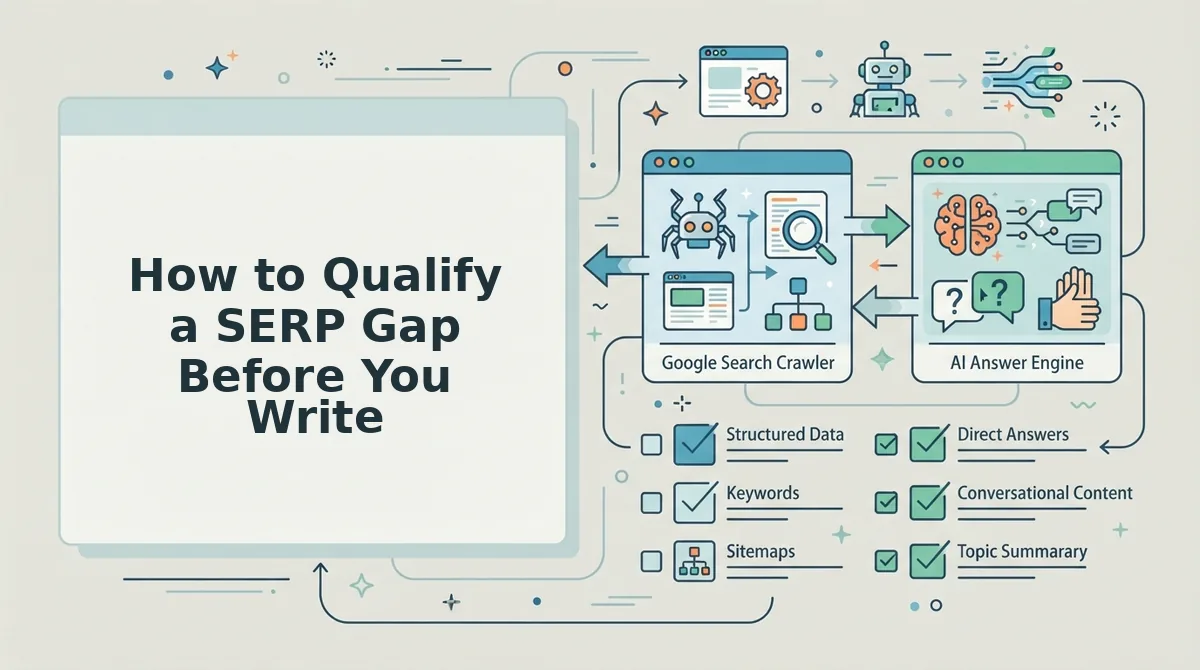
A gap is only worth targeting if you can answer the question better than the current top 10. Run every candidate gap through this three-question checklist before you commit a single word.
- Is the intent clear? A real gap has a single dominant search intent, informational, transactional, or navigational. If the SERP mixes intents across the top 10, Google has not settled on what the query means, and your article will struggle to rank for any of them. Only target gaps where one intent clearly dominates.
- Is the competitor weak? Open the top three ranking pages and check whether they actually answer the query. If the pages are thin, outdated, or only tangentially relevant, the gap is winnable. If the SERP is dominated by high-authority sites with strong, complete answers, the gap may be too hard to win without significant differentiation.
- Is there a format mismatch? Compare what the SERP rewards, featured snippets, video carousels, listicles, against what competitors actually publish. A format mismatch means you can win by matching the rewarded format even without out-authoring the incumbent. This is the lowest-effort, highest-return gap type.
BloGoose applies this qualification logic during its content calendar planning, so every article it drafts targets a gap that has already passed the intent, authority, and format checks.
FAQ: Finding SERP Gaps Without a Keyword Tool
Can I really do keyword research without any tools?
Yes. Google autocomplete, People Also Ask, related searches, and manual SERP analysis reveal intent, format, and depth gaps that keyword tools cannot surface. These free signals show what searchers actually ask and how competitors fail to answer.
What's the difference between a SERP gap and a keyword gap?
A keyword gap is a missing keyword in your content inventory. A SERP gap is a missing answer, an intent, format, or depth mismatch between what searchers ask and what the top 10 results deliver. SERP gaps exist even when the keyword is already targeted.
How long does a manual SERP gap analysis take?
About 30 minutes per query. That includes scanning the top 10 results, mining People Also Ask, checking formats, and writing a one-sentence gap brief. A full cluster of 10 queries takes roughly five hours of focused work.
Is manual gap analysis better than using a tool?
It is slower but reveals intent and format mismatches that tools miss. Tools compare keyword lists; manual scans compare what searchers ask against what competitors actually publish. The two methods are complementary, not interchangeable.
What if I find a gap but the SERP is dominated by high-authority sites?
Qualify the gap before writing. If the top 10 contains strong, complete answers from authoritative domains, the gap may be too hard to win. Look instead for format mismatches, a step-by-step guide can outrank a definitional page even from a smaller site.
A manual SERP gap scan works by comparing three lenses against the same query: the search intent behind the top 10 results, the content formats those results use, and the People Also Ask questions they leave unanswered. When a PAA question has no matching H2 in any ranking page, that is a depth gap. When the SERP rewards a format competitors ignore, such as step-by-step guides where definitions dominate, that is a format gap. When the top results target a different intent than the query implies, that is an intent gap. Each gap type is a winnable ranking opportunity that keyword tools cannot detect because they only compare keyword lists, not answer quality.
Keyword Tools Measure Volume. Gaps Measure Opportunity.
You just ran a complete SERP gap analysis with nothing but a browser and 30 minutes. No subscription. No spreadsheet stack. No waiting on a keyword tool to tell you what you already suspected: the results page is full of holes your competitors are too busy to notice.
The Three-Lens Gap Scan works because it inverts the workflow. Instead of starting with search volume and hoping intent follows, you start with the live SERP and let the gaps reveal demand. Volume is a lagging indicator. Gaps are leading ones.
Your next step is simple: run the scan on one target query today. Pick a page you already rank for on page two or three, apply all three lenses, and document every gap you find. Expect to surface three to five content angles no keyword tool would have shown you.
Once you have a repeatable process, the question becomes whether you want to run it manually every week or let BloGoose AI SEO content engine automate live SERP analysis and content gap detection across your entire site. The manual scan teaches you to see gaps. The engine makes seeing them your default state.
The best keyword tool is the search results page itself, because your competitors already did the keyword research for you.