Jasper for agencies vs an autopilot engine for client blogs
Draft speed was never your problem. The real problem shows up on client #12, when one more domain needs its own voice, keyword list, link map, and CMS login before a single post goes live.
Jasper drafts fast, and that has real value. However, most tutorials on Jasper for agencies blog content show one brand producing one post quickly. They rarely show what happens across a full client roster.
That gap is where the "12-tab content stack" grows. Agencies end up with tone drift between clients, manual prompt chaining, and copy-paste publishing loops that use up the hours that fast drafting saved.
This guide gives you an honest fit test for multi-client SEO. It covers where Jasper fits, a step count for onboarding a new client domain, and a matrix that separates campaign work from recurring blog clusters. For the single-brand view, read our breakdown of Jasper for SEO blogging.
One row in that matrix holds a cost that most agencies never price in. Check it before you renew any seats.
Key Takeaway: Jasper fits agencies whose main deliverable is campaign copy. Agencies that ship recurring SEO blogs across many client sites need per-site crawling, brand context files, calendars, and direct publishing.
Is Jasper the Right Tool for Agencies Writing Client SEO Blogs?
Jasper suits agencies whose core deliverable is campaign and marketing copy. It is a weaker fit for recurring SEO blog clusters. Each client site needs its own crawled context, internal link map, content calendar, and publishing route, and a draft-first tool leaves that per-site setup to your team.
A per-site content engine is a system that learns each client website separately, then plans, drafts, and publishes from that site's own context. Per-site crawling means reading one client's sitemap and published pages to map its existing topics and URLs. Brand context files are editable documents that store one client's voice, audience, and keywords so that every draft follows them.
Think of it like a law firm's client files. A skilled lawyer can write a brief fast, but each case still needs its own folder so facts never cross between clients.
Is Jasper good for agency SEO blogs?
Jasper works for agency SEO blogs when the agency manages a few brands and an editor owns every step after the draft, because its strength is producing copy quickly. It gets harder to scale when the deliverable is a recurring blog cluster for many client sites, since each site still needs a keyword plan, an internal link map built from its existing pages, and a calendar that grows coherent SEO topic clusters. Those tasks sit outside drafting, so the team repeats them by hand for every new client.
Worked example: onboarding a new client domain
With a draft-first tool, your team completes four manual tasks before the first post:
- Write a brand voice document.
- Build a keyword list.
- Assemble an internal link map.
- Configure CMS access.
With the BloGoose setup wizard, you provide one input:
- Enter the client domain.
- The wizard detects the XML sitemap.
- The wizard detects the CMS stack.
- The wizard generates eight editable Markdown files for you to review.
That is four manual build tasks compared with one input and a review. Those files then feed a pillar-focused calendar that publishes to WordPress or a custom API.
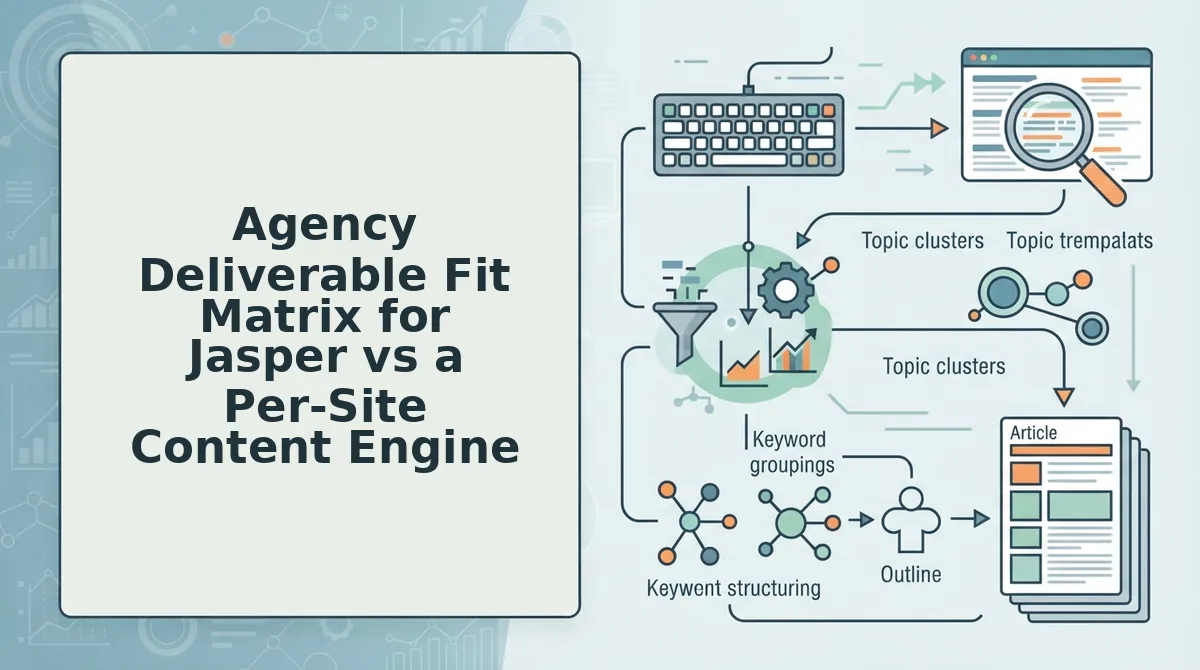
Agency Deliverable Fit Matrix for Jasper vs a Per-Site Content Engine
Jasper is built for campaign deliverables, and a per-site content engine is built for recurring blog clusters. Draft quality does not decide the choice. The deciding factor is the work that follows every draft: research, links, images, uploads, and indexing, repeated for each client site.
AEO (answer engine optimization) means structuring content so that AI assistants and chatbots can extract and cite it in their answers.
| Deliverable | Jasper fit | Per-site engine fit | Best for |
|---|---|---|---|
| Multi-channel campaign copy | Strong: fast drafts across channels | Limited: built around blog articles | Creative agencies |
| Ad variants | Strong: high volume of short-form options | Weak: not designed for ads | Paid media teams |
| Recurring SEO blog clusters | Moderate: strong drafts, manual planning | Strong: crawl-based calendar per client | SEO content agencies |
| AEO-cited articles | Moderate: relies on editors to add structure | Strong: AEO built into drafting | Publishers chasing AI citations |
| Per-client onboarding | Manual: four setup tasks per domain | Wizard: domain in, eight files out | Agencies adding clients often |
The Jasper descriptions above are general. Verify its current features and plans on Jasper's official site before you decide.
- Campaign copy: Choose Jasper if you are a creative agency running multi-channel launches.
- Ad variants: Choose Jasper if you are a paid media team testing many headlines.
- SEO blog clusters: Choose a per-site engine if you are an agency on monthly blog retainers.
- AEO-cited articles: Choose a per-site engine if you are a publisher targeting AEO optimization.
- Onboarding: Choose a per-site engine if you sign new clients every quarter.
Per-client onboarding is the row that most agencies never price in. Drafting time grows with the number of posts, but setup time grows with the number of clients. On client #12, these post-draft steps repeat for a twelfth site:
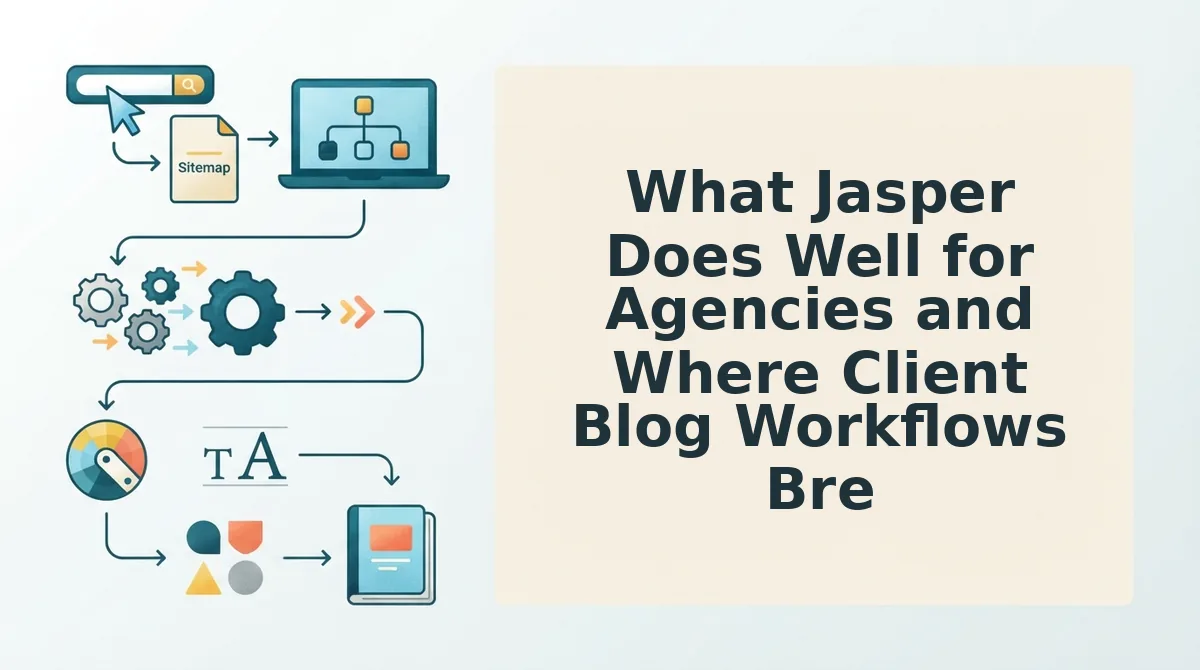
What Jasper Does Well for Agencies and Where Client Blog Workflows Break
Jasper is strong at campaign copy, brand voice controls, and team collaboration. Client blog workflows break after the draft, when the agency still has to research, edit, add images, link, upload, and index every post with separate tools.
Where Jasper earns its seat
- Campaign workflows. Jasper groups related assets so one brief can produce launch emails, social posts, and landing copy together. This helps agencies that sell multi-channel campaign retainers. Use it when one message has to appear across many formats.
- Brand voice features. Jasper lets teams store voice and style guidance so outputs sound closer to each client. This matters when several writers touch one account. Set up a separate voice profile per client before anyone generates copy.
- Team collaboration. Shared workspaces let strategists, writers, and account managers work on the same assets. This cuts down on version chaos across a roster. Give each client its own space so reviews stay separate.
The 12-tab stack self-audit
Most Jasper tutorials end at the finished draft and show only one brand. Agencies run many brands, so tick each tool you still pay for separately:
- SERP research tool: finds keywords and competing pages before the brief. Without it, drafts target guesses.
- Editor: fixes accuracy, structure, and tone. Expect real effort here, because Jasper blog drafts often need heavy editing.
- Image tool: creates featured and inline visuals. That is one more login and export step per post.
- Internal link mapping: connects new posts to each client's existing pages. Done by hand, it rarely scales past a few sites.
- CMS upload: moves formatted content into WordPress or another CMS. Copy-paste errors pile up quickly here.
- Indexing requests: asks search engines to crawl new URLs. Skipping this step slows down discovery.
If you ticked four or more, the copywriter is not your bottleneck. The work around it is.
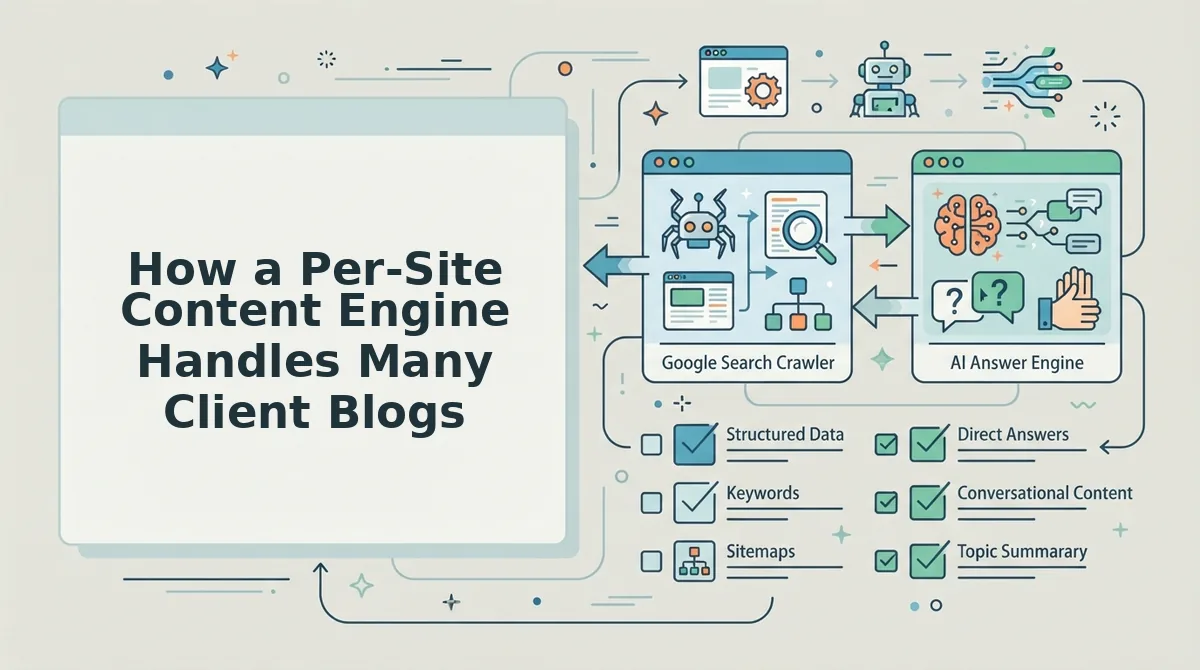
How a Per-Site Content Engine Handles Many Client Blogs
A per-site content engine runs the same seven-step pipeline once for each client, from site crawl to indexing request. BloGoose handles the full post-draft workflow, so a single operator can manage many client blogs.
Prerequisites: each client's domain, CMS access (WordPress credentials or a custom API endpoint), and Google Search Console access if you want indexing requests.
- Enter the client domain in the setup wizard. BloGoose locates the XML sitemap, inspects published pages, and detects the CMS stack. You should see the sitemap and platform listed before you continue. This usually takes a few minutes.
- Review the eight Markdown brand context files. Open files such as brand-voice.md, features.md, seo-context.md, and target-keywords.md, then correct anything the crawl missed. Allow about 15 to 30 minutes per client.
- Approve the 30-day content calendar. Check the pillar-focused topics, then edit or swap any that conflict with the client's plans.
- Generate drafts. Each article is written with SEO structure and AEO-ready direct answers already built in.
- Create images. Visuals are generated with each article, so no separate image tool is needed.
- Publish to WordPress or a custom API. Finished posts go straight to the client's CMS without copy-paste.
- Request indexing. Connect the Google Indexing API setup once. New URLs are then submitted after publishing.
How do agencies manage brand voice across clients? Agencies manage brand voice across clients by giving each site its own written voice rules, which every draft reads before writing. In BloGoose, each client has eight editable Markdown brand context files, including brand-voice.md. Suppose a client asks for shorter sentences and no exclamation marks. You edit that client's brand-voice.md once, and every later draft for that client inherits the change. Other clients' files stay untouched. This stops tone drift across a roster without anyone re-pasting style guides into prompts.
If your audit showed a stack of six tools for each client, see how automated SEO content replaces that stack with one pipeline per site.
Where BloGoose Is Not the Right Fit for Agencies
BloGoose is not the right fit when most of your client work is campaign or ad copy rather than recurring blog content. Its scope is narrow on purpose.
BloGoose is an AI SEO content engine that reads a site, learns its voice, plans a calendar, drafts articles, creates images, and publishes to WordPress or a custom API. It does none of the other work agencies sell.
Think of it like a dedicated bakery oven. It produces bread consistently every day, but you would not use it to grill steaks. In the same way, BloGoose does not produce multi-channel campaigns or ad variants (many versions of one ad written for testing). Agencies with mostly campaign retainers may still prefer Jasper.
Publishing has limits too. WordPress works out of the box. Other CMSs need an API route, meaning an endpoint your developer exposes so the engine can send posts in.
Finally, drafts still benefit from human editorial review before client sign-off. Automation removes the busywork, not the accountability.
With both sets of limits on the table, the choice comes down to your retainer mix.
Which Should Your Agency Choose for Client Blogs?
Choose by deliverable. Jasper fits campaign copy, while a per-site engine fits recurring blog clusters across many client domains.
Answer these five questions honestly:
- Deliverable mix: Are your retainers mostly campaigns or mostly blogs?
- Client sites: How many separate domains do you manage?
- Blog volume: Does each client need recurring posts every month?
- Publishing destination: Do posts ship to WordPress or a custom API?
- Indexing: Who owns getting posts indexed after they go live?
Picture an agency weighing campaign retainers against blog retainers. Campaign work stays in Jasper. Blog-cluster retainers move to a per-site engine that crawls each domain, learns its voice, plans a 30-day calendar, and publishes directly to the client's CMS.
That resolves the intro's question: the tool matters less than the retainer it serves.
Campaigns need a copy assistant, but client blogs need an engine that knows each site.
Check BloGoose pricing against your blog retainer count, then explore the AI SEO content engine. Run your first client domain through BloGoose.