How to Reduce SEO Tool Fatigue for Content Managers
Your browser has 12 tabs open: one for keyword research, one for the AI draft, one for the plagiarism checker, one for the rank tracker, one for the CMS, one for the image generator, one for the internal link tool, one for the schema validator, one for the AI-answer checker, one for the analytics dashboard, one for the project management board, and one more you forgot why you opened. That's not a workflow, that's a second job. If you're trying to reduce SEO tool fatigue for content managers, you already know the feeling: every tool promises to save time, but the boundaries between them quietly eat your calendar, your consistency, and your tone of voice.
You're right to be frustrated. The problem isn't your process; it's the assumption that more specialized tools produce better output. They don't. They produce more handoffs, more copy-paste loops, and more places for brand voice to drift.
Here's the roadmap. First, we'll quantify the hidden costs of tool sprawl, including one cost most content managers never measure until a quarter-end review exposes it. Then you'll run the 4-question elimination matrix against every tool you currently pay for. Finally, you'll get a consolidation path that works even if your team is mid-migration. Along the way, you'll see how a platform that reads your site, learns your voice, and publishes directly to WordPress or a custom API removes the boundaries where deadlines slip.
One finding ahead may surprise you: the most expensive tool in your stack is rarely the one with the highest subscription fee.
What SEO Tool Fatigue Actually Costs You
SEO tool fatigue is the compounding productivity, consistency, and financial drain that occurs when content teams juggle too many disconnected tools to research, draft, optimize, and publish a single article. The direct answer: it costs you roughly one full workday per week in context-switching alone, plus a quieter cost, measurable tone drift across every article that passes through multiple tool boundaries.
Think of each tool boundary like a toll booth on a highway. One toll booth is manageable. Twelve toll booths on a 10-mile stretch means you spend more time stopping than driving. Every time you export a keyword list from one tool, paste it into a brief in another, then copy the draft into an editor, then upload it to a CMS, you pay a "toll" in attention, formatting, and version control. The trip still ends at the same destination, it just takes three times longer and burns out the driver.
Ryan Stewart puts the financial angle bluntly: "It's easy to overpay for SEO tools." Subscription overlap is the most visible cost, two rank trackers, three AI writers, four research tools that all pull from the same SERP data. But the invisible costs are larger. Surfer Academy's research highlights that SEO responsibilities now span both Google rankings and AI search visibility, which pushes teams to bolt on yet another tool for every new channel. Each addition creates a new boundary.
Every tool boundary is a place where tone drifts and deadlines slip. When a writer drafts in one interface, an editor reviews in another, and a publisher formats in a third, the brand voice rules you documented in a fourth tool get applied inconsistently, or not at all. The result is a content library that sounds like five different companies wrote it, which weakens both reader trust and AI citation consistency.
What does context-switching actually cost a content team? Research on task-switching consistently shows a 20-40% productivity penalty when workers move between different interfaces and mental models. For a content manager producing four articles per week across a 12-tool stack, that penalty translates to roughly 6-8 hours of lost output weekly, time that could fund the consolidation effort itself. Teams that stitch tools together manually also create silent failure points: a broken export, a missed field mapping, or a version saved in the wrong folder. These are the SEO tool stitching mistakes that never show up in a tool's feature comparison chart but show up clearly in your publishing calendar.
The advanced cost is strategic. When your team spends its cognitive budget managing tool handoffs, it has nothing left for the work that actually moves rankings: topic selection, angle differentiation, and voice consistency. Tool fatigue doesn't just slow you down, it quietly caps the quality ceiling of everything you publish.
The Tool Stack Audit: 4 Questions That Eliminate 80% of Your Stack
Run every tool in your current stack through these four elimination questions. Any tool that fails two or more questions is a consolidation candidate. The audit takes about 45 minutes and requires your tool subscription list, your last month of publishing data, and access to your CMS.
Here's where most content managers get stuck: they audit tools by feature list instead of by workflow ownership. A tool can have 50 features and still be dead weight if it doesn't own a complete step in your publishing pipeline. The four questions below force that ownership test.
- Does it produce output I actually publish? Open your last 10 published articles and trace each one backward. List every tool that touched the article between idea and live URL. If a tool only produced intermediate artifacts, a keyword list you manually retyped, a score you screenshotted, a report you exported to a spreadsheet, it's a handoff, not an output. Expected outcome: you'll identify 2-4 tools whose output never reaches the published page directly.
- Does it read my site, or do I feed it context manually? Check whether the tool can crawl your domain, read your existing pages, and extract your brand voice automatically. If you're pasting your own content into the tool to "teach" it, you're doing the integration work the tool should do. Expected outcome: flag every tool that requires manual context upload as a consolidation candidate.
- Does it talk to my CMS, or do I copy-paste? Open your CMS and review your last five publishing sessions. Count how many times you copied content from an external tool into WordPress or your custom API. Each copy-paste is a toll booth. If a tool can't publish directly or via API, it's creating a boundary. Expected outcome: you'll see exactly which tools force manual transfer and how many minutes each transfer costs.
- Does it learn my voice, or does it reset every session? Test each AI writing or optimization tool by generating two drafts on the same topic one week apart. Compare tone, terminology, and formatting. If the second draft doesn't reflect the first, or your documented style guide, the tool has no persistent voice memory. Expected outcome: tools without voice learning fail this question and become prime elimination targets.
How do you decide which SEO tools to cut first? Eliminate in this order: tools that fail question 1 (no publishable output), then tools that fail question 3 (no CMS integration), then tools that fail questions 2 and 4 together (no site reading and no voice learning). This sequence removes the highest-friction boundaries first while preserving any unique data source you still need. A platform that crawls your site, extracts brand voice rules, drafts with SEO and AEO baked in, and publishes directly to WordPress or a custom API collapses all four questions into one pass, which is why consolidation efforts that start with publishing ownership produce the fastest relief.
Before you cancel anything, check what to fix before replacing your SEO tool stack so you don't automate a broken process. Once your audit is done, the next step is sequencing the consolidation itself.
The Consolidation Ladder: A Realistic Migration Path
You can cut your active SEO tool count from eight-plus down to two or three without losing output quality, if you consolidate in the right order. The migration below assumes you already have a working analytics setup and a CMS (WordPress or a custom API).
Prerequisites: Admin access to your CMS, your current keyword research export, and a list of every tool your team touched in the last 30 days.
- Keep analytics, consolidate drafting. Open your keyword research tool and export your target queries one final time. Paste that list into an AI SEO content engine that handles SERP analysis, brand voice extraction, and drafting in one pass. You should see a draft article that matches your site's tone without you writing a single prompt. Expected time: 30-45 minutes for the first article, under 15 minutes per article after setup.
- Replace manual publishing loops. Go to Settings, then API Keys in your content engine, and connect your WordPress site or custom endpoint. Select Publish on a finished draft instead of copying HTML into your CMS. You should see the article live on your domain with formatting intact, no staging copy-paste, no broken image URLs. Expected time: 10 minutes to connect, zero minutes per post afterward.
- Automate the calendar. Open the calendar view in your content engine and approve the 30-day cluster it generated from your sitemap. Click Schedule All. You should see a full month of posts queued with target keywords, internal links, and publish dates assigned. Expected time: 20 minutes per month instead of a half-day planning session.
BloGoose's site crawl and brand context extraction handle the heaviest lift here: it reads your existing pages, extracts voice rules, and applies them to every draft, so you consolidate SEO research, writing, and publishing without retraining a prompt library. Keep your analytics tool and one rank tracker. Everything else on your list is now optional.
What One Engine Actually Replaces (and What It Doesn't)
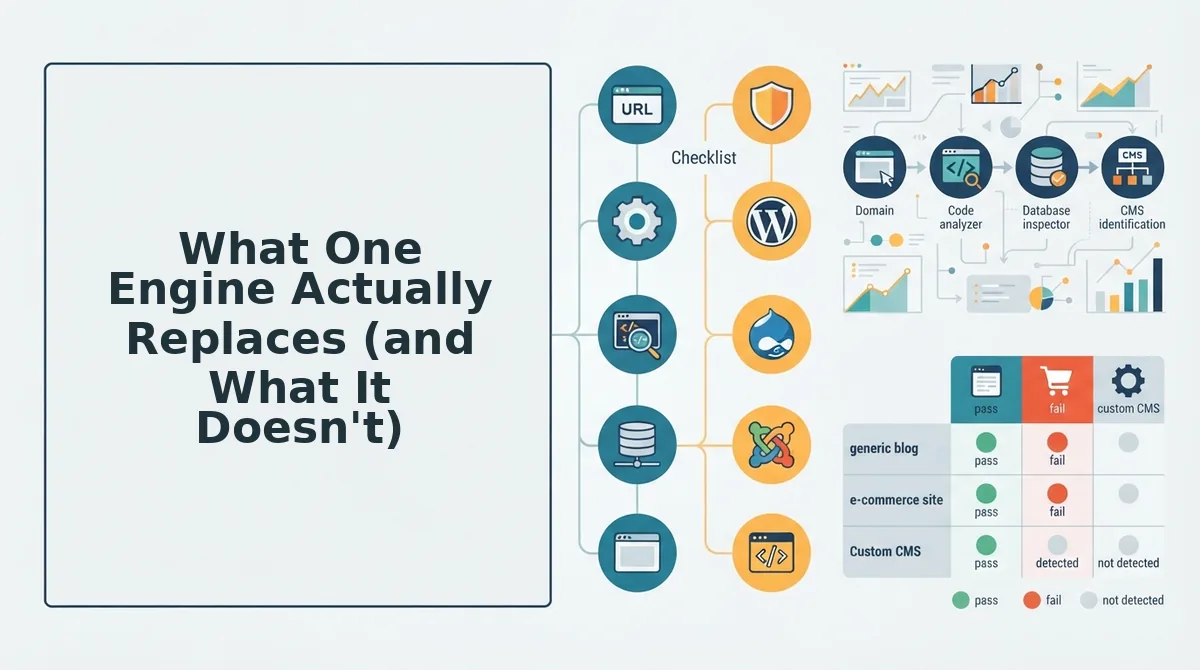
A consolidated AI SEO content engine replaces the research-to-publish middle of your stack cleanly, but it is not a replacement for deep analytics or technical SEO audits. The honest split: consolidate drafting, voice, images, and publishing; keep specialist tools for measurement and site health.
| Capability | Consolidates into one engine? | Still needs a specialist tool? | Best for |
|---|---|---|---|
| SERP research and keyword clustering | Yes, live SERP analysis runs during drafting | No | Content managers who currently toggle between 3 research tabs |
| Brand voice extraction | Yes, sitemap crawl builds 8 Markdown brand context files | No | Teams publishing across multiple writers or freelancers |
| Drafting and image generation | Yes, articles and images ship together | No | Solo operators and small content teams |
| CMS publishing | Yes, direct WordPress or custom API push | No | Publishers tired of manual copy-paste loops |
| Rank tracking and deep analytics | No | Yes, keep your analytics suite | SEO leads who report on movement weekly |
| Technical SEO audits | No | Yes, crawlers like Screaming Frog or Sitebulb | Technical SEO specialists |
Competitor point of honesty: standalone rank trackers and technical crawlers do their jobs better than any all-in-one content engine ever will. If your role is reporting on keyword movement or fixing crawl budgets, keep those tools. If your role is producing publish-ready, voice-accurate content clusters at volume, an AI-powered SEO content engine replaces the fragmented middle of your stack.
One underrated consolidation win is sitemap context extraction. Instead of manually documenting your brand voice in a shared doc that nobody reads, the engine crawls your published pages and generates structured brand context files automatically. That single step eliminates the voice-drift problem that plagues multi-writer teams.
What consolidates cleanly: SERP research, brand voice extraction, drafting, image generation, and CMS publishing all collapse into one workflow. What doesn't: rank tracking, deep analytics, and technical audits still deserve dedicated tools. The realistic end state for most content managers is two or three tools total, one content engine, one analytics suite, and optionally one technical crawler.
FAQ: SEO Tool Fatigue Questions Content Managers Actually Ask
Content managers reduce SEO tool fatigue by consolidating research, drafting, and publishing into one engine, then keeping only analytics and rank tracking as separate tools. The goal is fewer handoffs, not fewer features.
How do I reduce SEO tool fatigue as a content manager?
Audit your stack against four questions: Does this tool produce a deliverable, or just a report? Does it duplicate another tool's output? Does it require manual export-import steps? Does it slow publishing by more than a day? Eliminate anything that fails two or more, then consolidate the rest into one content engine.
What's the minimum SEO tool stack for a content team?
A workable minimum is three tools: one AI SEO content engine for research, drafting, and publishing; one analytics suite for traffic and conversion data; and one rank tracker for keyword movement. Everything else. SERP checkers, voice docs, image generators, CMS plugins, can consolidate into the engine.
Can AI content tools actually match my brand voice?
Yes, when the tool extracts voice rules from your existing site rather than relying on generic prompts. Sitemap crawling that generates structured brand context files, covering tone, terminology, formatting, and audience assumptions, produces drafts that read like your team wrote them, not like a chatbot guessed.
How do I get my content cited in AI answers without extra tools?
Write direct-answer paragraphs in the first 80-120 words of each section, use question-based H2s and H3s, and structure claims with concrete data. AEO content optimization is a formatting discipline, not a separate tool, the same engine that drafts your article can bake citation-ready structure in automatically.
Stop Auditing. Start Consolidating.
Tool fatigue doesn't resolve through more careful tool selection. It resolves through subtraction, and the 4-question audit gives you the permission slip to subtract ruthlessly.
The consolidation ladder isn't a one-weekend project. It's a sequence: eliminate the redundant, automate the repetitive, then consolidate the survivors into one engine that crawls, drafts, optimizes, and publishes without handoffs.
Here's the payoff you were promised: most content managers discover they need three tools, not twelve.
Your next action: run the 4-question audit on your current stack this week. Then explore BloGoose's site crawl to see what consolidation actually looks like when one engine reads your site, learns your voice, and ships rank-ready articles to WordPress without a 12-tab workflow.
Every tool you remove is a decision you never make again.