
Single platform content engine vs multi tool SEO stack for teams
Picture this: you have seven browser tabs open just to ship one post, keyword trackers, live SERP scrapers, prompt windows, and your CMS dashboard. You likely agree that organic growth stalls not from missing data, but from stack sprawl, where deciding between a single platform content engine vs multi tool SEO stack becomes a survival choice for margins. Search operations spend over 14 hours per piece solely copying entities across browser tabs.
Why tolerate this operational fragmentation when the solution is structural? You will discover how consolidating your publishing pipeline eliminates prompt engineering homework and robotic AI drafts. This guidance applies to editorial and search workflows across modern web publishing, excluding proprietary legacy monoliths. Later, you will also uncover the counterintuitive friction metric that explains why adding specialized tools quietly stalls indexation.
Consider this workflow: an operator inputs an XML sitemap into an automated SEO content engine to extract brand context rules automatically. The system conducts live SERP research, structures brand context files, drafts sections, and pushes complete articles directly to WordPress. Inspect your sitemap structure and brand guidelines first to evaluate your baseline readiness.
The structural contrast shifts team focus immediately.
The Verdict on Content Engines vs Multi Tool SEO Stacks
An integrated AI SEO content engine outperforms a multi-tool SEO stack for teams seeking automated organic velocity, while a fragmented multi-tool stack remains superior for enterprise teams that require bespoke manual copywriting control at every production stage. Choosing between them depends on whether your operational constraint is execution bandwidth or manual editorial customization.
An AI SEO content engine is an end-to-end publishing system that crawls site structure, extracts brand context, executes research, drafts articles, and publishes directly to a content management system without external handoffs. Disjointed setups force operators to stitch together separate SERP scrapers, standalone chat prompts, NLP optimization scorecards, and CMS upload interfaces.
Most search teams assume that stacking best-in-breed point tools guarantees superior organic rankings. That assumption fails when context breaks between tabs.
| Evaluation Criteria | Integrated Content Engine | Multi-Tool SEO Stack |
|---|---|---|
| Data Freshness | Real-time SERP queries pulled during drafting via live SERP extraction | Requires running manual queries across third-party research dashboards |
| Time-to-Publish | Automated drafting to direct CMS delivery (WordPress or API) | Manual copying across documents, editors, and publishing interfaces |
| Entity Consistency | Systemic context maintained via grounded site files and sitemap data | Manual prompt injection per session, risking tone drift |
| Operational Licensing | Single unified platform subscription with AI generation included | Multiple concurrent software seats, user licenses, and separate LLM API bills |
Decision Framework
- Choose an integrated content engine if you manage publishing calendars for niche sites, DTC brands, or digital agencies and need complete, publication-ready clusters shipped straight to your CMS without prompt engineering. Best for: Founders, solo operators, and lean growth leads.
- Choose a multi-tool stack if you employ dedicated in-house copywriters who craft bespoke brand campaigns across multiple channels and only require standalone NLP scoring editors like Surfer SEO or multi-variant ad generators like Jasper. Best for: Large corporate marketing teams with dedicated editorial layers.
Our recommendation: Choose the single-platform content engine if your primary objective is sustainable search and AI answer citation volume. Paying for multiple dashboard subscriptions rarely improves content velocity when your staff spends hours manually migrating copy between disconnected tools.
Fragmented stacks introduce compounding operational friction long before your first draft reaches the publishing queue.
The 5 Bottlenecks of Managing a Disjointed SEO Stack
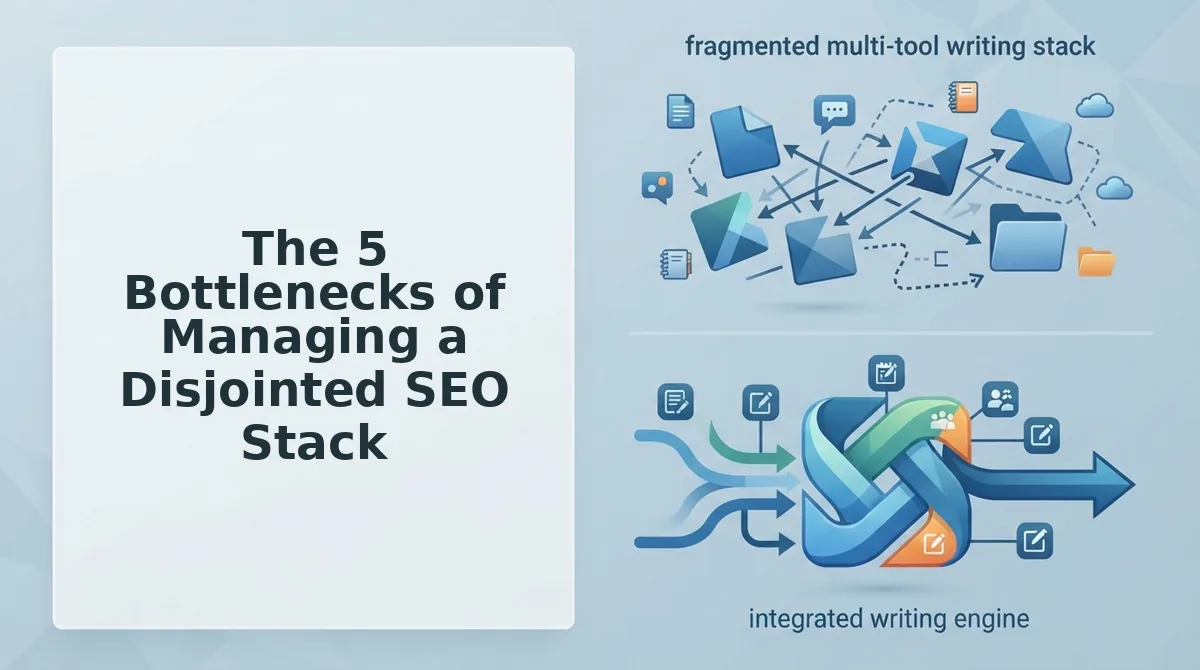
The primary bottlenecks of a disjointed SEO stack stem from the context-loss tax, where manual handoffs between siloed tools introduce latency, formatting errors, and diluted search intent. As teams jump between five distinct point solutions, content velocity stalls and strategic alignment collapses across every stage of production.
Research workflows break when intelligence gathered in one subscription fails to inform the next phase of drafting. Nathan Gotch at Rankability highlights that specialized AI search workflows require unified technical precision rather than fragmented manual inputs to capture real topical authority.
The context-loss tax is the operational overhead and strategic degradation that occurs when marketing teams manually transfer data across disconnected SEO point solutions. When team members copy keywords from spreadsheets into prompt windows and paste raw drafts into optimization dashboards, critical intent markers evaporate. Consider how this operational friction compounds across the five stages of content delivery:
- Manual research export friction occurs when SERP data, intent patterns, and keyword metrics remain isolated in standalone research tools. This creates immediate latency because analysts must export CSV spreadsheets and manually reinterpret search intent for writers. Eliminate this gap by syncing live SERP queries directly into the core drafting brief.
- Context collapse from prompt engineering happens when writers feed disjointed prompts into generic interfaces instead of grounded brand environments. Isolated chat-based prompt workflows strip out domain context, forcing operators to endlessly re-paste tone guidelines and internal link requirements. Solve this by maintaining permanent Markdown context repositories that guide draft generation automatically.
- NLP scoring silos emerge when finished text must be pasted into secondary scoring software to measure semantic entity density. This back-and-forth editing cycle degrades prose into mechanical keyword stuffing while consuming hours of manual optimization time. Remove this barrier by embedding entity optimization rules directly into the initial generation pass.
- Disconnected asset generation takes place when visual assets and charts are built in standalone graphics software without structured metadata. Visuals created in isolation routinely lack topical alignment, proper aspect ratios, and search-optimized alternative text. Streamline this by triggering contextual image generation directly alongside the copy.
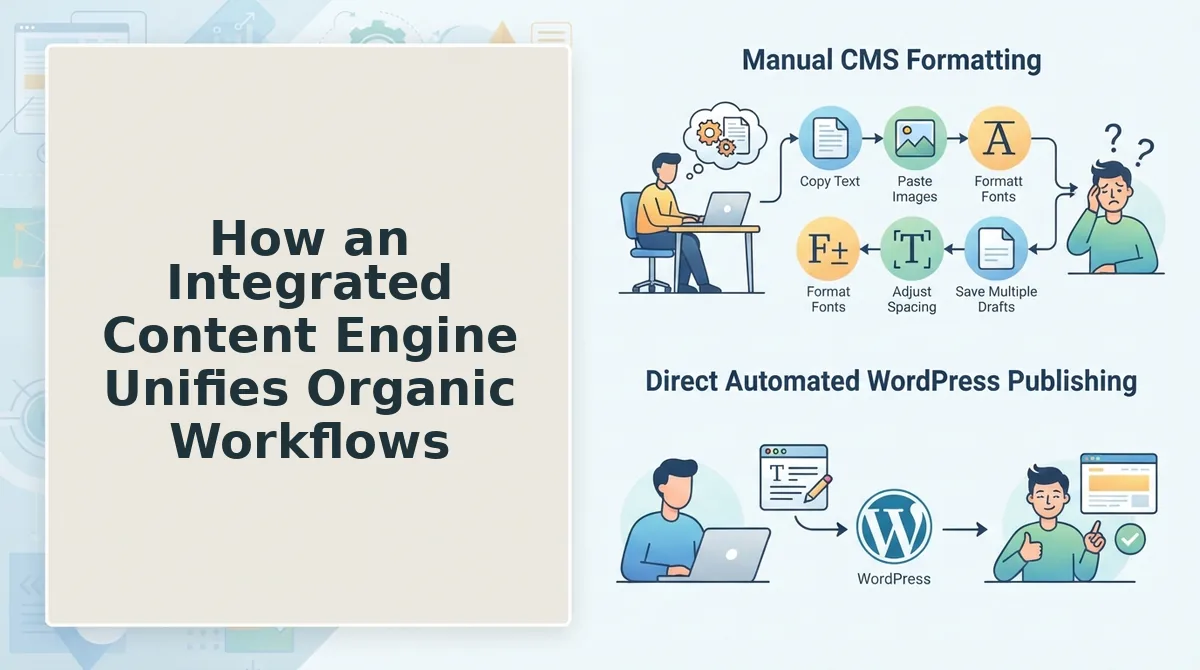
- Manual CMS upload loops occur when completed drafts, metadata, and media require manual formatting inside a blogging dashboard. Hand-pasting raw text risks broken HTML formatting, missing tags, and delayed requests to search crawlers. Resolve this friction by routing approved articles straight to the target publishing API.
Consolidating these disparate handoffs changes how publishing teams allocate their operational resources.
How an Integrated Content Engine Unifies Organic Workflows
An integrated content engine unifies organic workflows by replacing fragmented keyword research, draft generation, and CMS formatting with an automated pipeline grounded in existing site structure. Instead of stitching together separate prompt interfaces and ranking databases, publishing teams run the entire organic search lifecycle through a unified technical loop.
An AI SEO content engine is an end-to-end publishing system that inspects domain architecture, analyzes live search intent, drafts voice-aligned articles, and pushes production-ready posts directly to a target CMS or API.
Picture a growth lead opening six browser tabs every morning to manually copy URLs from a spreadsheet, paste tone instructions into disconnected chat prompts, format headers by hand, and upload images into a CMS. Think of that multi-tool stack like an assembly line where workers haul parts between separate buildings across town; an integrated engine brings every workstation under one roof.
What is an integrated content engine and how does it secure search visibility? An integrated content engine unifies organic discovery by crawling a website's live architecture to extract niche definitions, competitive rules, and internal link paths directly from source data. Instead of relying on manual prompt-engineering, the system combines automated XML sitemap context extraction with real-time SERP queries to draft pillar articles that match current ranking signals. By generating grounded copy and handling automated publishing, the engine positions content to rank on Google and secure citations in conversational search without requiring manual coordination across disparate point solutions.
The operational shift moves from manual inputs to structural intelligence:
- Taxonomy over prompts: The system automatically reads page hierarchies instead of relying on operators to paste brand voice guidelines into LLM chat windows.
- Grounded search signals: Drafts incorporate real-time SERP and social trend data rather than training-cutoff guesses.
- Connected delivery: Formatted posts push directly into WordPress or custom API endpoints without manual copy-pasting.
Consider an editorial team launching a topical cluster for an existing site. The operator enters their domain into the platform wizard. The engine identifies the XML sitemap, analyzes published posts, and automatically generates eight editable Markdown context files, including brand style guides and internal link maps. It queries active search engine result pages for current intent gaps, produces rank-ready articles, and routes them straight to the WordPress draft queue with contextual links intact. The publisher replaces hours of spreadsheet tracking with a consistent organic pipeline designed for answer engine optimization.
Unifying your publishing pipeline with BloGoose eliminates multi-tool subscription sprawl while keeping your blog consistently indexed and cited.
Even with an automated production loop, scaling teams must recognize the specific operational conditions where unified systems require precise configuration boundaries.
Where a Single Content Engine Hits Operational Boundaries
A single content engine hits operational boundaries when technical site health, server log audits, and off-page backlink investigations require forensic diagnostics rather than automated publishing workflows. While an integrated platform automates research, drafting, internal linking, and publishing, it does not replace deep technical auditing software.
A specialized enterprise crawler is a diagnostic utility engineered to monitor server-level status codes and complex client-side JavaScript rendering. Industry perspectives from SE Ranking on tool consolidation emphasize that unified platforms streamline daily execution, but specialist diagnostics remain indispensable for edge-case infrastructure troubleshooting and large-scale architectural triage.
Is an automated content engine designed to replace every single legacy SEO subscription? Never.
- Enterprise log file and JavaScript crawl audits: Specialized enterprise crawlers monitor raw server response codes, crawl budget waste, and complex client-side rendering bottlenecks. These technical anomalies occur deep within web architecture where editorial platforms cannot intervene. Deploy dedicated crawlers during platform migrations or core infrastructure updates to diagnose indexing failures before publishing new assets.
- Deep backlink graph forensic analysis: Independent link indexers crawl billions of external web pages to track domain authority drops, competitor acquisition velocity, and anchor text distribution. Integrated engines build internal contextual link meshes, but they do not parse the entire web graph to defend against off-page link penalties. Query dedicated link graph analyzers when conducting competitive disavow audits or manual penalty remediation.
- Granular real-time NLP density calibration: Automated platforms draft comprehensive search content directly from live SERPs, whereas traditional micro-editors focus on manual keyword density quotas. Teams that require manual sentence-level keyword scoring often utilize specialized content scoring alternatives to measure strict entity frequency ratios. Reserve manual scoring utilities for hyper-competitive affiliate terms where single-word frequency adjustments alter rankings.
- Active digital PR and outreach management: Link outreach workflows rely on relationship databases, prospect scraping, and automated inbox sequences rather than content generation. While an engine produces citation-optimized assets to earn editorial links passively, it does not execute manual journalist pitches. Maintain dedicated PR outreach software alongside your engine to distribute original survey data directly to newsrooms.
Evaluating where editorial automation stops and forensic diagnostic software begins clarifies how to reorganize your team workflow.
How to Transition from Fragmented Tools to an Automated Engine
Transitioning from a fragmented SEO stack requires auditing existing software seats, importing site architecture, establishing direct CMS webhooks, and routing publishing events through an automated indexing pipeline. A content engine is an integrated publishing platform that automates research, drafting, internal linking, and live distribution within a unified workflow.
Consider your team's current Monday routine: an editor bounces between disconnected browser tabs, copying keyword targets from one tool into chat prompts, before hand-formatting HTML in a CMS editor. Why maintain multiple disconnected subscriptions when an automated pipeline protects search performance while removing administrative overhead?
Before initiating migration, gather administrator access to your CMS, your active XML sitemap URL, and your active software subscription invoices. Having these assets ready prevents downtime during integration.
- Audit active software seat costs (Time: 30 minutes): Open your billing portals for standalone AI writers, SERP analyzers, and on-page optimization plugins to catalog every individual license. You should see a clear expense breakdown that pinpoints redundant software ready for cancellation once migration finishes.
- Extract internal link models (Time: 10 minutes): Enter your website domain into the setup wizard to trigger an automated crawl across your XML sitemap. The system crawls published URLs and builds an editable internal link mapping file, ensuring newly generated articles link accurately to existing pillar content.
- Configure CMS webhooks and credentials (Time: 15 minutes): Click Settings, select Integrations, and enter your WordPress Application Password or custom REST API endpoint details. You should see a verified connection status confirming the engine can push scheduled drafts, metadata, and featured images directly to your database.
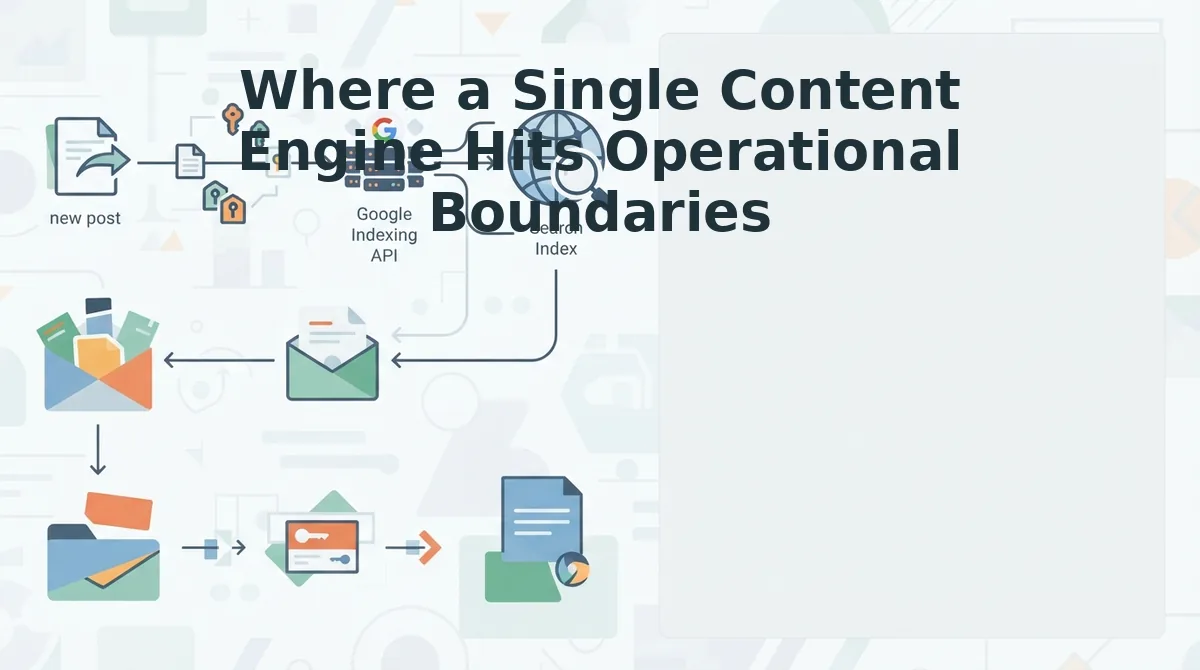
- Automate search indexing workflows (Time: 10 minutes): Upload your Google Cloud service account JSON key into the platform indexing dashboard to configure Google Indexing API automation. The platform will automatically dispatch immediate crawl notifications whenever an article goes live, removing the need for manual URL Inspection submissions.
Migrating organic workflows into a unified platform naturally prompts questions about daily editorial management and technical capabilities.
Frequently Asked Questions About Content Platforms and SEO Tool Stacks
A unified content platform eliminates tool sprawl, lowers software costs, and accelerates publishing velocity.
Can an AI content engine replace standalone keyword research tools?
An AI content engine replaces standalone keyword research tools by analyzing live SERP competitors and search intent during drafting. Instead of checking third-party databases, the engine automatically extracts core entities. Separate keyword subscriptions become unnecessary once topical mapping occurs directly inside the production pipeline.
How do subscription costs compare between unified platforms and fragmented stacks?
Unified platforms reduce monthly expenses by bundling search research, AI drafting, and CMS publishing into one flat fee. Fragmented stacks average four separate software subscriptions per seat; why pay recurring charges across disparate vendors when an integrated system handles research and delivery together?
How does an automated engine verify topical depth without manual scoring?
An automated engine verifies topical depth by analyzing live SERP competitors and extracting essential entities before writing begins. Rather than forcing writers to monitor manual grading gauges, the system automatically checks coverage against top-ranking pages. This algorithmic validation ensures each post satisfies search intent.
Can teams maintain a hybrid workflow combining manual review with automation?
Teams maintain full editorial control in a hybrid setup by automating initial drafts while reserving manual editing for voice refinements. Modern engines connect directly to WordPress or custom APIs, allowing editors to inspect drafts, refine brand guidelines, and review links before publication.
Managing these operational trade-offs determines how teams achieve sustainable organic growth.
Consolidating for Search Velocity and Sustainable Organic Growth
Consolidating your organic search workflow into an integrated content engine eliminates handoff friction and closes the massive operational divide between publishing two articles per month and scaling to twenty rank-ready assets. Disconnected stacks do not fail because individual tools lack capability; they fail because manual coordination caps your publication rate before topical authority can compound.
Are you evaluating tools for their standalone feature lists, or for whether they ship finished, indexed content without intermediate copy-pasting?
To capture sustainable organic market share without expanding manual coordination hours, execute two concrete operational shifts:
- Audit your team's publishing pipeline to replace separate prompt files, manual SERP exports, and hand-coded CMS formatting with direct automated pipeline publishing.
- Connect your domain architecture directly to live research inputs, ensuring every generated piece targets documented internal links and search intent automatically.
To replace multi-tool subscription overhead with an autopilot publishing architecture connected directly to WordPress or your custom API, explore BloGoose plans to begin scaling automated organic workflows.
Sustainable organic growth is fundamentally governed by publishing velocity, and an automated content engine transforms search visibility from an endless editorial assembly line into a compounding digital asset.