How Do AI Agents Split Blog Drafting Into Specialized Roles?

Your draft cleared the word count, hit the keyword, and still reads like three different people wrote it in shifts without meeting. That is the tell: one prompt set the outline, another drifted on tone halfway down, a third invented a statistic, and then you spent an hour hand-formatting headings nobody asked anyone to change.
That is a coordination problem, not a writing problem. Specialized AI agents for blog drafting solve it by splitting the work into narrow jobs with written boundaries instead of one heroic prompt. Below you get the four roles, the contract each one signs, and the routing table that decides who fixes a bad sentence.
An AI SEO content engine such as BloGoose runs this split as a default sequence â crawl, plan, draft, review, publish â with the planner reading a style file extracted from your own site rather than a blank topic box.
The cast, up front: a planner, a section writer, a reviewer, and a formatter. Hold onto one detail as you read â the split is the easy part, and the pass criteria are the piece almost everyone skips.
What Does Each Agent Own in a Multi-Agent Blog Writing Workflow?
In a multi-agent blog writing workflow, four agents split the job: a planner decides what gets written, a section writer drafts one assigned question, a reviewer passes or rejects the draft, and a formatter handles schema, headings, and links without touching prose.
Short answer: Four agents own a blog draft â planner (brief and keyword map), section writer (one assigned question), reviewer (claim checking plus pass or fail), and formatter (schema, headings, link placement). Each role gets a written contract naming its input, output, pass criteria, and escalation trigger.
A role contract is a four-line agreement stating what an agent receives, what it must return, how its output is judged, and when it must hand the problem elsewhere. Pass criteria are the specific conditions an output satisfies before the next agent accepts it.
| Agent | Input artifact | Output artifact | Pass criteria | Escalation trigger |
|---|---|---|---|---|
| Planner | Keyword map plus crawl-derived style file | Calendar of assigned questions with briefs | Every row names a question, a word ceiling, and a proof requirement | No source material exists for the assigned question |
| Section writer | One section brief | Draft at or under the ceiling, claims marked | Question answered in the first two sentences; no unflagged factual claims | Brief conflicts with the style file |
| Reviewer | Marked draft plus brief | Pass, or a reason code | Every claim traceable; tone matches the style file | Same reason code returned twice |
| Formatter | Passed section | Published HTML with schema and links | Headings, schema, and links correct; prose byte-identical | Link target missing or redirecting |
The planner is the only agent allowed to choose topics, and it consumes a keyword map plus a crawl-derived style file â not a bare topic string. That is what the SEO content brief looks like in practice.
A section writer is the agent that converts one assigned question into one section of prose under a word ceiling. It drafts; it does not decide scope, and it flags claims rather than sourcing them.
Think of it like a newsroom: the assigning editor never writes the paragraph, the reporter never sets the headline type, and the copy desk never re-reports the story.
The reviewer never rewrites either. It returns a verdict, which keeps the failure visible instead of silently patching it.
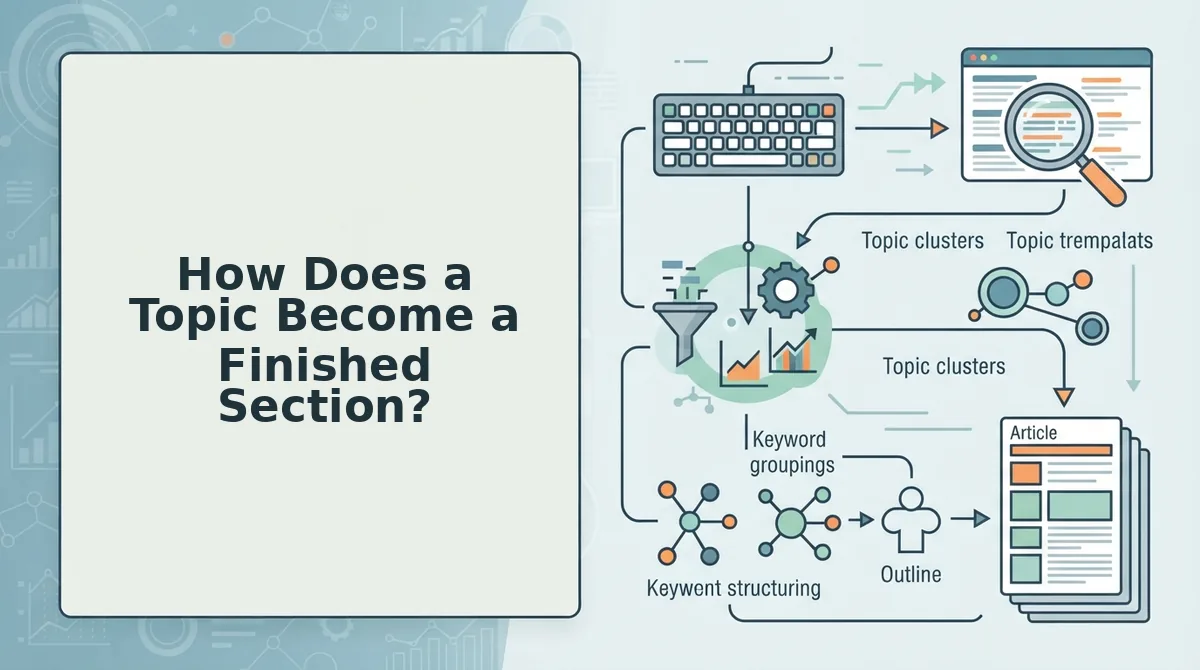
How Does a Topic Become a Finished Section?
To turn a topic into a finished section, the planner writes a section brief, the section writer drafts against it with claims marked, and the reviewer either passes the draft or sends it back to a named stage with a reason code.
Prerequisites: a keyword map, a crawl-derived style file, and the four role contracts written down. Budget roughly twenty minutes for the first full cycle and under five for each rework.
- Open the planner and attach the keyword map and style file. You should see a calendar of assigned questions, not topic labels.
- Fill the brief with four fields: the assigned question, a word ceiling, the proof requirement, and two named internal links. Success looks like a brief a stranger could draft from without asking you anything.
- Send the brief to the section writer. It returns prose at or under the ceiling with every factual claim flagged inline. Unflagged sentences should be opinion or transition only.
- Resolve each flag by attaching a named source or cutting the sentence. Expect about five minutes per section.
- Pass the draft to the reviewer. It returns a pass or a reason code such as unsupported claim or tone drift. A pass advances the section; anything else halts it.
- Route rework to the stage named in the code â brief, writer, or reviewer â rather than regenerating the whole post.
- Send the passed section to the formatter, which sets headings, schema, and link placement and never edits a sentence.
Citation-shaped passages come out of steps two and four, which is what AEO optimization actually runs on â and BloGoose enforces the same sequence end to end, publishing straight to WordPress or your API once the reviewer signs off.
The chain still collapses if the writer and the reviewer disagree about what your brand sounds like.
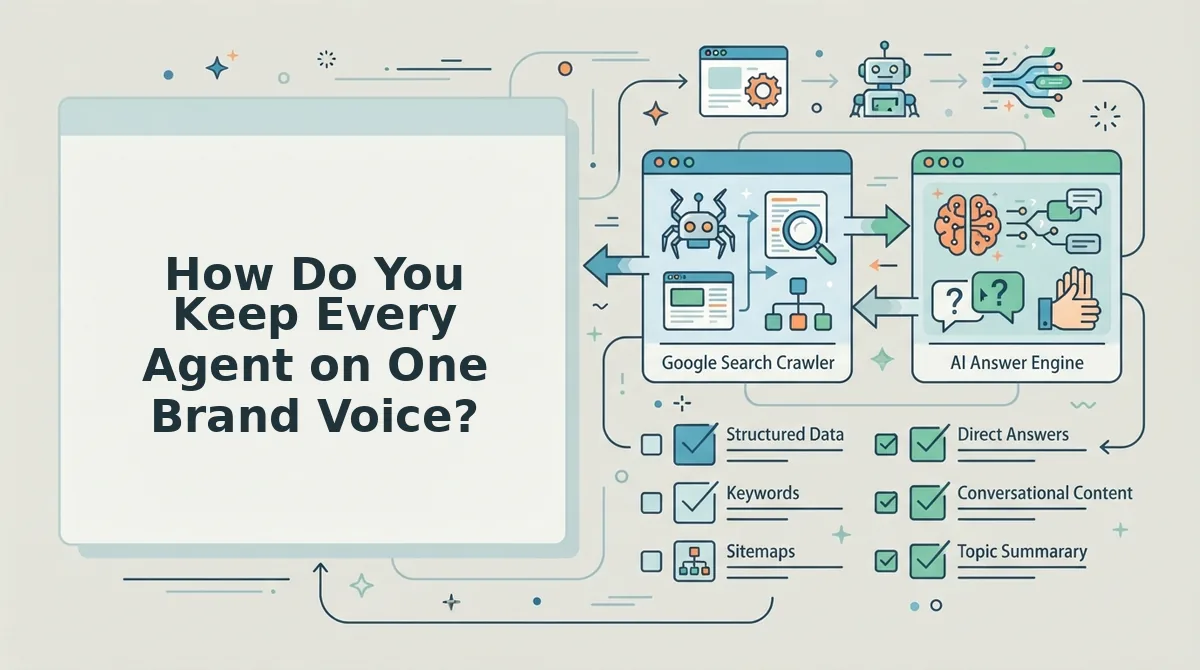
How Do You Keep Every Agent on One Brand Voice?
Voice drift is a context problem, not a prompt problem. Every agent reads the same Markdown brand files before it writes â sentence-length rules, banned jargon, first-person stance â so an edit in one file fixes every stage at once.
- Store the voice as Markdown files, not pasted prompt text. A site crawl can produce a style guide, a keyword file, and an internal-link map that any agent reads on demand. One readable source of truth beats a paragraph retyped into five prompts and forgotten in two of them.
- Load the files before the outline, not after the draft. Stance and structure lock in at the outline stage, so the outline agent needs the style guide first. If the voice file only arrives at drafting time, the writer inherits headings that already sound like someone else.
- Write down what skipping the file breaks. Ignore the style guide and sentence length creeps upward, the banned-jargon list gets violated by line three, and first-person stance flips mid-post. These are the defects readers feel first and diagnose last.
- Make the writer quote the rule back. Before drafting, the section writer restates the one voice rule it is applying in a single line. That puts the constraint in the visible output where a reviewer can check it, instead of buried in a system prompt nobody reads.
- Push the same files through publishing. Pair the voice files with your automated SEO content pipeline so formatting and metadata inherit identical rules. Otherwise the final mile quietly reintroduces the drift the agents just removed.
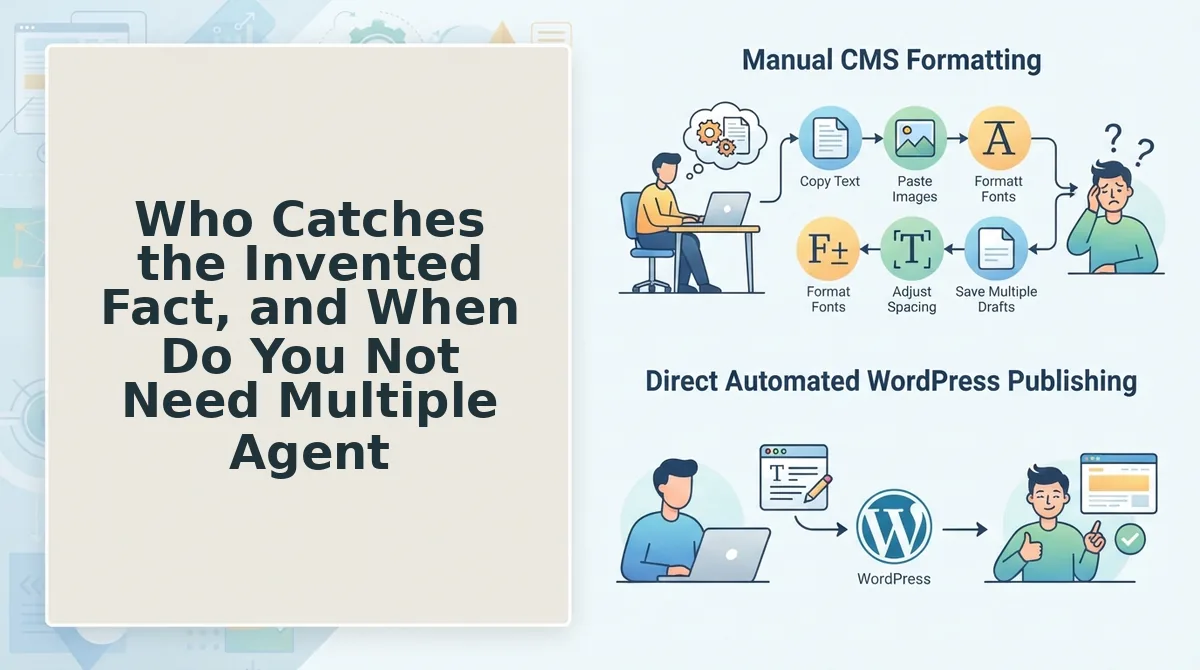
Who Catches the Invented Fact, and When Do You Not Need Multiple Agents?
A defect router is a table that assigns every failure type to exactly one agent stage, so a fix never bounces between roles. Structure failures return to the outline agent, voice drift to the section writer, unsupported claims to the reviewer, and formatting to the formatter.
| Failure type | Returns to |
|---|---|
| Missing or weak sections | Outline agent |
| Voice drift | Section writer |
| Unsupported claim | Reviewer |
| Broken formatting, bad markup | Formatter |
Think of it as a restaurant pass: a bland dish goes back to the cook, not the server. Routing a fact-check to the outline agent burns a full regeneration to fix a sentence.
The failure that slips through is the near-miss section â it satisfies every point of its brief, hits the word count, and still fails review because the voice drifted and one claim has no source behind it. No single agent sees both: the writer cannot audit its own sourcing, and a structure check will not notice tone. Give the reviewer both mandates and a pass criterion that names them.
Cost explains the routing. A linear pipeline reads each section once [est.], but every review-revise cycle re-sends it, so two cycles roughly triples input volume on the reviewed section.
That arithmetic sets the threshold. Below roughly 800 words, with no brand-voice risk and no claims to verify, one agent is enough; if your drafts live in that range, compare single-prompt blog post quality before adding roles.
| Situation | Agents needed |
|---|---|
| Under ~800 words, low voice risk, nothing to verify | Single writer |
| Longer, or brand voice and citations matter | Outline plus reviewer pair |
A second writer agent fixes nothing â leverage sits in outline and review, not drafting capacity. BloGoose runs that chain as one workflow: crawl, brand files, calendar, draft, review, publish.
Start With the Contracts, Not the Agent Count
The role split is the cheap part. Naming four agents takes an afternoon, but the pass criteria and the defect routing table are what decide whether the output is publishable. Write those two artifacts first, before you add a fifth agent.
Then run one real brief through the whole chain â outline, section, review, format â and watch where it stalls. The stall point is your bottleneck, and it is almost never drafting.
BloGoose executes that chain end to end: drop in your domain, and it crawls the site, extracts the brand files, and publishes to WordPress or your API. If you are weighing that final step, the publishing path comparison covers the tradeoffs in two minutes.
The team that wins the next content cycle will not be the one running the most agents â it will be the one whose agents agree on what "done" means.