
Surfer SEO Alternative for Teams That Hate Copy Paste

Your team has 12 tabs open: one for keyword research, one for the content editor, one for Google Docs, one for WordPress, one for the style guide, and seven more you've forgotten why you opened. Every article follows the same ritual, optimize, export, paste, format, re-check, and somehow the formatting still breaks. If that sounds familiar, you're not alone: optimization-only tools don't grow traffic by themselves, and the paste-and-pray loop is where most publishing teams quietly bleed hours.
You're right to be frustrated. A Surfer SEO alternative without copy paste isn't a luxury, it's the difference between shipping 4 articles a month and shipping 20. This guide walks through why Surfer's workflow creates a manual bottleneck, what an integrated engine actually replaces, and which alternatives remove the loop entirely. Along the way, you'll see a worked calculation that reveals something most Surfer SEO alternatives lists never mention: the real cost isn't the subscription, it's the tax you pay every time content moves between tools. BloGoose approaches this differently by crawling your site, learning your brand voice, and publishing finished drafts straight to WordPress or your API, no chat window with hopes, no 12-tab stack.
Why Surfer SEO Creates a Copy-Paste Bottleneck
Surfer SEO is a content optimization tool that scores your draft against top-ranking pages and suggests keywords, headings, and structure changes, but it stops at the suggestion. The actual writing, formatting, and publishing still happen somewhere else, which means every article passes through a manual handoff loop.
Think of Surfer like a personal trainer who writes your workout plan but never hands you the weights. You still have to find the gym, load the bar, and track your own reps. The plan is valuable, but the execution is entirely on you, and execution is where teams stall.
The workflow breaks into a predictable five-step loop: optimize the draft in Surfer's editor, export it as text or HTML, paste it into WordPress or Google Docs, format headings, images, and internal links by hand, then re-check the published page against Surfer's score to confirm nothing broke in transit. Every step introduces friction, and friction compounds.
This is the Copy-Paste Tax: the hidden cost of moving content between disconnected tools. The formula is simple, time per article × articles per month × error rate. If each handoff costs 25 minutes and formatting errors force a redo on 2 of every 10 articles, a 10-article month quietly consumes over 4 extra hours. That's half a workday spent on mechanics, not content.
At the advanced level, the bottleneck gets worse. Teams that publish at scale start building internal scripts, hiring virtual assistants for formatting, or accepting lower quality control just to keep the calendar moving. The optimization tool was never the problem, the missing pipeline was. An integrated engine that performs live SERP analysis during drafting and publishes directly to WordPress eliminates the handoff entirely, because the draft, the optimization, and the final formatted post are the same artifact.
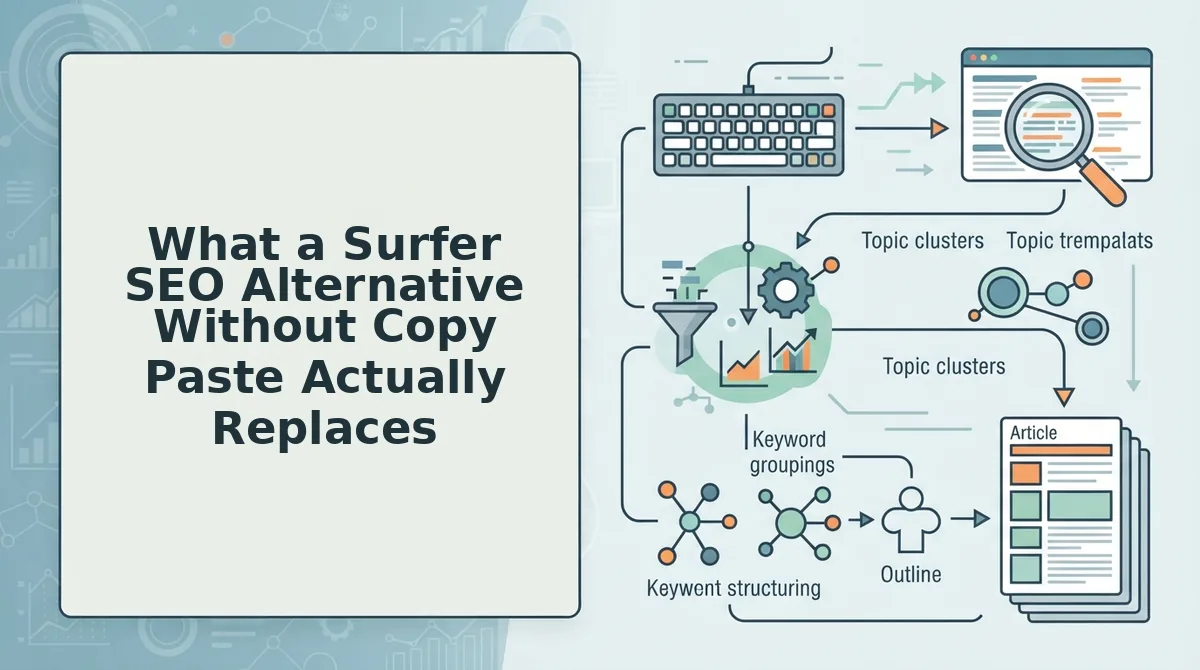
What a Surfer SEO Alternative Without Copy Paste Actually Replaces
A true Surfer SEO alternative without copy paste doesn't just swap one editor for another, it collapses the entire optimize-export-paste-format loop into a single drafting and publishing pipeline. Surfer remains a strong choice for teams that want granular, manual control over on-page scoring and already have a polished publishing workflow. But if the handoff is the bottleneck, the replacement needs to absorb those steps, not relocate them.
The table below maps Surfer's core capabilities to what an integrated content engine does with them:
| Surfer SEO Capability | What It Does | What an Integrated Engine Replaces It With |
|---|---|---|
| Content Editor | Scores your draft against top-ranking pages in a separate interface | Integrated drafting with brand voice rules applied automatically during generation |
| NLP Keyword Scoring | Flags missing terms and suggests additions you manually insert | Live SERP research baked into the draft before you ever see it |
| Export & Paste | Requires manual transfer to WordPress, Docs, or another CMS | Direct publishing to WordPress or a custom API, no export step exists |
| Formatting & Re-checking | Headings, images, and links must be rebuilt after paste | Finished, formatted articles ship as complete posts with images included |
Best for granular control: Surfer SEO suits a solo SEO specialist who wants to manually fine-tune every heading and keyword placement, and who already enjoys the editing process. Best for publishing teams: an autopilot SEO content platform fits content managers and agencies running multi-article calendars who need drafts to arrive formatted, optimized, and ready to publish without a formatting pass. Best for AI-visibility teams: an engine with AEO content optimization built in serves publishers targeting both Google rankings and AI chatbot citations, since answer-engine formatting is applied during drafting rather than retrofitted afterward.
The honest tradeoff is control versus throughput. Surfer gives you a microscope; an integrated engine gives you a conveyor belt. Neither is wrong, but if your team's bottleneck is the copy-paste loop itself, the conveyor belt is the only fix that scales. Here's what that looks like across five concrete alternatives.
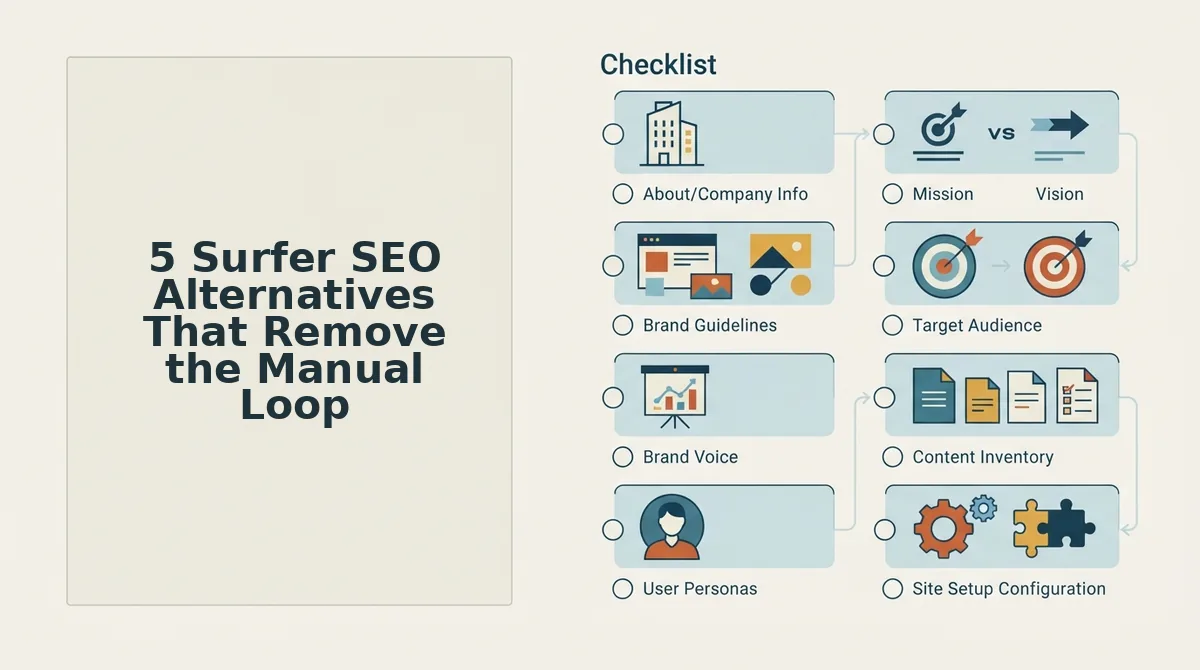
5 Surfer SEO Alternatives That Remove the Manual Loop
These five tools are evaluated by one question: does it eliminate the copy-paste loop between research, optimization, and publishing, or just move it to a different tab? Ranked by workflow automation, not feature count.
- BloGoose, research-to-publish automation with direct WordPress and API publishing. BloGoose crawls your site to extract brand voice and sitemap context, then drafts, optimizes, and publishes finished articles straight to your CMS without any export step. Use it when your team's bottleneck is the manual handoff between optimization and publishing, not the optimization itself. It is the only tool on this list built as an automated SEO content engine rather than an editor bolted onto a publishing workflow.
- SE Ranking Content Editor, affordable on-page optimization that still ends in manual export. SE Ranking scores your draft against live SERP competitors and gives actionable content briefs at a lower price point than Surfer. Use it when budget is the primary constraint and your team tolerates copying the optimized text into WordPress by hand. The copy-paste loop shrinks but does not disappear.
- Semrush One, a broad suite where content optimization is one module among many. Semrush One bundles keyword research, content scoring, and rank tracking into a single subscription, which suits teams already living inside the Semrush ecosystem. Use it when you need the full marketing stack and accept a heavier interface lift for the content workflow. Publishing still requires a separate CMS step.
- Frase, research briefs and optimization scoring with a manual CMS handoff. Frase aggregates top-ranking content into a research panel and scores your draft against competitor coverage, which speeds up the writing phase. Use it when your bottleneck is research rather than publishing. The final article still gets copied into WordPress or your CMS manually.
- NeuronWriter. NLP-driven content scoring that requires an export step. NeuronWriter analyzes competitor content for semantic terms and grades your draft on NLP coverage, which helps writers hit topical depth. Use it when your team has a dedicated editor who handles the export-and-paste step. The optimization loop closes, but the publishing loop stays open.
If your team's real cost is the hour spent pasting optimized text into WordPress, start with the tool that removes the loop entirely rather than the one that scores it best.
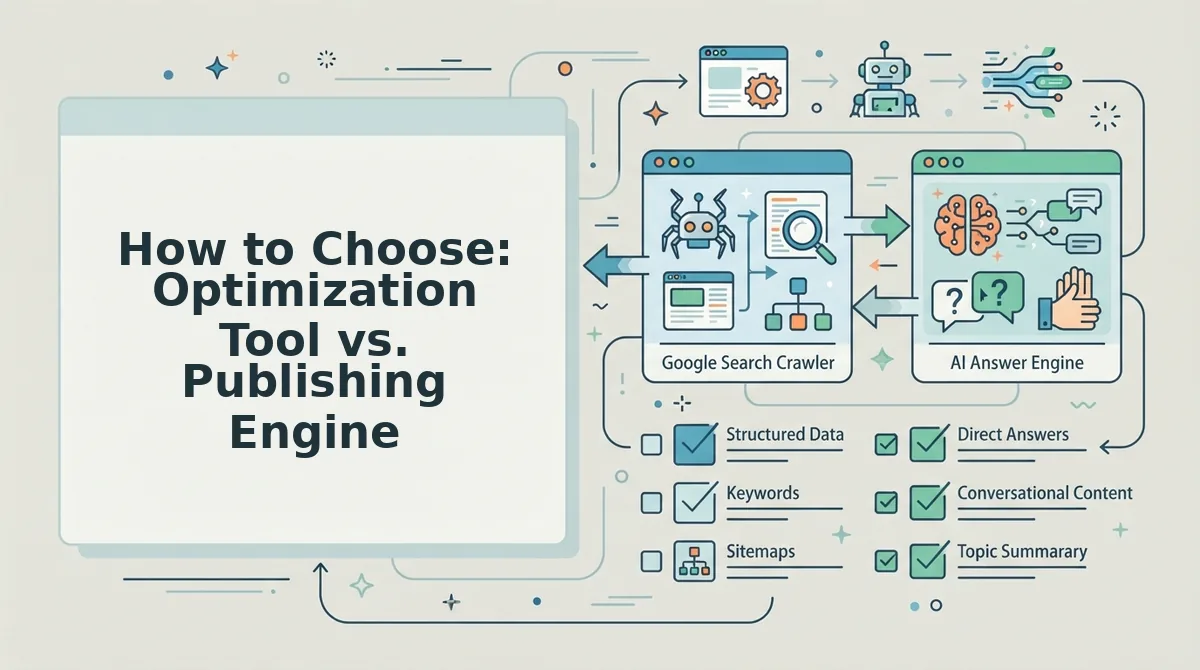
How to Choose: Optimization Tool vs. Publishing Engine
A Surfer SEO alternative either optimizes content or publishes it. The right choice depends on whether your copy-paste loop is costing you rankings through delayed publishing or just costing you time.
- Audit your last five published articles and time the gap between final draft and live URL. Open your CMS and check the publish timestamps against when the draft was approved. If the gap averages more than 24 hours, the copy-paste loop is delaying indexation and you need a publishing engine, not another optimizer.
- Count how many tools touch a single article from keyword to publish. List every tab, export, and login involved in your current workflow. If the count exceeds three, a tool like BloGoose that consolidates research, drafting, and publishing into one pipeline removes the coordination overhead.
- Check whether your CMS supports direct API publishing before committing to any tool. Open your WordPress dashboard, go to Settings, then locate the Application Passwords or REST API section. If your CMS exposes an API, an automated engine can publish directly; if not, any tool you choose will still end in manual paste.
- Evaluate whether the tool reads your site structure before writing. Look for sitemap context extraction in the tool's setup flow. A tool that crawls your sitemap and existing pages produces drafts that match your internal linking and topical clusters, which is the technical foundation of automated publishing.
- Run a one-week trial with one article and measure time-to-publish, not feature count. Pick a single post, run it through the candidate tool end to end, and record the minutes from keyword selection to live URL. Surfer still makes sense when your team has a dedicated publisher and optimization depth is the bottleneck; it stops making sense when the loop between export and publish is where articles stall.
Success looks like a published URL with optimized content and zero manual steps between the draft and the CMS. If you still see a copy-paste step at the end of your trial, you have not removed the loop.
FAQ: Surfer SEO Alternative Without Copy Paste
Direct answers to the questions teams actually ask when the copy-paste loop between Surfer SEO and WordPress becomes the bottleneck.
What is a Surfer SEO alternative for teams that hate copy paste?
A Surfer SEO alternative for teams that hate copy paste is a tool that drafts, optimizes, and publishes content directly to WordPress or a custom API without an export step. BloGoose is the primary example: it crawls your site, learns your brand voice, and ships finished articles to your CMS automatically.
Does Surfer SEO publish to WordPress?
No, Surfer SEO does not publish to WordPress. It stops at content scoring and export, which means every optimized draft still requires a manual copy-paste step into your CMS. That gap between export and publish is where publishing delays and ranking losses accumulate.
What is the fastest research-to-publish path for SEO content?
The fastest path is keyword research, live SERP analysis, automated draft generation, and direct publishing in one connected pipeline. Each manual handoff adds hours or days to time-to-index, so tools that combine these steps into a single automated flow beat multi-tool stacks on speed.
Is an AI content engine worth it for a small site?
Yes, if the site publishes regularly and the owner does the copy-paste work personally. The time saved per article compounds across a 30-day content calendar, and direct publishing removes the step most likely to cause publishing delays on small teams with no dedicated content ops role.
If the copy-paste loop is the bottleneck, the next step is removing it entirely.
Stop Pasting, Start Publishing
The subscription was never the real cost. The Copy-Paste Tax is the loop itself: export from Surfer, paste into WordPress, reformat, re-upload images, re-check scores, repeat. Every manual handoff adds minutes, and every minute adds up to a publishing cadence you can't sustain.
Here's the synthesis that ties this whole comparison together: optimization scores don't publish articles. Engines do. A tool that stops at a score leaves the hardest part, shipping, on your desk. A publishing engine treats the score as a checkpoint, not a destination.
Your next step depends on where the bottleneck lives:
- If you're still pasting: start with BloGoose and let the crawl-to-publish pipeline replace the loop entirely.
- If you're evaluating options: revisit the live SERP guide and comparison posts linked earlier, they map each tool's handoff count side by side.
- If you're already convinced: the fastest test is dropping your domain into the setup wizard and watching the first article ship without a single paste.
The teams that win in 2026 aren't the ones with the highest optimization scores. They're the ones whose content goes from idea to indexed without a human standing in the middle.
The Copy-Paste Tax is the only SEO expense that grows with every article you publish, and the only one you can eliminate with a single workflow change.