
Surfer SEO Workflow vs BloGoose Autopilot for Blog Teams

Your content team has 12 tabs open: one for keyword research, one for SERP analysis, one for the draft, one for the content score, one for internal linking, one for image generation, one for WordPress, and five more you forgot to close. That stack is the reason your publishing cadence keeps slipping. The Surfer SEO workflow vs BloGoose autopilot comparison isn't about which tool is better in a vacuum, it's about how many of those tabs you can close and still rank.
You're right to feel stuck. Surfer SEO scores your drafts brilliantly, but scoring is only one station on the assembly line. BloGoose was built to run the whole line: it crawls your site, extracts your brand voice, researches live SERPs, drafts the article, and publishes it to WordPress or your custom API without you touching a prompt.
Here's what you'll learn: a stage-by-stage breakdown of where Surfer's manual loop ends and where BloGoose's automation begins, what each tool actually does with your content after you hit publish, and which workflow fits a blog team that needs volume without losing voice. One stage in this comparison will surprise you, the publishing gap, and it's the reason most "SEO workflows" never actually close the loop.
What Is the Surfer SEO Workflow?
Surfer SEO is a content optimization tool that scores your writing against top-ranking pages in real time, but it does not research topics, draft articles, or publish them to your CMS. The workflow is a manual loop: research elsewhere, write in your editor, score in Surfer, revise, then publish through a separate platform.
Think of Surfer like a fitness tracker for your draft. It tells you how many steps you've taken, how your heart rate compares to the competition, and where you're lagging, but it doesn't cook your meals, drive you to the gym, or log your workout for you. You still do the work; Surfer just measures it.
The typical Surfer workflow breaks into three stages. First, you research keywords and competitors in a separate tool, then open a blank document. Second, you write while Surfer's content editor scores your draft against the top 20 ranking pages, flagging missing terms, word count gaps, and heading structure issues. Third, you export the finished text, manually upload it to WordPress or your CMS, and handle images, internal links, and metadata yourself.
Surfer Academy's own YouTube content confirms this scope: the tool's workflow centers on content scoring and MCP integration for real-time suggestions, not on drafting or publishing. ZAFFAI's video review reinforces the same point. Surfer's core value is live SEO feedback during writing, not end-to-end content production.
For a solo blogger, this loop is manageable. For a team publishing 20 articles a month, it means every piece passes through at least three tools and two manual handoffs before it goes live. The publishing gap, the space between a perfect content score and a live, indexed URL, is where Surfer's workflow quietly ends.
BloGoose closes that gap by treating publishing as part of the content engine, not an afterthought.
What Does BloGoose Autopilot Actually Automate?
BloGoose is an AI-powered SEO content engine that crawls your existing site, extracts your brand voice rules, researches live SERPs, drafts complete articles, generates images, and publishes directly to WordPress or a custom API, without manual handoffs between tools.
Think of BloGoose like a self-driving car versus Surfer's dashboard of gauges. Surfer tells you when you're drifting out of your lane; BloGoose steers, accelerates, brakes, and parks the car in your garage while you work on the next route.
The automation boundary starts where Surfer's workflow stops. First, BloGoose crawls your domain, locates your XML sitemap, and inspects your published pages to detect your technical setup and content patterns. Second, it extracts brand voice into eight Markdown files, tone, vocabulary, formatting preferences, and structural habits, so every draft sounds like you wrote it, not like a generic AI. Third, it runs live SERP analysis and social research to identify what's actually ranking and being shared right now, replacing the manual research step entirely.
Then the engine drafts the article with SEO and AEO optimization baked in, creates supporting images, and publishes the finished piece to WordPress or your custom API. The indexing step, the one Surfer leaves entirely to you, is handled as part of the same pipeline.
For a blog team, "autopilot" means the calendar plans itself, the drafts arrive voice-accurate, and the publishing loop closes without a spreadsheet coordinator. That's the boundary no competitor defines clearly: automation isn't just scoring or suggesting, it's shipping.
Now let's see how these two workflows stack up stage by stage.
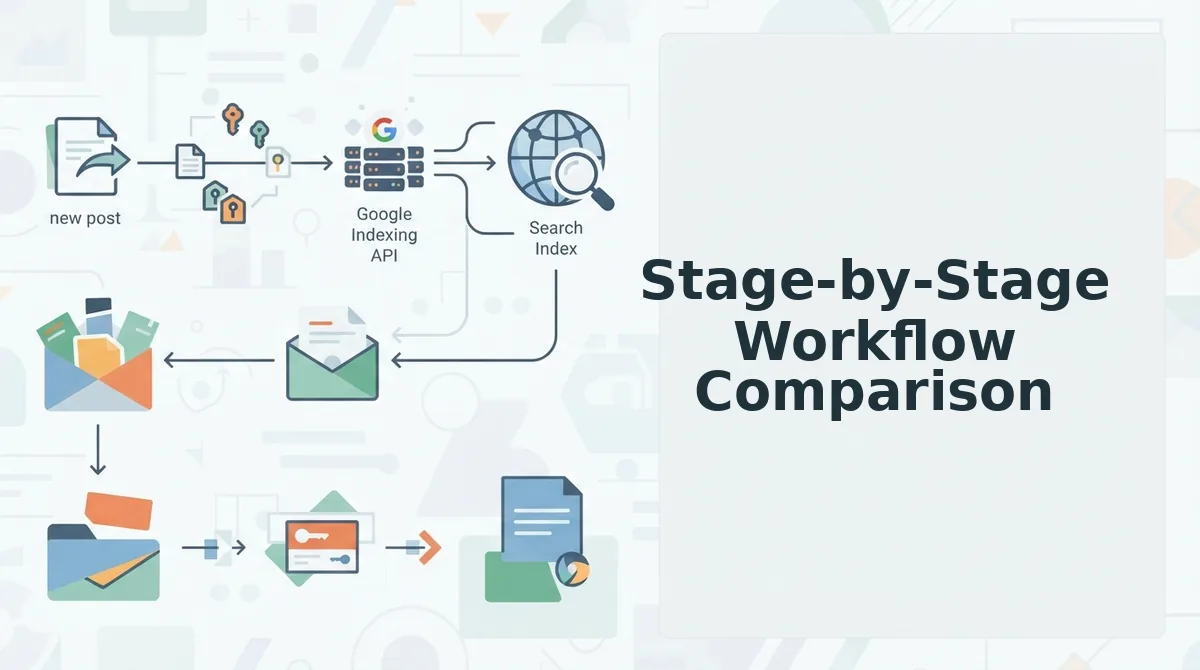
Stage-by-Stage Workflow Comparison
Surfer SEO automates the optimization layer of content production; BloGoose automates the entire pipeline from research to indexing. The practical difference shows up in how many browser tabs, manual steps, and human hours each stage demands from your team.
Surfer's workflow is genuinely strong for teams that already have writers and want tighter on-page optimization. Its content editor gives real-time scoring against top-ranking pages, and its brief generator saves hours of manual SERP analysis. Where it stops is everything before and after the editor: keyword clustering, drafting, image creation, CMS upload, and search console submission all happen in separate tools or by hand.
BloGoose collapses those stages into a single automated flow. The trade-off is less granular control over individual sentence-level optimization in exchange for removing the human from the loop entirely.
| Stage | Surfer SEO Workflow | BloGoose Autopilot |
|---|---|---|
| Research | Manual: keyword clustering in separate tool, SERP analysis in Surfer, competitor review by hand | Automated: crawls your site, extracts brand voice, builds keyword clusters from your sitemap |
| Outline | Semi-automated: Surfer generates briefs, but writer structures headings manually | Automated: pillar-focused calendar and article outlines generated from site structure |
| Draft | Manual: human writer or separate AI tool produces the draft outside Surfer | Automated: AI drafts full articles with brand voice rules applied |
| Optimize | Automated: Surfer's content editor scores against top-ranking pages in real time | Automated: SEO and AEO optimization baked into the drafting step itself |
| Publish | Manual: copy-paste into CMS, upload images separately, format by hand | Automated: ships directly to WordPress or custom API with images included |
| Index | Manual: submit URLs to Search Console, monitor indexing status yourself | Automated: search indexing handled as part of the publishing pipeline |
The "editor vs. autopilot" distinction matters because it changes who does the work. Surfer is an editor: it makes a human writer better. BloGoose is an autopilot: it removes the human from the loop for teams that don't have one to spare.
Best for a content manager with an in-house writing team: Surfer SEO, because you keep editorial control and your writers get a powerful optimization layer. Best for a solo founder or growth lead running content alongside everything else: BloGoose, because the automated SEO content pipeline replaces the five-tool stack you don't have time to manage.
The Stack Tax: What Surfer's Workflow Actually Costs
The Stack Tax is the hidden cost of running a manual content workflow across multiple disconnected tools, the hours spent moving work between platforms, not the subscription fees themselves. It's the toll you pay every time a draft leaves one tool and enters another.
Think of it like cooking in a kitchen where every ingredient lives in a different room. The groceries aren't expensive. The walking is what kills you.
A typical Surfer-based stack looks like this: Surfer for optimization, a separate AI writing tool for drafting, a manual CMS upload for publishing, an image tool for visuals, and a Search Console routine for indexing. That's five distinct handoffs per article. Each handoff costs 10-20 minutes of copy-paste, reformatting, and context-switching. Across a 20-article month, that's 15-30 hours of pure tool-to-tool friction, before anyone writes a single word of actual content.
The price tag isn't the subscription. It's the hours between tools.
This friction is why users increasingly evaluate Surfer against other AI SEO platforms. The manual workflow works fine at low volume, but it doesn't scale linearly, it scales with your tolerance for repetitive copy-paste. Teams that publish daily hit the wall fast.
If you're already feeling that friction, exploring Surfer SEO alternatives that collapse the stack into one pipeline is a reasonable next step. The question isn't whether Surfer optimizes well. It's whether optimization alone is worth the toll booth between every stage.

AEO: The Blind Spot in Manual Optimization
AEO (Answer Engine Optimization) is the practice of structuring content so AI chatbots and answer engines can extract and cite it directly, and it requires three things Surfer's workflow doesn't automate: question-based headings, quotable 80-120 word passages, and inline entity definitions.
Ranking on Google and getting cited in AI answers are now two different games. Surfer optimizes for the first: keyword density, content score, SERP alignment. None of those signals guarantee an AI assistant will pull your paragraph into a response.
Think of it like writing a textbook. Google is the librarian who files your book on the right shelf. An AI answer engine is the student who needs a clean, self-contained paragraph to quote in an essay. If your content doesn't have quotable passages, the student paraphrases someone else.
Here's what AEO actually requires: question headings that mirror how people ask things conversationally, self-contained passages of 80-120 words that answer one specific query without context, and entity definitions that tell AI systems exactly what a term means. A Surfer-optimized article can score 90+ on content score and still lack all three, because the content editor measures against ranking pages, not against answer-engine extraction patterns. That means a human still has to retrofit AEO elements manually after optimization.
BloGoose bakes AEO content optimization into the drafting step itself, so quotable passages and entity definitions exist from the first draft rather than being bolted on later. The gap isn't about which tool optimizes better, it's about which workflow treats AI citations as a first-class outcome instead of an afterthought.
That distinction is exactly what the next section weighs.
Decision Matrix: Which Tool for Your Team?
Run your team through these four questions in order. Each answer narrows the field until one tool is the obvious fit.
- Team size: solo operator or multi-role team? A solo operator managing strategy, writing, and publishing needs BloGoose's consolidated pipeline to avoid context-switching across five tools. A team with a dedicated SEO specialist and separate writers can absorb Surfer's manual workflow because the labor is already distributed.
- Publishing volume: under 4 or over 8 articles per month? Surfer's per-article optimization loop works at low volume where each piece justifies 3-4 hours of manual refinement. BloGoose's automated research-to-publish pipeline becomes the clear winner past roughly 8 articles monthly, where manual optimization hours compound into a full-time role.
- Technical comfort: do you enjoy prompt engineering and tool configuration? Teams that want granular control over every heading, keyword placement, and content score will find Surfer's hands-on interface satisfying. Teams that want to drop a domain and receive publish-ready drafts will find BloGoose's setup wizard removes the friction Surfer leaves in place.
- AI-citation goals: is getting quoted in ChatGPT or Google's AI Overviews a priority? If yes, BloGoose bakes AEO structure into every draft automatically. Surfer requires you to know AEO principles and apply them manually, which most teams skip entirely.
The verdict: Choose Surfer SEO when you have a dedicated SEO operator who wants sentence-level control and publishes fewer than 4 articles monthly. Choose BloGoose when you need a publishing pipeline that researches, drafts, optimizes, and ships content without prompt chaining or manual coordination.
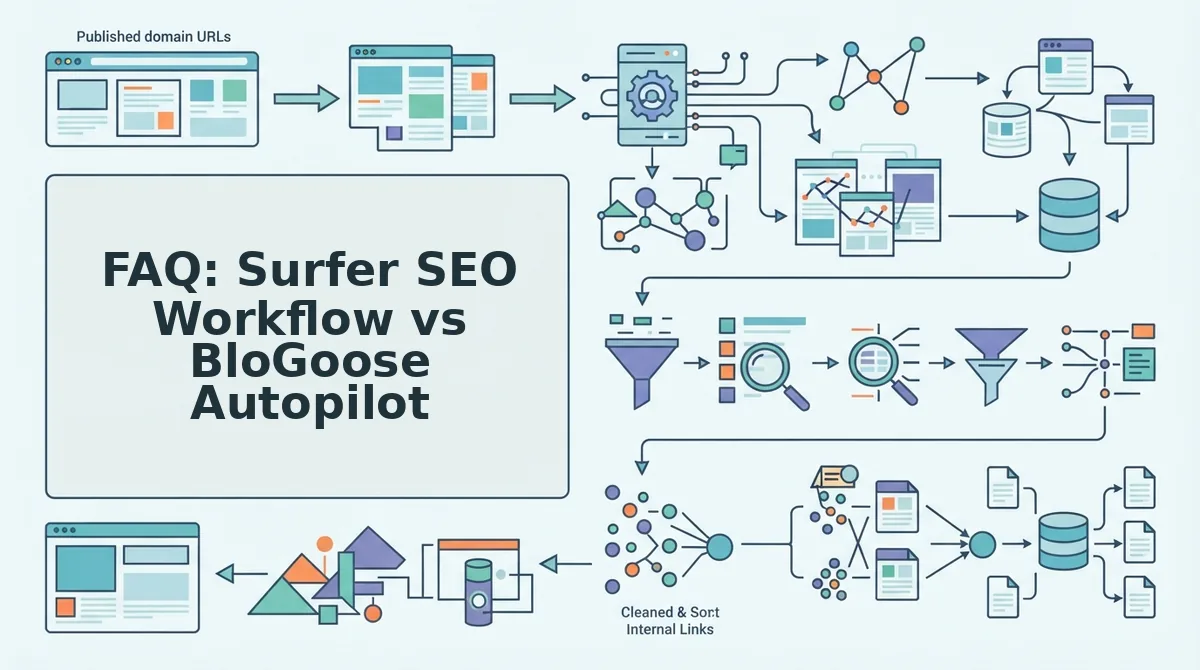
FAQ: Surfer SEO Workflow vs BloGoose Autopilot
Does Surfer SEO actually write and publish content?
No. Surfer SEO optimizes content you write manually by scoring it against top-ranking pages and suggesting keywords, headings, and structure. It does not draft articles or publish them to WordPress; you still need a separate writer and publishing step.
What does "autopilot" actually mean for a blog team?
Autopilot means BloGoose handles the full pipeline automatically: it crawls your site, extracts brand voice, builds a content calendar, drafts articles with SEO and AEO baked in, creates images, and publishes directly to WordPress or a custom API without manual handoffs.
Which tool is better for a solo operator vs. a content team?
A solo operator benefits more from BloGoose because it consolidates research, drafting, optimization, and publishing into one workflow. A content team with a dedicated SEO specialist may prefer Surfer's granular control, since the manual labor is already distributed across roles.
How does Surfer SEO workflow compare to BloGoose autopilot for blog teams?
Surfer SEO is an optimization layer that sits on top of your existing writing and publishing stack, requiring manual coordination across tools. BloGoose replaces that stack entirely by automating the full research-to-publish loop, which matters most for teams publishing at volume.
Can Surfer SEO help with AI citations and answer engine optimization?
Surfer SEO focuses on traditional Google rankings and does not automate AEO structure for AI answer engines. BloGoose bakes citation-optimized formatting into every draft, targeting both search rankings and AI chatbot quotes without extra manual steps.
The Bottom Line: Optimization Is Not a Pipeline
Surfer SEO sharpens content you already plan to write. BloGoose removes the need to plan, write, optimize, and publish as separate manual steps. That distinction explains why teams burn out on Surfer's workflow: the optimization is excellent, but the pipeline around it still runs on human labor.
If you want hands-on control of every sentence, Surfer remains a strong choice. If you want a publishing pipeline that runs without prompt chaining, spreadsheet calendars, or manual WordPress uploads, BloGoose is the answer.
Your next step: drop your domain into BloGoose's setup wizard and watch it extract your brand voice, build a 30-day calendar, and ship the first draft to WordPress automatically.