
How to Write Long Blog Posts Without Prompt Engineering
You've spent three hours crafting the perfect prompt, only to watch the AI produce 2,000 words of confident, generic filler that sounds nothing like your brand. Here's the contrarian truth: prompt engineering is a workaround, not a requirement. You can write long blog posts without prompt engineering by giving the AI something better than instructions, your actual site.
You're right to be frustrated. Competitors teach prompts as the only path, but that's because their tools lack context. BloGoose, an AI SEO content engine, takes the opposite approach: it crawls your site, extracts your brand voice, structure, and keywords automatically, then generates section by section, no prompt chains required.
In this guide, you'll learn the four-stage context-first workflow (crawl, extract, generate, publish), why prompt engineering fails for long-form content, and what actually replaces the prompt. Stick around for the surprising part: your sitemap does more heavy lifting than any prompt ever could.
Why Prompt Engineering Fails for Long-Form Content
Prompt engineering is the practice of manually crafting detailed instructions to coax useful output from an AI model. It fails for long-form content because the AI lacks your site's context, not because your prompts are weak.
Think of prompt engineering like giving a chef a single recipe card and expecting a full restaurant menu. The chef can cook one dish, but without knowing your kitchen, your suppliers, or your diners' tastes, every plate comes out generic. Long-form AI content has the same problem: the model doesn't know your site structure, niche, or voice before you prompt it.
The failure modes compound as content length grows:
- Context-window drift: A 2,000-word post generated in one prompt drifts generic in the middle sections because the model loses the thread of your opening instructions.
- Voice flattening: Without extracted brand rules, the AI defaults to a neutral corporate tone that sounds like every other AI-generated article.
- Prompt chains as a symptom: Tools that require multi-step prompt chains are compensating for a lack of built-in context, the AI keeps forgetting what you told it three prompts ago.
Here's the passage competitors skip: long-form AI content fails when the AI lacks context, not when prompts are weak. A model generating section by section from extracted site data, your sitemap, existing pages, and brand voice files, never drifts because each section inherits the same structural and tonal anchor. That's the difference between a chat window and an AI content engine vs chat window workflows.
The Context-First Workflow: Crawl, Extract, Generate, Publish
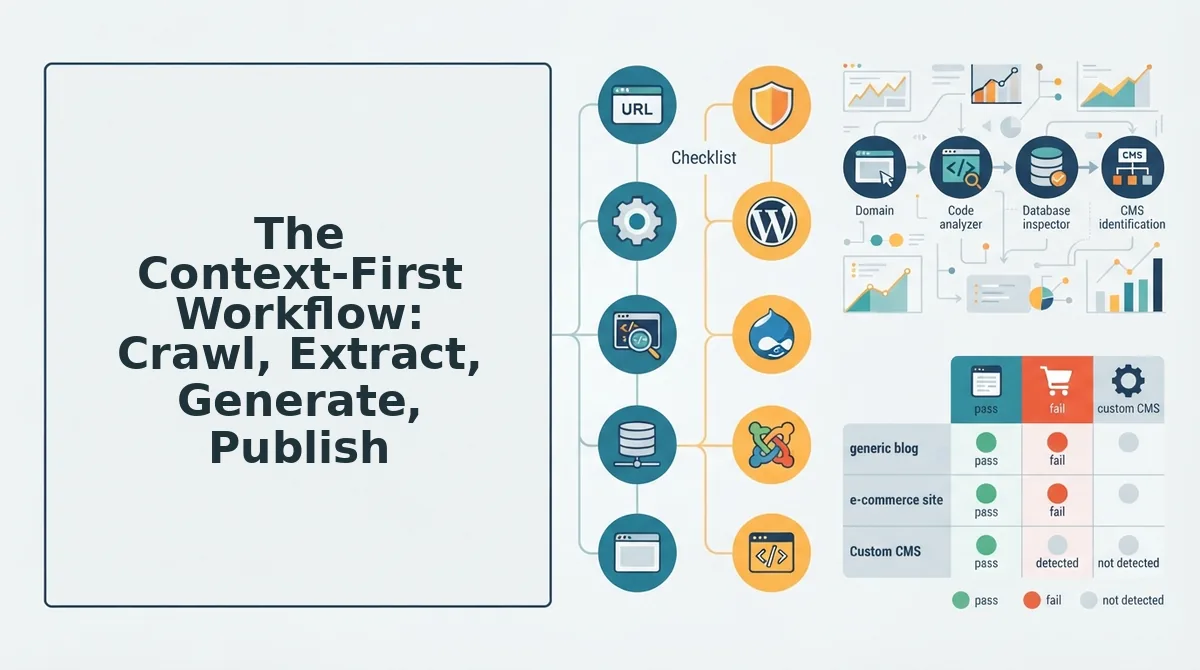
The context-first workflow replaces prompts with a four-stage system: crawl your site, extract brand context, generate section by section, then publish and index. Each stage feeds the next, so the AI always works from your real site data instead of your best guess at instructions.
Prerequisites: a live website with an XML sitemap, and access to a content engine like BloGoose that automates the crawl-to-publish pipeline.
- Crawl your site. Enter your domain into the setup wizard. The engine automatically detects your XML sitemap, identifies your CMS, and inspects published pages. You should see a crawl summary listing detected URLs and your platform (WordPress, Webflow, or custom). Time: 2-5 minutes.
- Extract brand context. The engine generates eight Markdown files covering brand voice, audience, topic clusters, and keyword priorities. Review these files once, they become the standing instructions the AI uses for every article. Time: 10-15 minutes.
- Generate section by section. Instead of one massive prompt, the engine drafts each article section sequentially, pulling from your extracted context. Sectional generation beats single-shot because the AI re-anchors to your brand files for every heading, preventing mid-article drift. Time: automated, 5-10 minutes per article.
- Publish and index. Send the finished article directly to WordPress or your custom API. The engine can also trigger the Google Indexing API so your post enters the search queue immediately. You should see a publish confirmation with a live URL. Time: under 1 minute.
This is the core difference from prompt-based workflows: your sitemap and existing content replace the prompt. Sitemap context extraction gives the AI a structural map of your site, so every generated section stays on-topic and on-voice without you writing a single instruction.
Next, let's look at what actually replaces the prompt: the brand context files themselves.
What Replaces the Prompt: Brand Context Files
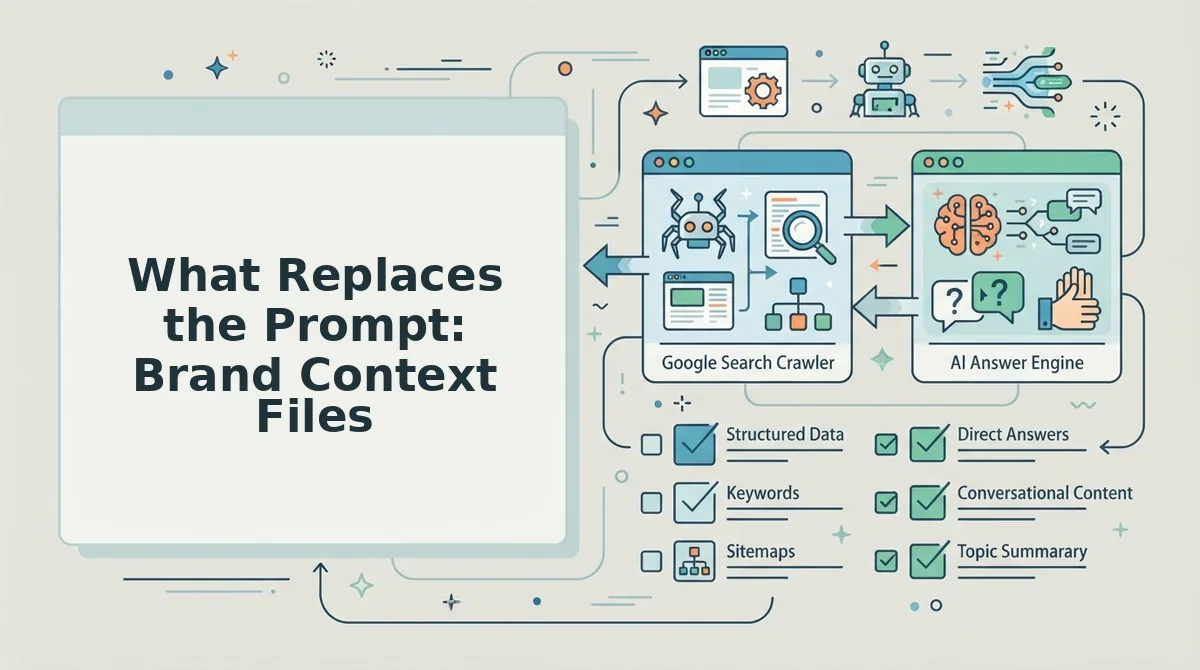
Brand context files replace ad-hoc prompts with structured Markdown documents that define how your content should sound, rank, and link. Each file encodes one dimension of your publishing playbook, so the AI never guesses.
- style-guide.md. Defines tone, voice, and formatting rules extracted from your existing site. It matters because voice consistency is what separates a branded article from generic AI filler. Use it to enforce sentence length, vocabulary boundaries, and formatting conventions across every generated section.
- target-keywords.md. Maps primary and secondary keywords to specific pages and search intents. It matters because keyword-to-page alignment prevents cannibalization and keeps each article focused on one rankable query. Use it to verify every H2 and body section targets the right intent before publishing.
- internal-links-map.md. Maps internal link opportunities discovered during the sitemap crawl. It matters because internal linking distributes authority and helps search engines discover related content. Use it to insert contextual links to pillar pages and supporting posts without manual research.
- seo-guidelines.md. Encodes meta tag conventions, title length limits, and search intent rules. It matters because on-page SEO consistency across dozens of posts compounds into measurable ranking gains. Use it to auto-generate title tags, meta descriptions, and schema markup that match your established patterns.
- content-calendar.md. Sequences topics by pillar cluster and publishing cadence. It matters because topical authority builds faster when related posts publish in a logical order. Use it to prioritize high-value clusters and avoid orphan content.
- audience-personas.md. Documents reader jobs-to-be-done, pain points, and reading level. It matters because content that speaks to a specific reader outperforms content written for "everyone." Use it to adjust examples, analogies, and CTAs per article.
- competitor-gaps.md. Records content gaps and angle opportunities identified during research. It matters because differentiation is the fastest path to ranking when competitors already cover the basics. Use it to choose angles that add genuinely new information.
These files are the foundation of markdown brand context files, a system where the AI reads your rules instead of guessing from a prompt. You can generate a markdown style guide automatically from any existing website in minutes.
When you drop your domain into a setup wizard, the system crawls your sitemap, inspects published pages, detects your CMS, and generates eight context files automatically. Each file captures a different dimension of your publishing strategy: voice, keywords, internal links, SEO rules, calendar, audience, competitors, and formatting. The AI reads these files before drafting any section, which means every article starts from your actual publishing playbook rather than a generic prompt. This is why articles generated with brand context files stay on-voice across 2,000 words while prompt-only generation drifts generic by the middle sections.
How Sectional Drafting Keeps a 2000-Word Post Coherent
Sectional drafting is a content generation method where an AI writes one section at a time, each informed by the same shared brand context files. It prevents the coherence collapse that happens when a single prompt tries to produce an entire long-form article in one pass.
Think of single-shot generation like dictating a 2,000-word essay to someone in one breath. The beginning is sharp because the instructions are fresh, but by the middle the speaker has forgotten the opening rules and starts improvising. Context window drift causes generic middle sections in single-shot generation, the AI's attention to early instructions degrades as output length grows.
Sectional drafting solves this by breaking the article into discrete units: introduction, explanation sections, list sections, how-to sections, and FAQ. Each section is generated separately, but every generation call reads the same brand context files. Sectional agents share the same brand context files, so each section stays on-voice even when the article spans 2,000 words or more.
Here's how it works in practice. A publisher drops their domain into the setup wizard. The wizard locates the sitemap, inspects pages, detects the CMS, and generates the eight context files. When drafting begins, the system assigns each section to a dedicated generation pass. Section 4 reads style-guide.md and target-keywords.md before writing. Section 5 reads the same files plus the outline. No section starts from a blank slate, and no section inherits drift from the previous one.
This approach matters because long-form articles fail in predictable ways. The intro promises a specific angle, the middle sections wander into generic advice, and the conclusion contradicts the opening. Sectional drafting with shared context eliminates that failure mode. Avoiding brand context extraction mistakes is the prerequisite, if your context files are wrong, every section inherits the error.
When you draft sectionally with a shared context layer, you get the coherence of a single author with the speed of parallel generation. That's the workflow BloGoose automates end to end.
From Draft to Published: The Step Competitors Skip
Most guides stop at the draft, but publishing and indexing are where content actually starts ranking. Here's the full workflow from finished draft to live, crawlable post.
Prerequisites: A BloGoose account with your domain connected, brand context files generated, and your CMS credentials ready.
- Review the final draft in the BloGoose editor. Check section headings, internal links, and keyword placement. You should see a green "Ready to Publish" indicator when all SEO checks pass.
- Click Publish and select WordPress or Custom API. BloGoose sends the article directly to your CMS with formatting, images, and metadata intact. No copy-paste, no manual upload.
- Verify the live post. Open the published URL and confirm the title, meta description, and internal links render correctly. You should see the article live within seconds.
- Trigger a Google Indexing API request. BloGoose submits the new URL to Google's Indexing API automatically. This expedites indexing post-publish, often cutting crawl wait time from days to hours.
- Monitor indexing status in the dashboard. Check the indexing report for a "Submitted" or "Indexed" status. You should see confirmation within 24-48 hours for most sites.
Automated publishing to WordPress or a custom API removes manual upload loops that waste hours per post. AI blog generator direct WordPress publishing means your draft becomes a live post without touching wp-admin. After publishing, ask Google to crawl new posts through the Indexing API so your content enters the ranking queue immediately.
If your current workflow stops at the draft, you're leaving the final two steps, publishing and indexing, to manual effort that compounds across every post. BloGoose closes that gap.
Now let's answer the most common questions about writing long blog posts without prompt engineering.
FAQ: Writing Long Blog Posts Without Prompt Engineering
Direct answers to the questions readers ask most about producing long-form content without hand-crafting prompts.
Do I need to learn prompt engineering to write long posts with AI?
No. Prompt engineering is a workaround for tools that lack context. A context-first workflow, where the AI receives your site crawl, brand voice rules, and content calendar before drafting, replaces prompt crafting with structured inputs, so the tool already knows what to write.
How do I keep AI content from sounding generic across a 2000-word post?
Feed the AI a brand context file extracted from your existing site: tone, vocabulary, formatting habits, and audience assumptions. Sectional drafting then applies those rules consistently. Without that context, the model defaults to neutral corporate prose that drifts by paragraph three.
What happens after the draft is written?
The draft moves through optimization and publishing. A context-first engine checks internal links, headings, and keyword placement, then pushes the finished article to your CMS or API. The step most competitors skip is automated delivery, writing is only half the workflow.
Can I use this workflow with any AI tool?
Yes, the crawl-extract-generate-publish sequence works with any capable model. The difference is manual effort: without an integrated engine, you copy-paste sitemap data, maintain brand docs by hand, and publish manually. An automated platform handles all four stages in one pass.
Why does my AI-generated long post lose coherence halfway through?
Because most tools generate the entire article in one shot, and the model's attention degrades past roughly 800 words. Sectional drafting, generating each H2 block separately against the same brand context, keeps every section aligned with the outline and the voice rules.
How do I get my long posts cited in AI answers?
Structure content for extraction: direct-answer sentences, clear headings, and standalone definitions under 55 words. Answer engines pull from pages that state facts immediately. Learn more about how to get cited in AI answers with citation-optimized formatting.
The Prompt Is Not the Product
Prompt engineering was never the skill, it was the symptom of tools that did not know your site. The context-first workflow removes the entire prompt layer: crawl your domain, extract brand rules, generate section by section, and publish automatically. That four-stage loop is what actually produces a coherent 2,000-word post.
BloGoose implements the full sequence as an AI SEO content engine, so the workflow is not a manual checklist but a single automated pass from sitemap to published article. The contrarian takeaway holds: you do not need better prompts. You need better context.
Next step: drop your domain into the setup wizard and let the crawl extract your brand voice before you write another word. The posts that rank and get cited in AI answers are built this way, not prompted into existence.