
A Workflow for Building a 30 Day Blog Plan From Live SERP Data
You've got 12 tabs open: one for keyword research, one for a SERP overlay tool, one for a spreadsheet that hasn't been updated in three weeks, and a chat window full of generic prompts that keep spitting out the same tired advice. Planning a month of content by gut feel, or by "check search volume" alone, is how publishing teams burn 40 hours a month and still miss the queries their audience actually asks.
You're right to be frustrated. Most advice stops at volume and difficulty scores, ignoring what the search results themselves are screaming at you. This guide will show you exactly how to build a 30 day blog plan from live SERP data, not from static keyword metrics, using a four-signal framework that reads intent, freshness, competition gaps, and AI answer boxes directly from the top 10 results.
Here's the roadmap: pull live SERP data for your topic cluster, score every topic with the 4-signal validation framework, then sequence 30 days of articles in an order that compounds topical authority. If you're already running a 30-day content calendar, you'll see exactly where live SERP signals replace guesswork. One signal in particular, freshness patterns, will change how you prioritize every single topic, and it's not what most publishers expect. BloGoose automates this entire research-to-calendar pipeline, but understanding the manual workflow first makes the automation infinitely more valuable.
What Live SERP Data Actually Tells You That Keyword Tools Don't
Live SERP data is the real-time composition of the top 10 search results for a query, including content types, publish dates, featured snippets, People Also Ask boxes, and ranking domains, captured at the moment you pull it. Unlike keyword tools that report historical volume and a static difficulty score, live SERP data shows you what Google currently rewards for that exact query.
Think of keyword volume as a census report from last year, while live SERP data is standing on the street corner watching who actually walks into the store today. The census tells you how many people live in the neighborhood. The street corner tells you what they're buying right now.
Here's what live SERP data reveals that a volume metric never will:
- Intent composition: Whether the top 10 is dominated by listicles, product pages, or forums reveals the intent you must match. If eight of ten results are comparison posts and you planned a how-to guide, you'll struggle to rank regardless of volume. You can find content gaps from niche SERPs by spotting where your planned format diverges from what actually ranks.
- Freshness patterns: When most top results were updated in the last 3 months, Google treats the query as freshness-sensitive. That signals how often you'll need to refresh to stay competitive, and which topics deserve a recurring slot in your calendar.
- AEO answer boxes: Featured snippets and People Also Ask boxes show which questions AI engines are likely to cite. If a query triggers a snippet, targeting that exact question format increases your odds of being quoted in AI answers. Identifying SERP feature gaps, queries where the snippet is weak or absent, surfaces low-competition opportunities.
Live SERP data is the difference between planning content for the search results you hope exist and planning for the search results that actually do. A keyword tool tells you a query gets 2,900 searches a month. The live SERP tells you those searchers click on a 2023 listicle with a broken table of contents, a forum thread with 14 replies, and a product page that hasn't been updated since launch, which means the query is winnable with a fresh, structured article that directly answers the questions in the People Also Ask box.
Step 1, Pull Live SERP Data for Your Topic Cluster
Start with one seed keyword that anchors your cluster, then capture the top 10 results, their content types, publish dates, and any answer boxes. You'll need a SERP analysis tool or manual search with an incognito window, plus a spreadsheet to log signals.
- Open an incognito browser window and search your seed keyword. Incognito strips personalization so you see the SERP most users see, not the one Google tailored to your history. You should see the top 10 organic results without localized or personalized reordering.
- Log the top 10 results in a spreadsheet with four columns: URL, content type (listicle, how-to, product page, forum, tool roundup), last updated date, and whether it triggers a featured snippet or People Also Ask box. Rank Math SEO's SERP analysis video demonstrates reading these signals directly from top-10 results, the content type and date columns matter more than the domain authority column.
- Check the freshness pattern by scanning the "last updated" dates across all 10 results. If seven or more were updated in the last 3 months, mark the query freshness-sensitive. If most are 18+ months old, you've found a stale SERP that a new article can disrupt.
- Capture answer boxes by noting which results occupy the featured snippet and what questions appear in People Also Ask. These are the exact queries AI engines are most likely to cite, and they become your H2 and H3 targets.
For example, pulling live SERP data for "SEO content automation" reveals a mix of tool roundups and how-to guides, with several outdated posts from 2024 still ranking, a clear opening for a fresh, structured article. If you want to systematize this before drafting, find content gaps before writing by logging the same signals across your entire cluster. BloGoose automates this crawl-and-log step for every keyword in your sitemap, but the manual version above works with nothing more than a browser and a spreadsheet. Once your spreadsheet is filled, you're ready to score every topic against the 4-signal validation framework.
Step 2, Score Every Topic with the 4-Signal Validation Framework
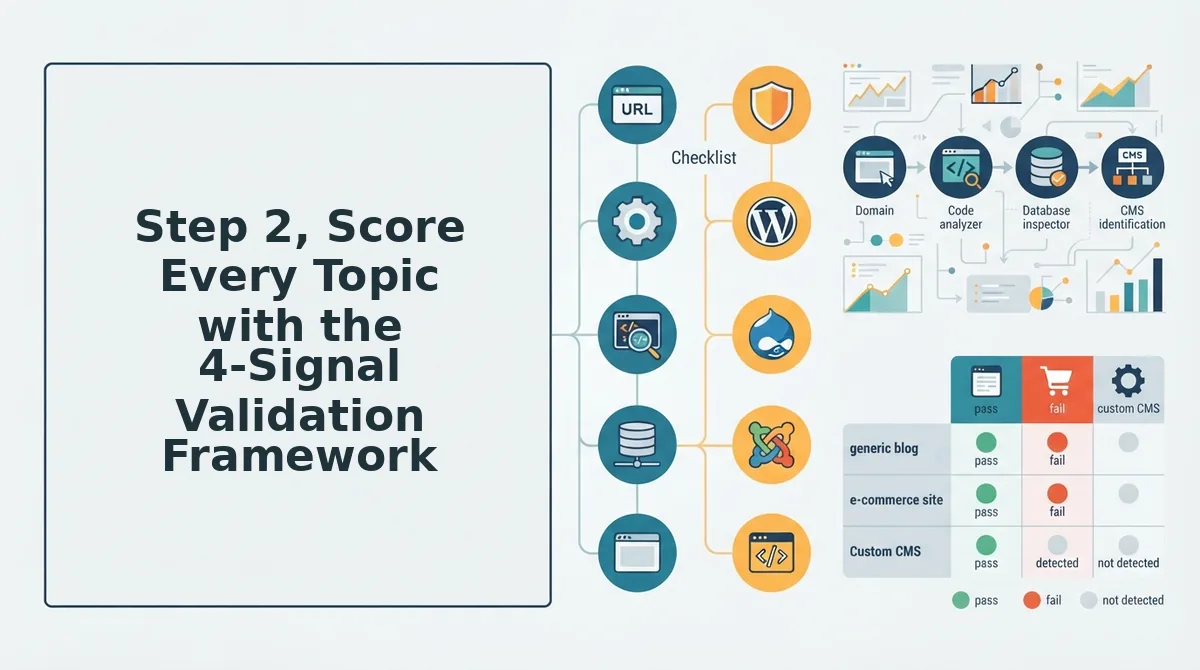
The 4-Signal Validation Framework scores each candidate topic on intent match, gap size, freshness vulnerability, and AEO quotability, write anything scoring 12 or higher, refine 8-11, and skip below 8.
Prerequisites: Your SERP export from Step 1, a spreadsheet (Google Sheets or Excel), and 30-45 minutes per cluster of 10-15 topics.
- Open your SERP export and create four new columns labeled Intent Match, Gap Size, Freshness Vulnerability, and AEO Quotability. You should see each topic row ready for scoring alongside the ranking URLs you pulled.
- Score Intent Match from 1-5 by comparing the top 5 results' dominant intent against the intent you plan to target. If all five results are transactional but you planned informational content, score 1; if the SERP is mixed informational and you can match it, score 4-5. You should see a clear number that tells you whether Google will accept your angle.
- Score Gap Size from 1-5 by counting how many top-10 results are thin, outdated, or off-intent. Open each ranking page and check word count, publish date, and whether it actually answers the query. Three or more weak results earns a 4-5; a fully optimized SERP earns a 1-2. You should see which topics have realistic entry points.
- Score Freshness Vulnerability from 1-5 by checking the average last-updated date of the top 5. If most results are 18+ months old, score 4-5; if everything was updated within 90 days, score 1-2. You should see which topics a fresh, current article can displace.
- Score AEO Quotability from 1-5 by asking whether the query has a single, extractable answer. Check if a featured snippet or People Also Ask box appears, and whether the answer fits in 40-60 words. A present snippet with a clear answer earns 4-5; no snippet and diffuse answers earn 1-2. You should see which topics can win AI citation placement, the same logic covered in our guide to blog topic research for AI citations.
- Sum the four columns and apply the decision matrix. Total 12-20: write now. Total 8-11: refine the angle or target a narrower long-tail variant. Total below 8: skip and reallocate the slot. You should see a ranked list of validated topics ready for sequencing.
Here is the scoring table and decision matrix in one view:
| Signal | Score 1-2 (Weak) | Score 3 (Moderate) | Score 4-5 (Strong) |
|---|---|---|---|
| Intent Match | SERP intent conflicts with your angle | Mixed intent, partial fit | Your angle matches dominant intent |
| Gap Size | Top 10 all thorough and current | 2-3 weak results | 3+ thin or outdated results |
| Freshness Vulnerability | All top 5 updated within 90 days | Mixed recency | Most results 18+ months old |
| AEO Quotability | No snippet, diffuse answer | Snippet present, answer long | Clear snippet with 40-60 word answer |
Decision matrix: Score 12-20 and you have writing capacity this week, publish. Score 12-20 but capacity is full, queue for next cycle. Score 8-11, refine the angle or target a narrower variant, then re-score. Score below 8, skip regardless of capacity; the SERP is not winnable right now.
Validation prevents the most common 30-day plan failure: filling a calendar with topics that look good in a keyword tool but have no realistic path to page one. A topic that scores 15 on this framework has already proven intent alignment, weak competition, stale incumbents, and AI-answer potential before you write a single word.
Step 3. Sequence the 30 Days for Topical Authority
Sequencing by cluster logic compounds topical authority, each published piece strengthens the cluster's relevance signals for every other piece, unlike random date-filling that scatters authority across unrelated queries.
- Days 1-3: Publish the pillar page. The pillar is your cluster's broadest, highest-volume topic and should link down to every supporting article you plan to publish. Writing it first establishes the semantic center that Google and AI answer engines use to understand your cluster's scope.
- Days 4-10: Publish 3-4 supporting articles. Supporting articles target mid-volume subtopics that scored 12+ in validation and link back to the pillar. Publishing them immediately after the pillar signals a coherent topic cluster rather than isolated posts.
- Days 11-20: Publish 5-7 long-tail articles. Long-tail pieces target lower-volume, lower-competition queries that convert faster because they capture specific intent. This block builds page count and internal link density while the pillar and supporting articles gain their first indexation signals.
- Days 21-25: Publish 3-4 AEO-targeted question articles. Question-format articles answer the People Also Ask and AI-citation queries your SERP pull surfaced in Step 1. These pieces are engineered for 40-60 word extractable answers and position your cluster for chatbot citations.
- Days 26-30: Reserve 2-3 buffer slots for refresh and re-validation. Buffer slots absorb SERP shifts, new competitor entries, or underperforming early pieces. Use them to refresh a weak article or re-validate a topic that scored 8-11 before committing a full draft.
If you are sequencing this manually, the calendar work alone can consume a full day. An AI SEO content engine automates the scoring, sequencing, and publishing loop so your 30-day plan executes without spreadsheet drift.
Step 4. Build in SERP Change Triggers
A 30-day plan without buffer slots is a plan that assumes Google will not move, and Google always moves. Reserve 2-3 slots per 30 days for re-validation so your calendar adapts instead of breaking.
Prerequisites: Your scored topic list from Step 2, a rank tracker or manual SERP check routine, and 15 minutes per week for trigger review.
- Open your rank tracker and set alerts for your top 10 target queries. Configure the tool to flag any new domain entering the top 3, any featured snippet appearing or disappearing, and any freshness date shift on a top-5 result. You should see an alert feed that tells you when a planned topic's competitive landscape changed.
- Review alerts weekly and mark any affected topic as "re-validate". If a new competitor entered the top 3 for a topic you planned for Day 18, open the SERP and re-run the 4-Signal score. You should see whether the topic still clears 12 or needs to be swapped for a buffer topic.
- Use a buffer slot to re-score, refresh, or replace. If the topic still scores 12+, publish as planned. If it dropped to 8-11, pivot the angle or target a narrower variant. If it fell below 8, replace it with a buffer topic and move on. You should see your calendar stay full of winnable topics instead of stale bets.
Buffer slots are also where content refresh work belongs, updating an existing article that lost position is often faster than writing a new one from scratch.
Once your triggers are set and buffer slots are reserved, you are ready to execute the plan and re-validate it weekly.
Step 5. Execute and Re-Validate Weekly
Execution without re-validation is how 30-day plans drift into irrelevance. A weekly 15-minute check against the 4-signal framework keeps your calendar aligned with what Google is actually rewarding right now.
Prerequisites: Your scored topic list from Step 2, access to your SERP tool of choice, and a published article from the current week.
- Open your SERP tool and re-pull the top 3 results for next week's scheduled topic. Compare their title tags, headings, and content depth against the snapshot you captured during initial scoring. You should see either confirmation that your angle still holds or a clear shift in intent that requires a 10-minute brief adjustment.
- Check the answer box and People Also Ask panel for each of your top 3 competitor URLs. Note whether any new question formats or answer structures have appeared since your last check. You should see a list of 2-3 fresh angle opportunities or confirmation that your existing outline already covers the current PAA set.
- Re-score the topic using the same 4-signal framework from Step 2. If the score dropped by more than one signal, flag the topic for a refresh or replacement before you invest writing time. You should see a clear go/no-go decision for every topic in the upcoming 7-day window.
- Log freshness shifts in your calendar document. Record any new publish dates, updated entities, or changed search intent for topics scheduled 8-30 days out. You should see a living calendar that reflects current SERP reality, not last month's assumptions.
Jeff Sauer's automation demo shows how recurring SEO reporting can be automated, which means this weekly re-check doesn't have to be manual forever. Tools like BloGoose fold re-validation into the automated SEO content pipeline, so the calendar self-corrects as SERPs shift.
FAQ: Live SERP Data and 30-Day Blog Planning
Live SERP data is the current, real-time snapshot of what ranks for a query, titles, answer boxes, PAA questions, and freshness signals, pulled directly from Google results rather than estimated from a keyword database.
How long does live SERP research take per topic?
Manual live SERP research takes 10-15 minutes per topic when you check the top 3 results, answer boxes, and PAA questions. With a tool that automates the pull, you can validate a full 30-topic cluster in under an hour. The time cost is front-loaded but prevents weeks of writing content that misses the actual ranking intent.
What's the difference between live SERP data and keyword tool data?
Keyword tools show historical estimates, search volume, difficulty scores, and suggested terms from cached databases. Live SERP data shows what Google is ranking right now, including answer boxes, featured snippets, and freshness patterns. Keyword tools tell you what people search; live SERPs tell you what Google rewards for that search.
Can I build a 30-day plan without a paid SERP tool?
Yes. You can manually search each target query in an incognito window, screenshot the top 10 results, and log answer boxes and PAA questions in a spreadsheet. It's slower, roughly 5-7 hours for a 30-topic cluster, but the data quality is identical. Paid tools simply automate the collection and tracking.
How do I know if a topic is worth refreshing instead of writing new?
Check whether your existing page still ranks in the top 10 and whether the SERP has shifted intent or freshness. If competitors have added newer data, expanded answer formats, or changed their angle in the last 90 days, refresh your page. If the SERP is stable and your page holds position, write new content instead.
Does live SERP data help with AI answer citations?
Yes. AI answer engines cite pages that directly answer the question in the format they extract, concise definitions, numbered steps, and structured comparisons. Live SERP data reveals which answer formats Google is already featuring, and AEO optimization applies those same patterns to win citations in AI responses.
Your 30-Day Plan Starts with One Cluster
Here's the payoff the intro teased: a 30-day plan built from live SERP data doesn't just rank better, it compounds. Each published article strengthens your topical authority for the next one, and each weekly re-validation keeps the whole cluster aligned with shifting intent. The plan isn't a static document; it's a feedback loop.
The difference between teams that sustain this and teams that abandon it after two weeks is automation. Manual SERP pulls, scoring spreadsheets, and calendar updates consume hours that most content teams don't have. BloGoose runs all five steps, crawling your sitemap, pulling live SERP data, scoring topics with the 4-signal framework, sequencing the calendar, and re-validating weekly, from a single workflow.
Your next step: pick one topic cluster from your sitemap and run it through the 4-signal framework this week. Score 10 topics, sequence the top 5, and publish the first one. See how the live SERP data changes your angle before you scale to 30 days. When you're ready to stop doing it manually, BloGoose turns that exact workflow into autopilot.