How to Turn SERP Feature Gaps Into Blog Articles

More than half of all Google searches now end without a single click. Your carefully optimized article can rank in position three and still get zero traffic because a featured snippet, People Also Ask box, or AI Overview already answered the query above you. If you've watched impressions climb while clicks flatline, you're not imagining it, you're losing to SERP features you never audited.
Most content teams stop at keyword research and never check which SERP features are present or missing for their target terms. That's the exact blind spot you can turn into a publishing advantage. This guide will show you how to turn SERP feature gaps into blog articles that win the click, the snippet, and the AI citation. You'll learn how to audit any SERP, classify four specific gap types, and build a content calendar around the opportunities competitors ignore.
Before you start, learn how to spot content gaps in SERP listings so your audit starts from a complete picture. One of the four gap types we'll cover is hiding in plain sight on nearly every results page, and it's the one almost nobody writes for. BloGoose automates this entire detection workflow, but the method below works manually too.
What Is a SERP Feature Gap?
A SERP feature gap is any mismatch between the search feature Google displays for a query and the quality, format, or freshness of the content behind it. When Google shows a featured snippet, People Also Ask box, video carousel, or AI Overview for a keyword, it's signaling exactly what searchers want, and a gap exists whenever your page (or any page) fails to match that signal.
Think of a SERP feature like a restaurant menu with a highlighted "Chef's Special." The highlighted dish is what most diners order. If your kitchen only serves side dishes, you're technically in the restaurant business but missing the order everyone's placing. A SERP feature gap is the difference between what's on the highlighted menu and what your content actually serves.
There are four distinct gap types, and naming them changes how you fix them:
- Missing feature gap: Google shows a feature (like a video carousel or local pack) but no page on your site targets that format or intent.
- Thin feature gap: A page ranks for the query but lacks the depth, structure, or schema markup needed to earn the feature.
- Outdated feature gap: The ranking content is stale. Google favors fresh answers, and your page hasn't been updated. Learn how to detect outdated content in SERP results before it costs you the snippet.
- Misaligned feature gap: The feature targets a different intent than your page serves, you wrote a product page, but Google wants a how-to guide.
For AI answer engines, a SERP feature gap also means your content isn't structured to be extracted as a standalone answer. When Google's AI Overview or ChatGPT cites a source, it pulls from pages that directly answer the query in 40-60 words with clear entity definitions. If your article buries the answer in paragraph three, you have a misaligned gap even if you rank. BloGoose detects these gaps by crawling your sitemap, checking which features appear for your target keywords, and classifying each mismatch so you know exactly what to write next.
Step 1: Audit Your Target SERPs for Feature Presence
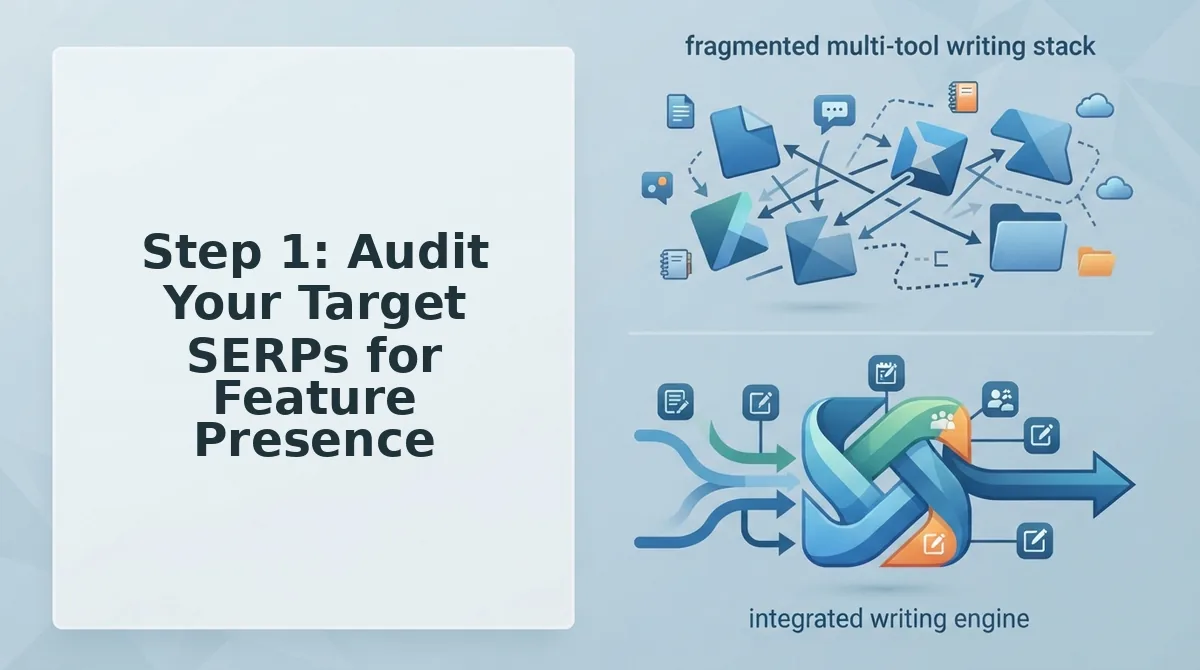
Before you can write articles that fill gaps, you need a complete inventory of which SERP features appear for your target keywords, and which ones your content currently misses. You'll need a keyword list, a browser with an incognito window (to avoid personalized results), and either a spreadsheet or an automated tool like BloGoose that crawls your sitemap and runs live SERP research.
- Open an incognito browser window and search your first target keyword. Record every feature that appears above the organic results: featured snippet, People Also Ask, video carousel, image pack, local pack, AI Overview, knowledge panel, or shopping results. You should see a complete feature map for that query, unaffected by your search history.
- Click through to the page currently winning each feature. Note its format (list, table, paragraph, video), its word count, its publish date, and its URL structure. This shows you the exact bar Google has set for earning that feature.
- Check whether any page on your site already targets that keyword. If yes, record which features your page does and doesn't appear in. If no, mark it as a missing feature gap immediately.
- Repeat for every keyword in your list and log results in a spreadsheet with columns for keyword, features present, winning URL, winning format, freshness, and your current status. Expect 10-15 minutes per keyword manually.
- Alternatively, automate the audit. BloGoose crawls your XML sitemap, detects which SERP features exist for your target terms, and classifies each gap using live search data, turning a multi-hour manual audit into a generated gap list. For a deeper walkthrough, see how to build a content gap list from live search results.
Once every keyword has a feature map and a gap status, you're ready to prioritize. The next step is classifying each gap so you know whether to write new content, rewrite existing pages, or update stale ones.
Step 2: Classify Each Gap with the Feature Gap Matrix
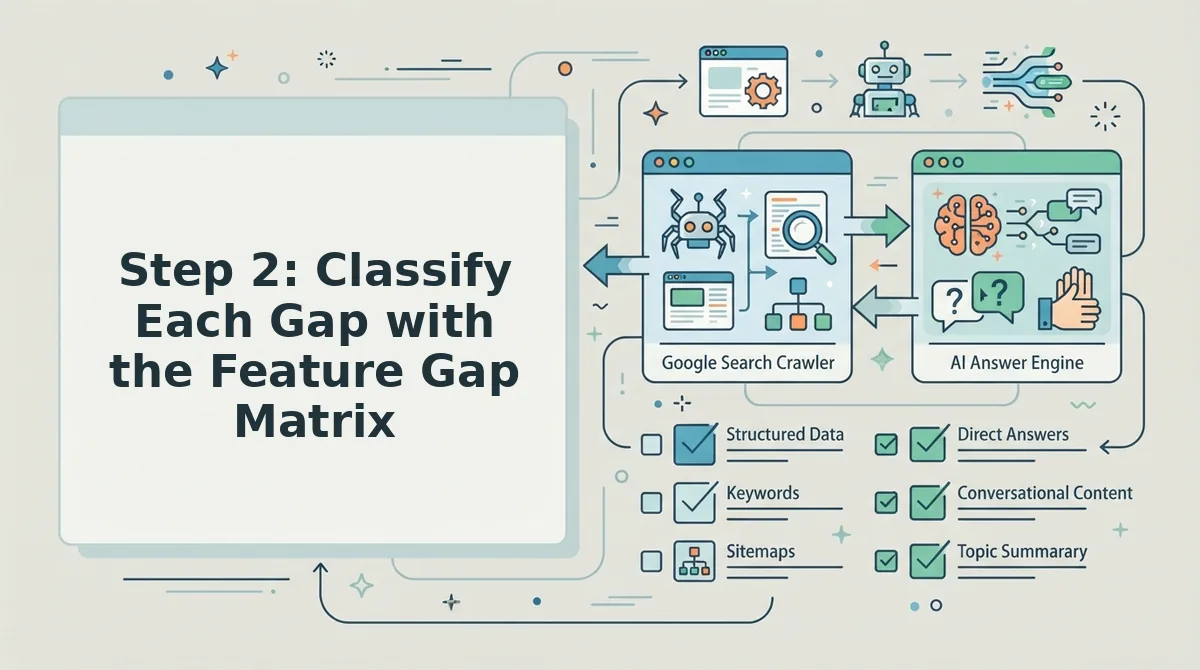
The Feature Gap Matrix is a 2x2 decision framework that maps SERP feature presence against your existing content quality to produce one of four clear actions: expand, defend, create, or format-switch.
Think of the matrix like a triage nurse in an emergency room. You don't treat every patient the same way, you assess severity first, then assign the right treatment. Similarly, not every SERP gap deserves the same response. Some gaps need a quick patch, others need a full rewrite, and a few need an entirely new asset.
To use the matrix, plot each keyword from your audit on two axes. The vertical axis asks: is the SERP feature present or absent? The horizontal axis asks: is your existing content for that keyword thin or strong? The intersection lands you in one of four quadrants.
Quadrant 1: Feature present + content thin = expand. The feature already exists on the SERP, which means Google has decided this query deserves rich treatment. Your job is to earn it. Expand the existing article with the missing depth: add the direct-answer paragraph, the data table, or the step-by-step instructions the feature demands.
Quadrant 2: Feature present + content strong = defend or differentiate. You already rank and hold the feature. Don't get complacent. Refresh the article quarterly, update stale statistics, and monitor whether competitors are closing the gap. If a competitor's content is structurally better formatted for the feature, differentiate by adding original data or a unique angle they cannot replicate.
Quadrant 3: Feature absent + content thin = create. No feature exists and your content is weak. This is a greenfield opportunity. Build a new article from scratch, engineered specifically for the feature type you want to trigger. Before committing, validate SERP content gaps with social research to confirm the topic resonates beyond search volume alone.
Quadrant 4: Feature absent + content strong = format-switch. Your content is solid but the feature still doesn't appear. The problem is likely format, not substance. A 2,000-word essay will never win an image pack. Convert the content into a visual listicle, a video tutorial, or an FAQ-structured page to match the missing feature's preferred format.
One self-contained passage worth bookmarking: The Feature Gap Matrix works because it separates the two failure modes most content teams conflate. A thin article competing for a present feature needs expansion, not a new page. A strong article failing to trigger an absent feature needs reformatting, not more words. By diagnosing the quadrant before acting, you avoid wasting production cycles on content that was never structurally capable of winning the feature in the first place.
Step 3: Match Each Gap to an Article Format
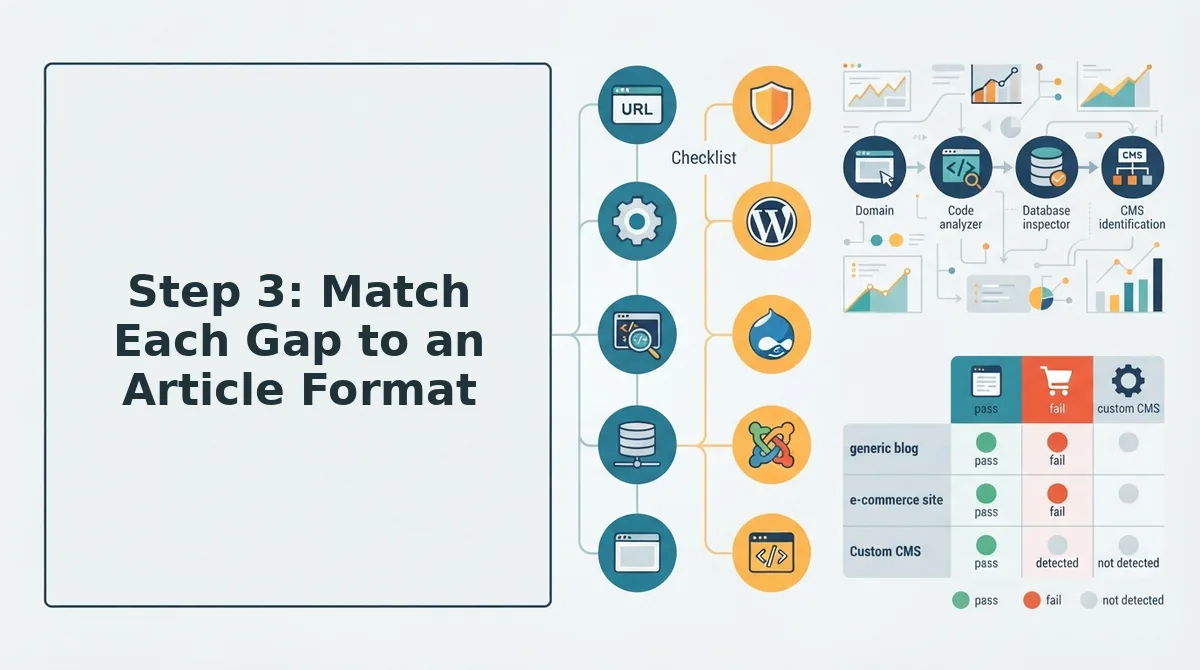
Each SERP feature has a preferred content format, and matching your article structure to that format is the fastest path to winning the feature. Competitors often produce excellent content in the wrong shape, which is why balanced format selection matters more than raw word count.
BloGoose handles this mapping automatically when it builds content calendars, but manual teams can apply the same logic. The table below bridges the four most common feature gaps to the article formats that trigger them.
| SERP Feature Gap | Recommended Article Format | Why It Works | Best For |
|---|---|---|---|
| Featured snippet | Paragraph-led how-to with direct answer in first 80 words | Google pulls snippet text from the opening paragraph | SEO leads targeting high-volume informational queries |
| People Also Ask (PAA) | FAQ-structured guide with question H2s | Each H2 mirrors a PAA question, making extraction trivial | Content managers building topical authority hubs |
| Video carousel | Tutorial with embedded video | Google prioritizes pages with on-page video for carousel placement | DTC brands demonstrating product usage |
| Image pack | Visual listicle with original images | Image packs reward unique, crawlable visual assets | Publishers in visual niches like food, travel, or DIY |
Competitor strengths deserve honest acknowledgment. Many established publishers already produce strong written content, their gap is rarely expertise, it's format mismatch. A competitor with a 3,000-word definitive guide may simply lack the embedded video or original photography required for richer features.
When building any format, use inline images in SEO content to reinforce visual feature eligibility. The format you choose determines which features become winnable, not just which keywords you target.
Step 4: Write for the Feature, Not Just the Keyword
Keyword-optimized content earns rankings; feature-optimized content earns the click. Writing for the feature means structuring your article so Google can extract it cleanly, and so AI answer engines can cite it accurately.
Prerequisites: Your Feature Gap Matrix classification from Step 2 and your format match from Step 3. No additional tools required beyond your CMS or content editor.
- Open your article draft and locate the H2 that targets the gap. Place a 40-60 word direct answer immediately after the heading, before any context or preamble. You should see a self-contained paragraph that could stand alone as a snippet.
- Write one self-contained 80-120 word passage per question. Each passage must answer exactly one query without referencing other sections. You should be able to copy any passage into a PAA box and have it read as complete.
- Select the schema type that matches your feature target. In your CMS, navigate to the schema or structured data settings. Choose Article schema for snippet targets or FAQ schema for PAA targets. You should see valid structured data in Google's Rich Results Test.
- Align the same passages for AI answer engines. AI assistants cite content that mirrors their answer format: concise, declarative, and self-contained. Review each passage against AEO optimization principles. You should see your passages structured for both Google extraction and AI citation.
BloGoose applies these formatting rules automatically during drafting, so every article ships with answer-box formatting, passage indexing, and schema alignment baked in, no manual checklist required. Next, the most common questions about SERP feature gaps, answered directly.
Frequently Asked Questions About SERP Feature Gaps
These answers address the questions readers ask most often about finding and exploiting SERP feature gaps, drawn from real search queries and community discussions.
How do I find SERP feature gaps without expensive tools?
Run manual searches for your target keywords in an incognito window and log which SERP features appear, featured snippets, People Also Ask boxes, video carousels, local packs, and image results. Compare your page's presence in each feature against competitors. Free tools like Google Search Console show which queries trigger your pages and which features you already win, leaving the gaps visible by subtraction.
What's the difference between a content gap and a SERP feature gap?
A content gap is a topic or keyword your site doesn't cover at all. A SERP feature gap is a keyword you already rank for, or could rank for, where Google displays a feature (snippet, PAA, video, image pack) that your page doesn't occupy. You have content but no feature presence, which means you're losing clicks even when you rank.
Can I target multiple SERP features with one article?
Yes, but prioritize one primary feature per article. A single page can win a featured snippet, appear in PAA, and rank in image results simultaneously if you structure for snippet extraction, answer related questions in H2s, and include original images with descriptive alt text. Attempting to optimize for every feature equally dilutes focus and reduces your chance of winning any.
How often should I re-audit SERP features?
Re-audit quarterly for stable niches and monthly for fast-moving industries like SaaS, e-commerce, or news-adjacent topics. Google updates SERP layouts frequently, and competitors actively target the same features. A quarterly cadence catches shifts before traffic loss compounds, while monthly checks let you respond to new PAA questions or featured snippet changes within days.
Why does my page rank on page one but get no clicks?
Because a SERP feature above your organic listing is absorbing the clicks. Featured snippets, People Also Ask expansions, and video carousels push organic results below the fold and answer the query without requiring a click.
Do SERP feature gaps matter for AI search engines like ChatGPT and Perplexity?
Yes, because AI answer engines pull heavily from pages that already win featured snippets, PAA entries, and structured content. When your page occupies a SERP feature, it signals to AI crawlers that your content is the authoritative extractable answer. Pages without feature presence are far less likely to be cited in AI-generated responses, making feature gaps a direct AI visibility problem.
Start Turning SERP Feature Gaps into Ranking Assets This Week
The gap you're ignoring is the article your competitor will publish next month. Every SERP feature you don't occupy represents a click, a citation, and an AI answer that currently belongs to someone else, and the window to claim it narrows with each algorithm update.
The four-step audit you've learned, identify, classify, format-match, and publish, turns abstract SERP analysis into a repeatable publishing system. Start by pulling your top 20 keywords from Search Console and logging which features appear for each. Then classify one gap using the Feature Gap Matrix and write a single article targeting that feature. One article is enough to prove the return.
When manual auditing becomes the bottleneck, the BloGoose AI SEO content engine automates the loop: it crawls your site, detects feature gaps across your keyword set, and publishes feature-optimized articles directly to WordPress. The SERP is already telling you what to write, the only question is whether you'll be the one who writes it first.