
How to Find Content Gaps in Local SERP Results

Your competitor ranks in the local map pack with a 200-word service page while your 2,000-word pillar post sits on page two, and you're wondering what you did wrong. The answer isn't more content; it's the right content for the right layer of the local SERP. If you've been trying to find content gaps in local SERP results using the same keyword tools you'd use for a national blog, you've been fighting a three-front war with one weapon.
You're not imagining the mismatch. Local SERPs have three layers, national organic, the local pack, and hyperlocal long-tail, and each one rewards a different kind of content. This guide gives you a repeatable framework for mapping those layers, identifying which gaps actually move rankings, and closing them without burning your publishing calendar. Along the way, you'll see why thin local pages sometimes outrank exhaustive guides, and how to turn that quirk into an advantage. If you've already run a live SERP gap analysis, you know the raw data is only half the battle; the framework below turns it into a publishing plan. BloGoose's site-crawl and brand-voice extraction can automate the mapping step once you've locked in your target queries.
Why Local SERP Gap Analysis Is Different from Generic Gap Analysis
Local SERP gap analysis is the process of identifying which content opportunities exist within each of the three layers of a location-specific search results page, national organic, the local pack, and hyperlocal long-tail, rather than treating the SERP as one uniform ranking surface. Generic gap analysis assumes every result competes on the same content signals; local gap analysis recognizes that proximity, Google Business Profile (GBP) strength, and query geography change which gaps are winnable.
Think of a local SERP like a three-story building. The ground floor is the local pack, the map with three business listings. The middle floor is national organic results, where big directories and brand sites live. The top floor is hyperlocal long-tail queries, like "emergency plumber open now in Fishtown," where intent is narrow and competition is thin. Most gap analysis tools only measure the middle floor.
Here's the consequence: a local business can rank #1 in the map pack with a 200-word service page because proximity and GBP strength outweigh content depth at that layer. Meanwhile, a competitor with a 3,000-word guide may dominate the organic layer but never appear in the pack. If you treat both as "ranking pages" and copy the long-form approach, you'll invest in content that can't win the layer you're targeting.
This is the 3-Layer Local SERP Model: national organic results reward topical depth and backlinks; the local pack rewards proximity, category accuracy, and review velocity; hyperlocal long-tail rewards specificity and speed. A gap only counts if it exists in the layer you can actually compete in. For a deeper walkthrough of how to identify which listings are missing from each layer, see our guide on how to spot content gaps in SERP listings.
Step 1: Map Your Local SERP Landscape
Before you can find gaps, you need a snapshot of what currently ranks for each target query, and which layer dominates. You'll need a browser in incognito mode, a spreadsheet, and ideally a SERP analysis tool like InfraNodus AI for topic clustering.
- Open an incognito browser window and search your top 10 target queries one at a time, appending your city or neighborhood to each (for example, "emergency plumber Fishtown" rather than "emergency plumber"). Incognito strips your location history so you see a cleaner local SERP. You should see a mix of map pack results, organic listings, and possibly "People also ask" boxes.
- Record the SERP composition for each query in a spreadsheet with columns for query, map pack presence (yes/no), number of organic results, and whether any hyperlocal pages (neighborhood-specific landing pages, local news, community forums) appear. This takes roughly 10 minutes per query.
- Classify which layer dominates each query using this decision list: if a map pack appears, the local pack layer dominates; if only organic results appear with no map, the national layer dominates; if neighborhood-specific pages or forums appear in the top five, the hyperlocal long-tail layer is active. You should end up with each query tagged to one primary layer.
- Run a topic cluster analysis on the top-ranking pages for your highest-value queries using InfraNodus AI's topic cluster approach. This shows which subtopics dominate the local SERP, and which are absent. You should see clusters for service types, pricing, emergency scenarios, and location modifiers; missing clusters are your first gap signals.
With your landscape mapped and each query tagged to a layer, you're ready to compare your content against competitors at the keyword level, which is exactly what Step 2 covers.

Step 2: Run a Geo-Modified Keyword Gap Analysis
Geo-modified keyword gap analysis adapts standard competitive keyword tools to local intent by classifying queries as explicit local (city name in the query) or implicit local (service + "near me") before comparing your domain against local competitors. This reveals which region-specific terms your competitors rank for that you don't.
Prerequisites: Ahrefs or SEMrush account, your mapped local SERP landscape from Step 1, and a seed list of 20-30 service keywords from your core offerings. Total time: 45-60 minutes.
- Open Ahrefs and navigate to Site Explorer, then Content Gap. Type your domain into the first field and add 3-5 local competitor domains identified in Step 1. Click Show keywords. You should see a table of keywords competitors rank for that you don't, filtered by intersection count.
- Select the Filters dropdown and apply the Geo-Intent Filter Matrix: first filter for explicit local terms by adding "city name," "neighborhood," or "near me" to the Include field. Then create a second filter for implicit local terms using your service keywords plus "near me" or "local." Expected outcome: a segmented list of explicit and implicit local keyword gaps.
- Type your seed keywords into SEMrush's Keyword Gap tool under Competitive Research. Select your domain as "You" and add the same local competitors. Click Compare. You should see a Venn diagram showing Missing, Weak, and Shared keywords.
- Click the Missing tab and export the list as CSV. Sort by Volume descending and filter for keywords containing geo-modifiers. Expected outcome: a prioritized list of local keywords where competitors outrank you, ready for content mapping.
- Upload the exported CSV into your content calendar tool or spreadsheet. Tag each keyword as explicit local or implicit local using the Geo-Intent Filter Matrix. You should see a clean, categorized list of 15-40 actionable local keyword gaps.
The Geo-Intent Filter Matrix is the piece most competitors lack. Explicit local keywords include the city or neighborhood name directly, "plumber in Austin" or "Riverside HVAC repair." Implicit local keywords carry local intent without a place name, "emergency plumber near me" or "24-hour locksmith." Treating these as one bucket produces generic content that fails both. Separating them lets you build dedicated city pages for explicit terms and service-area pages with local schema for implicit terms.
Once you've identified your keyword gaps, validate SERP content gaps with social listening before committing resources. BloGoose can automate this entire geo-modified gap workflow by crawling competitor domains and generating a prioritized local keyword matrix without manual CSV exports.
Step 3: Mine Local PAA Boxes and Forums for Region-Specific Questions
Local People Also Ask (PAA) boxes and regional forums surface the exact questions your audience asks, which keyword tools often miss. Mining these sources gives you question-based content gaps that map directly to featured snippet opportunities.
Prerequisites: A browser with incognito mode, Google search access, and a spreadsheet for logging questions. Total time: 30-40 minutes per service area.
- Open Google in incognito mode and type your core service keyword plus a city name, such as "HVAC repair Austin." Scroll to the People Also Ask box. Click each question to expand it, which triggers Google to load 2-3 additional related questions. You should see the PAA box grow with each click.
- Select and copy every geo-modified question from the expanded PAA box. Paste them into your spreadsheet under a column labeled "PAA Questions." Expected outcome: 8-15 region-specific questions per query.
- Type each PAA question back into Google search and observe the autocomplete dropdown as you type. Note any autocomplete variations that differ from the original question. You should see Google suggesting longer, more specific local queries, these are validated demand signals.
- Open Reddit or a local forum like Nextdoor and search your service keyword plus the city name. Click the top 5 threads and scan for repeated questions or complaints. Expected outcome: 10-20 community-sourced questions that don't appear in keyword tools.
- Click through to any thread with high engagement and note the specific language locals use. Log these verbatim phrases in your spreadsheet. You should see patterns emerge, the same 3-5 pain points repeated across threads.
For a deeper layer, Nodus Labs discourse-level gap analysis maps what's missing from local discussions by visualizing topic clusters and identifying under-connected nodes, questions asked but never answered well. This reveals content gaps no keyword tool surfaces. Once you've mined these questions, cross-reference them against your keyword list to find low-competition topics hiding in crowded local SERPs.
Step 4: Exploit Thin Local Pages
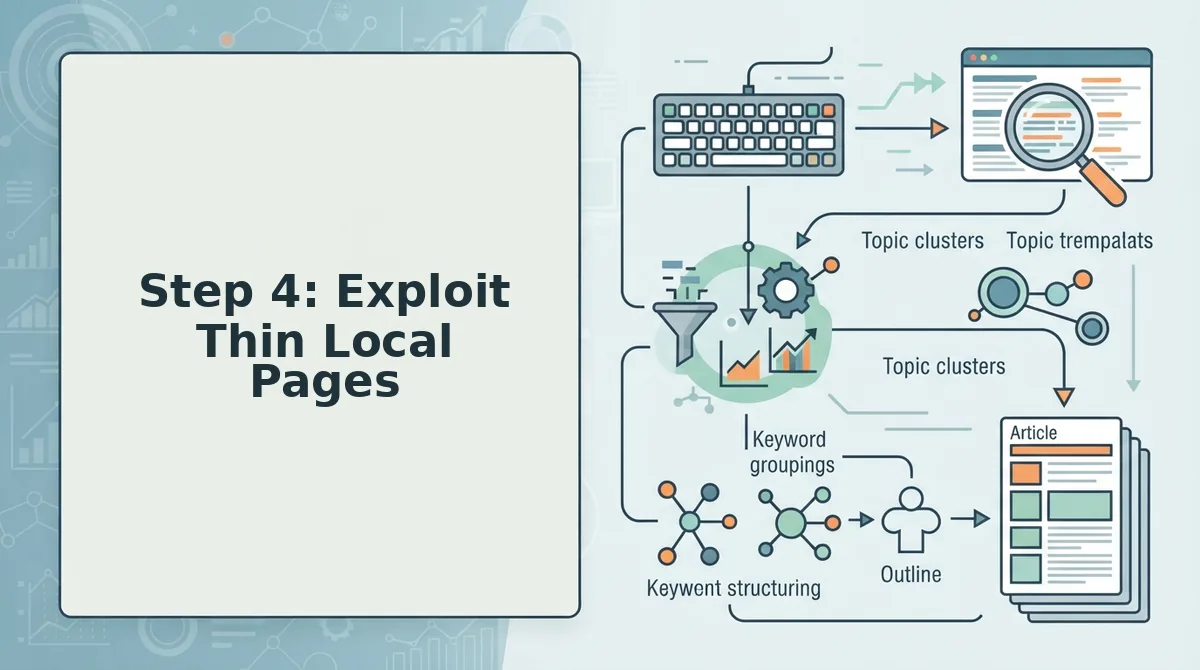
Thin local pages are competitor URLs ranking on proximity and Google Business Profile strength rather than content quality. These pages are your fastest wins because you can outrank them with substantive content plus a GBP optimization combo.
Prerequisites: Your mapped local SERP landscape from Step 1, a word count tool, and access to view page source. Total time: 20-30 minutes per competitor page.
- Open the top 10 local SERP results for your target keyword and click each competitor URL. Use a word count tool to measure body content. You should see a clear split between substantive pages (800+ words) and thin pages (under 300 words).
- Select every page under 300 words and run the thin-page checklist: no FAQ section, no local schema markup, no neighborhood mentions, no internal links to service-area pages. Expected outcome: a list of 3-7 thin pages ranking in the top 10.
- Click View Page Source in your browser and search for
LocalBusinessorFAQPageschema. If absent, the page lacks structured data. You should see zero schema results on thin pages, confirming the gap. - Type the competitor's business name into Google and check their GBP listing. Note review count, response rate, and category accuracy. Expected outcome: a profile of whether their ranking comes from GBP strength or content, usually GBP strength for thin pages.
- Upload your thin-page list into your content calendar and prioritize by search volume. You should see a ranked list of opportunities where content quality alone can close the gap.
Local rankings often reflect proximity and GBP strength, not content quality. That means content gaps in local SERPs are easier to win than national SERPs, a thin page ranking at position 4 is beatable with a 1,200-word page that includes an FAQ, local schema, and neighborhood-specific sections. Use these SERP weaknesses as blog topic ideas to build your attack list. BloGoose automates this by crawling competitor pages, flagging thin content, and drafting replacement articles with local schema baked in, no manual word count checks required.
With your thin-page targets identified, the next step is turning every gap into a scheduled, prioritized publishing plan.
Step 5: Turn Gaps into a Local Content Calendar
Converting raw gap findings into a publishable calendar requires a scoring system, not gut feel. Before starting, have your gap list from Steps 2-4, a spreadsheet, and access to your CMS or an automated CMS export checklist ready.
- Score every gap using the Gap Prioritization Score. Open your spreadsheet and add three columns: search volume, geo-intent strength (1-5), and business relevance (1-5). Type the formula
(volume × 0.4) + (geo-intent × 0.4) + (relevance × 0.2)into a fourth column. You should see a numeric score between roughly 1 and 10 for each row. - Sort the sheet by score, highest first. Click the sort control on the score column and select descending order. A hyperlocal gap like "emergency plumber in [neighborhood]" should outrank a generic "plumbing tips" gap because geo-intent and business relevance carry 60% of the weight combined.
- Assign each top-scoring gap to a calendar week. Open your content calendar and place the top 4-6 gaps into the next 30 days, one primary local page per week. You should see a balanced mix of service-area pages, neighborhood guides, and question-answer posts.
- Draft the brief for each assigned gap. Click into your CMS or content tool and create a new draft. Paste the target keyword, the top 3 local competitors' URLs, and the PAA questions you mined in Step 3. You should see a complete brief ready for writing or AI generation within 10 minutes per page.
FAQ: Local Content Gap Analysis Questions
How do I find content gaps in local SERP results?
Compare your site's ranking pages against competitors for geo-modified queries like "dentist in Austin" or "plumber near me." Identify queries where competitors rank but you don't, then check if the intent is local, informational, or transactional before building content.
What tools can I use for local content gap analysis?
Ahrefs' Content Gap tool, Semrush's Keyword Gap, and Google's own "People Also Ask" boxes work well. Pair them with a local rank tracker like BrightLocal or Local Falcon to see which gaps actually appear in your target neighborhoods.
How do I find hyperlocal keywords competitors miss?
Mine neighborhood names, landmarks, and colloquial terms from local forums, Nextdoor threads, and Reddit city subreddits. Competitors often target city-level terms while ignoring district-level phrases like "East Nashville HVAC repair" or "SoMa coffee shop with parking."
What is a thin local page and why does it matter?
A thin local page has minimal unique content, often just a duplicated service description and an embedded map. These pages rank poorly because they offer nothing Google can cite. Replacing them with neighborhood-specific content creates an immediate gap-filling opportunity.
Why do local PAA boxes matter for content gaps?
People Also Ask boxes reveal the exact questions searchers ask about local services. Each unanswered PAA question in your market is a content gap you can fill with a dedicated section or short article targeting that snippet.
Once you've identified the gaps, the real work begins: building a system that fills them consistently.
Start Finding Local Content Gaps Today
Local content gaps are not a mystery to solve once, they are a system to run continuously. The three-layer framework, geo-intent matrix, thin page exploit, and prioritization score work together as a repeatable loop, not a one-off audit.
Your next action is a single step: run the framework on one service area or one neighborhood cluster this week. Pick the geo-intent matrix row with the highest search volume and lowest local competition, then draft one page that answers the PAA questions you mined and out-structures the thin competitor page you identified.
Scaling that loop manually is where teams stall. BloGoose automates local SERP gap research and publishes directly to WordPress, so the gap-to-published-page cycle shrinks from days to hours. Pair the framework with automated SEO content that applies your brand voice to every geo-targeted page without prompt engineering.
Here is the synthesis that ties it together: local rankings are won by the publisher who finds the question no competitor bothered to answer, in the neighborhood no competitor bothered to name, and ships the page before the next algorithm update rewards them for it.