
How to Schedule Draft Intervals for Consistent Blog Output
You stare at a blank page for an hour before writing a single line. Deadlines pile up faster than your drafts ever do. If that scenario sounds familiar, the problem isn't your writing ability, it's that you're relying on motivation instead of a system. Learning how to schedule draft intervals for consistent blog output removes willpower from the equation entirely.
You already know consistency matters more than raw frequency. What you haven't had is a repeatable cadence that fits your actual capacity, not someone else's publishing fantasy. By the end of this article, you'll know exactly how to calculate your optimal draft interval, configure it inside an AI SEO content engine, and automate the handoff from draft to published post without a 12-tab content stack.
Here's the roadmap: first, we'll define what a draft interval actually is and why it matters more than your posting frequency. Then, you'll learn a simple formula to calculate your personal cadence. Finally, we'll walk through configuring that interval step by step. Stick around for the formula, it produces a number that surprises most publishers, and it's the difference between a content calendar that survives week three and one that dies quietly in a spreadsheet.
What Is a Draft Interval and Why It Matters More Than Posting Frequency
A draft interval is the fixed number of days between starting one article draft and starting the next, regardless of when either piece gets published. It's a production rhythm, not a publishing schedule.
Think of a draft interval like a restaurant's prep schedule. The head chef doesn't decide each morning whether to chop vegetables, prep happens on a fixed rotation so the kitchen never runs dry during dinner service. Your blog works the same way: a fixed drafting cadence keeps the publishing pipeline full without last-minute scrambles.
Most publishers obsess over posting frequency, two posts a week, one post a day, but that number is meaningless if drafts aren't being produced upstream. Consistency in drafting matters more than raw frequency because it compounds. A steady one-draft-every-five-days rhythm produces 73 drafts a year. A "when I feel inspired" approach produces maybe 12, and half of those arrive in a panic.
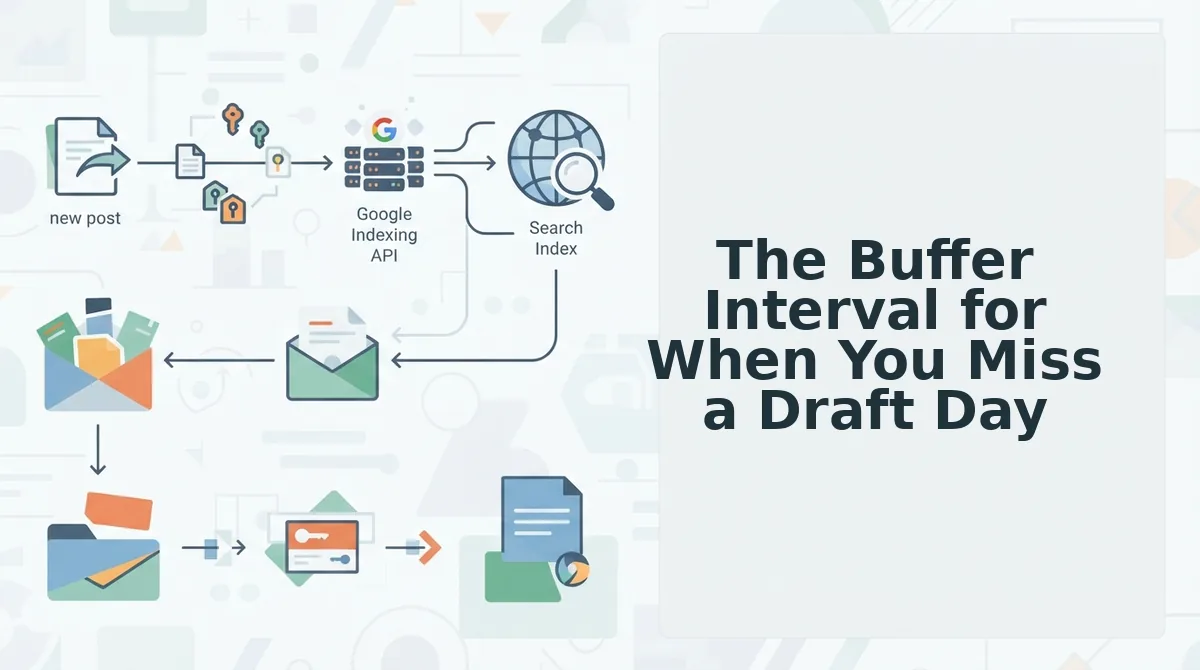
Here's the connection competitors never make: your draft cadence directly influences how search engines crawl your site. When drafts become published posts on a predictable rhythm, crawlers learn when to return. An erratic publishing pattern signals an erratic site. A consistent one trains crawl budget allocation in your favor, which means new content gets indexed faster and AI answer engines have a reliable stream of fresh material to cite.
Sophia Lee's approach to content calendar planning treats the calendar as the foundation of consistent blogging, not an afterthought bolted on after the writing. The draft interval is that foundation made operational: a number you can plug into a tool and forget about, rather than a promise you renegotiate with yourself every Monday morning.
The Draft Interval Formula to Calculate Your Optimal Cadence
A draft interval is the number of days between starting one draft and starting the next, calculated as (site size × crawl frequency) ÷ content capacity. This formula aligns your production speed with what your site can actually absorb and what you can actually sustain.
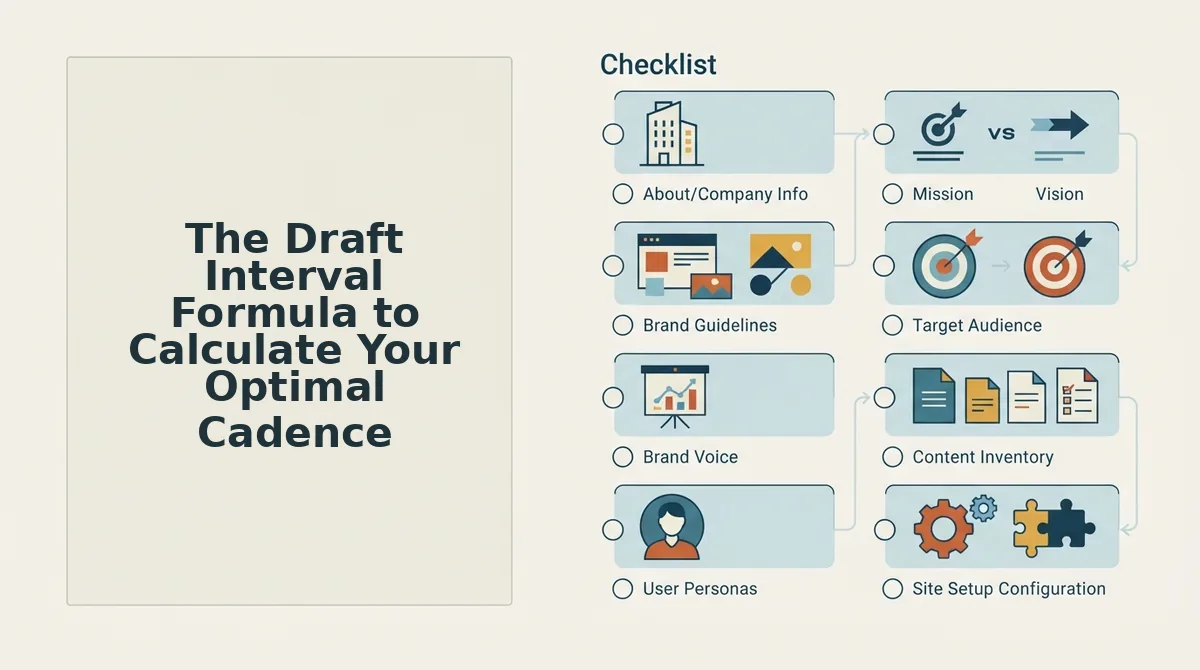
Before you calculate, gather three inputs: your total number of published pages, how often search engines crawl your site (check server logs or a tool like Google Search Console's crawl stats), and your honest weekly writing capacity in hours. The formula then gives you a cadence you can maintain without burnout.
- Count your published pages. Open your CMS or sitemap and note the total number of live URLs. A 10-page site has different needs than a 500-page publication. Write this number down as your site size.
- Determine your crawl frequency. Check your server logs or Search Console crawl stats for how often Googlebot returns. Weekly crawls are common for small sites; daily crawls signal a larger, more active domain. Convert this to a number: weekly = 7, daily = 1.
- Audit your weekly content capacity. Be brutally honest about how many hours you can dedicate to drafting, not editing, not publishing, just drafting. Two focused hours per week is a realistic starting point for a solo operator.
- Apply the formula. Multiply site size by crawl frequency, then divide by content capacity. For a 10-page site with weekly crawls and 2 hours per week: (10 × 7) ÷ 2 = 35. That's your raw interval score.
- Convert the score to days. Divide the raw score by 7 to get a practical interval. In the worked example: 35 ÷ 7 = 5. You should start one new draft every 5 days. That's roughly 1.4 drafts per week, sustainable, crawl-aligned, and specific.
Here's how the formula plays out across common scenarios:
| Site Type | Site Size | Crawl Frequency | Weekly Capacity | Draft Interval |
|---|---|---|---|---|
| Small blog | 10 pages | Weekly (7) | 2 hours | Every 5 days |
| Growing site | 50 pages | Twice weekly (3.5) | 5 hours | Every 5 days |
| Large publication | 300 pages | Daily (1) | 15 hours | Every 2-3 days |
The formula's real value is that it removes negotiation from your calendar. You don't ask "do I feel like drafting today?", the interval already answered that question. A 30-day blog plan built on this cadence gives you a concrete sequence of draft start dates, and an AI SEO content engine can automate the drafting itself so your capacity hours stretch further.
Once you have your number, the next step is putting it to work inside a tool that respects the interval automatically.
How to Configure Draft Intervals in BloGoose Step by Step
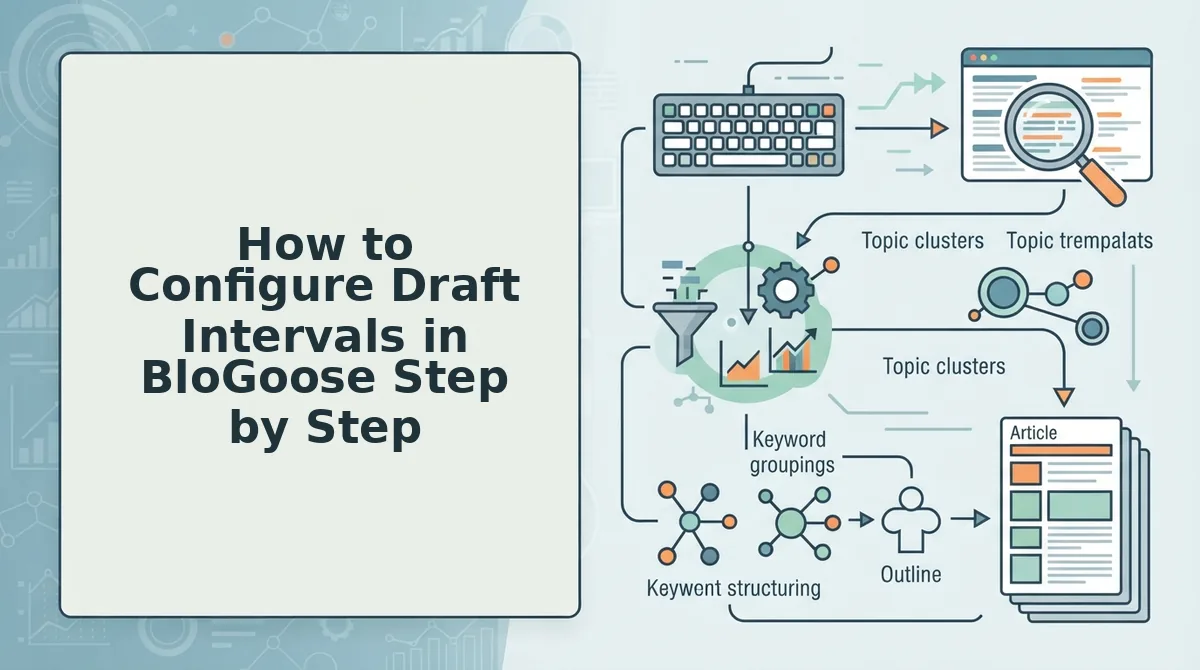
BloGoose turns draft interval planning from a spreadsheet chore into a configured workflow that runs on autopilot. You need an active BloGoose account, your website's domain, and access to either WordPress admin credentials or a custom API endpoint before starting.
- Open the Setup Wizard and enter your domain. Click New Project in the BloGoose dashboard, type your site URL, and select Start Crawl. BloGoose locates your XML sitemap and inspects published pages. You should see a crawl progress bar that completes in 2-5 minutes for most sites.
- Review the extracted brand context. Once the crawl finishes, open the Brand Voice tab. BloGoose pulls tone markers, formatting habits, and terminology from your existing content. Click Confirm Voice Profile or edit any rule that feels off. You should see a green checkmark next to each detected voice attribute.
- Open the Calendar tab and select your draft interval. Click Calendar, then Interval Settings. Choose a cadence from the dropdown, daily, every 2 days, every 3 days, or weekly. BloGoose automatically spaces drafts across your selected days and marks the 7th slot as a buffer interval. You should see a 30-day preview populate instantly.
- Set your review window. In the same Interval Settings panel, choose how many hours a draft sits in review before publishing, 24, 48, or 72 hours. This is your safety net for edits. You should see each draft labeled with a Review Due timestamp.
- Connect your publishing destination. Click Settings, then Publishing. For WordPress, select WordPress and enter your site URL plus an application password. For custom stacks, select Custom API and paste your endpoint. BloGoose supports publishing AI blog posts via custom API endpoints without middleware. You should see a green connection status after a test ping.
- Toggle Auto-Publish to On. Return to the Calendar tab and flip the Auto-Publish switch. BloGoose now drafts, holds for review, and publishes on your interval without manual triggers. You should see the next draft date and time listed at the top of the calendar.
WordPress auto-scheduling of AI posts is possible but tool-dependent, native WordPress scheduling only works for posts already in the queue, while BloGoose generates and queues drafts on the interval itself. Sophia Lee's content calendar planning methods emphasize batching topics in advance, which is exactly what the 30-day preview enables. If you want the full mechanics behind the drafting engine, read about automated SEO content generation.
The Buffer Interval for When You Miss a Draft Day
A buffer interval is a scheduled catch-up slot, typically every 7th day, reserved for recovering missed drafts without breaking your publishing rhythm. It reframes consistency as resilience rather than perfection.
Think of a buffer interval like the spare tire in your trunk. You don't plan to use it, but knowing it's there changes how confidently you drive. Most content calendars collapse the moment one draft slips, because every subsequent task shifts forward and the whole system cascades into chaos. A buffer interval stops that cascade by giving the slip a designated landing zone.
The simple version: leave one day per week empty on your calendar. If you hit every draft, that day stays free. If you miss Tuesday's draft, the buffer day absorbs it and the rest of the week proceeds unchanged.
The intermediate version: pair the buffer interval with a review-window extension. When a draft lands in the buffer slot, extend its review window by 24 hours so quality checks don't get compressed. BloGoose handles this automatically when you enable the 7th-day buffer in Interval Settings, missed drafts are rescheduled into the buffer slot and the review window adjusts.
The advanced version: treat the buffer interval as a content debt meter. If you use the buffer slot three weeks in a row, your cadence is too aggressive, drop from every 2 days to every 3 days. No competitor addresses failure recovery this way; most tools simply show you a red "missed" label and move on. Backstage Income's advice that consistency is key is true, but nobody explains what happens when you slip. The buffer interval is that missing explanation, and it's why avoiding calendar sprawl matters as much as hitting publish.
A buffer interval is a recurring empty slot in your publishing calendar that absorbs missed drafts so one slip doesn't derail the entire schedule. Instead of shifting every future task forward when you miss a day, the buffer slot catches the overdue draft and keeps the rest of the calendar intact. This works best on a weekly cadence: if you publish five drafts per week, schedule six slots and leave the seventh open. When you miss a Tuesday draft, it moves to the buffer day, and Wednesday through Friday proceed as planned. If you never miss, the buffer day simply stays empty, no harm done. The key is treating the buffer as a structural feature, not an afterthought, so recovery is automatic rather than improvised.
How Draft Intervals Feed AI Answer Engines
AEO citation velocity is the rate at which your site produces fresh, quotable passages that AI answer engines can pull into responses. Consistent draft intervals directly increase that velocity, while irregular publishing starves it.
Think of AI answer engines like a newsroom that only quotes sources it has seen recently. A reporter won't cite a publication that hasn't printed anything in six weeks, and an AI assistant won't cite a blog that stopped producing quotable passages. Every draft you publish on a fixed interval adds another passage to the pool of text an AI can extract, summarize, or attribute.
The mechanism is straightforward. AI answer engines index content and evaluate it for extractability, clear definitions, direct answers, and self-contained paragraphs. Regular drafts create a compounding library of these passages. Irregular drafts create gaps, and gaps signal staleness. BloGoose bakes AEO optimization into every draft, so each interval delivers passages structured for citation, not just ranking.
AEO citation velocity is the speed at which a website accumulates passages that AI answer engines can quote, summarize, or attribute in generated responses. Every published article contains extractable statements, definitions, statistics, step-by-step instructions, that AI systems may pull into answers. When you publish on a consistent draft interval, you add new quotable passages at a predictable rate, which keeps your site in the pool of sources AI engines actively reference. When publishing becomes irregular, that pool stagnates and AI systems gradually deprioritize your content. The practical takeaway: a steady cadence of five drafts per week produces roughly 20 quotable passages weekly, compounding into hundreds of citation-ready snippets per quarter. Consistency, not volume, drives citation velocity.
If your draft interval is erratic, your AEO visibility will be too, here are the most common questions about fixing both.
Draft Intervals and Blog Consistency FAQ
Draft intervals answer the most common publishing questions in one place: how often to post, what happens when you miss a day, and whether consistency actually moves the SEO needle. Here are the questions readers and search users ask most.
How often should you post on your blog?
Post once or twice per week if you want compounding organic growth without burnout. Search engines reward freshness and crawl frequency, but publishing daily with thin content hurts more than it helps. Match your cadence to the depth you can sustain per article, not to an arbitrary calendar.
What if I miss a draft day?
Shift the draft to the next scheduled slot instead of doubling up. A buffer interval of one to two days absorbs missed sessions without collapsing the calendar. The key is resuming the rhythm immediately, consistency is measured over months, not individual weeks.
Can I automate WordPress scheduling?
Yes. An AI SEO content engine like BloGoose can draft, optimize, and schedule posts directly to WordPress on a fixed interval, removing manual upload steps. You set the cadence once, and the engine queues finished drafts for publication without spreadsheet coordination or prompt engineering.
Does consistency affect SEO?
Consistency affects SEO indirectly by increasing crawl frequency and building topical authority over time. Search engines revisit sites that publish on predictable schedules, which means new content gets indexed faster. Irregular bursts of publishing do not produce the same crawl behavior or authority signals.
Why do AI chatbots cite some blogs more than others?
AI answer engines favor sites with structured, regularly updated content that directly answers common questions. A consistent draft interval keeps your content fresh and citation-ready, because answer engines re-crawl and re-evaluate sources that demonstrate ongoing authority in a topic cluster.
For a self-contained answer: a draft interval is the fixed number of days between starting one article and starting the next. Setting it to seven days produces roughly four posts per month, which is enough to build topical clusters without sacrificing depth. The interval matters more than the posting date because it controls research time, editing capacity, and how predictably search engines and AI crawlers encounter new content on your domain.
Make the Interval Automatic, Not Another Reminder
The real payoff from a draft interval is not the calendar, it is removing the decision of what to write next. When the interval is fixed and the pipeline is automated, every draft day starts with a topic already researched, a voice already matched, and a publishing slot already reserved.
Start by revisiting your cadence formula from the earlier section and locking in a seven-day interval for one month. If manual scheduling keeps slipping, move to the AI SEO content engine and let its 30-day autopilot calendar generate, draft, and queue posts to WordPress on the rhythm you set. Stop managing reminders. Let the engine schedule the drafts.
The blogs that win in 2026 are not the ones that publish the most, they are the ones that never have to think about publishing at all.