Single Platform Content Engine vs Multi Tool SEO Stack
You know the feeling: eleven browser tabs deep, copying a keyword from one tool into an AI chat, pasting that output into a doc, then manually re-uploading the result into WordPress, only to realize the image is still sitting in a fourth tab. That's the 12-tab content stack, and it's quietly eating your publishing schedule alive.
If that scenario sounds familiar, you're not disorganized, you're running a workflow that was never designed to work as one system. The real question behind the single platform content engine vs multi tool SEO stack debate isn't which approach has more features. It's which one can actually sustain your publishing cadence without burning out the person running it.
In this guide, you'll get a clear decision framework: what a fragmented stack really costs you in time and consistency, what a single platform like an AI SEO content engine actually does step by step, and a head-to-head comparison across six criteria that matter for ranking and AI citations. Along the way, you'll see why the answer hinges on cadence, not tool count, and one finding about switching costs may surprise you.
Here's the roadmap: first, we'll quantify the hidden tax of context switching. Then we'll walk through the mechanics of a unified platform. Finally, we'll put both approaches side by side so you can choose based on your publishing goals, not vendor hype.
The 12-Tab Tax: What a Fragmented SEO Stack Actually Costs You
A fragmented SEO stack is a workflow where research, drafting, optimization, image creation, and publishing happen across separate tools that don't share context. The direct answer: it costs you roughly 20-30 minutes of lost focus per article just from switching between applications, before you've written a single word.
Think of it like cooking a meal in a kitchen where the stove is in one room, the knives in another, and the refrigerator is down the hall. Each ingredient requires a walk. The meal gets made, but the friction compounds with every dish, and you're less likely to cook tomorrow.
The 12 Tabs, Named
Here's what a typical multi-tool publishing session actually looks like for a content manager:
- SERP analysis tool (checking what ranks)
- Keyword research tool (validating volume and intent)
- AI chat window (generating an outline)
- Second AI chat window (rewriting a section)
- Document editor (assembling the draft)
- Brand voice or style guide doc (cross-referencing tone)
- Image generation tool (creating a featured image)
- Image compression tool (optimizing file size)
- CMS admin panel (pasting the final article)
- Internal link checker (finding related posts)
- Analytics dashboard (checking last week's performance)
- Project management board (updating the content calendar)
Each switch carries a cognitive cost. Research on task switching consistently shows that regaining full focus after an interruption takes anywhere from several seconds to over 20 minutes, depending on task complexity. Even at a conservative estimate of 2-3 minutes per switch, a single article requires 22-33 context changes, which translates to roughly 45-90 minutes of pure switching overhead per piece.
Now compound that across a 30-day content calendar. If you publish 12 articles per month, that's 9-18 hours lost to tab management alone. That's two full workdays per month spent not writing, not optimizing, not publishing, just reorienting.
For a deeper breakdown of how this compares to a unified workflow, see our analysis of AI content engine vs chat window workflows.
The hidden cost isn't just time. It's consistency. When every article requires 12 manual handoffs, the probability of skipping a step, forgetting alt text, missing an internal link, publishing without a meta description, rises with every piece. A single platform content engine removes those handoffs by design, which is why the switching cost math matters more than any individual tool's feature list.
What a Single Platform Content Engine Actually Does Step by Step
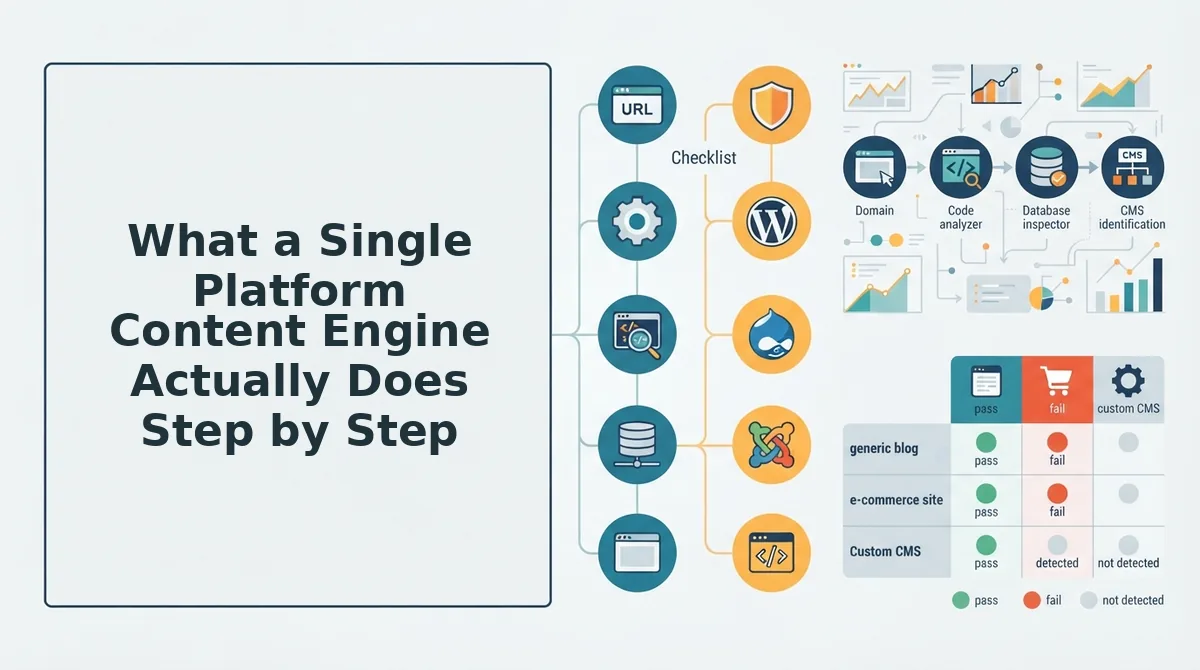
A single platform content engine automates the full publishing pipeline, from site analysis to live article, inside one connected workflow. Here's exactly how that works, using the documented BloGoose process as the reference implementation.
Prerequisites: You'll need access to a content engine platform account and the domain of the site you want to publish for. No separate keyword tool, AI subscription, or image generator is required.
- Enter your domain into the setup wizard. The platform automatically locates your XML sitemap and crawls your existing pages. Expected outcome: within a few minutes, you should see a map of your site's structure and detected content patterns. This is the sitemap context extraction step that replaces manual site audits.
- Review the extracted brand context files. The engine analyzes your published content to learn tone, terminology, and formatting conventions. Expected outcome: a set of brand voice rules you can approve or edit, no prompt engineering required.
- Approve the generated 30-day content calendar. The platform proposes pillar-based topics mapped to your site structure and keyword gaps. Expected outcome: a ranked list of article briefs ready for drafting, replacing manual spreadsheet coordination.
- Trigger a draft. The engine runs live SERP analysis without leaving the platform, then writes the article with SEO and AEO optimization baked in. Expected outcome: a complete draft with headings, internal links, and citation-friendly structure in minutes, not hours.
- Review the generated image. The platform creates a featured image matched to your brand style automatically. Expected outcome: a ready-to-use visual with no separate design tool or compression step.
- Click publish. The finished article ships directly to WordPress or your custom API. Expected outcome: a live, indexed-ready post with the draft-image-publish loop closed in one session.
The entire workflow, from domain input to published article, happens without opening a second tab. That's the core difference: the platform carries context forward at every step, so nothing gets lost between research and publication. Next, we'll put this approach head to head against the multi-tool stack across six criteria that determine real-world performance.
Head to Head: Single Platform vs Multi Tool Across 6 Criteria
A single platform content engine wins on publishing speed, brand voice consistency, and AEO readiness, while a multi-tool stack still leads on deep backlink analysis, enterprise compliance, and specialized flexibility. The right choice depends on which criteria matter most for your publishing operation.
The comparison below evaluates both approaches across the six criteria that determine whether content actually ranks, gets cited in AI answers, and ships on schedule. Multi-tool stacks earn honest credit where their depth is genuinely hard to replicate in an integrated platform.
| Criterion | Single Platform Content Engine | Multi Tool SEO Stack | Best For |
|---|---|---|---|
| Research depth | Automated sitemap crawl, brand context extraction, and live SERP research in one flow. Covers on-page and topical gaps without manual tab switching. | Dedicated tools like Ahrefs or Semrush offer deeper backlink graphs, competitor gap analysis, and historical keyword data that integrated platforms rarely match. | Multi-tool: SEO leads running aggressive link-building or competitor displacement campaigns. |
| Content quality and brand voice accuracy | Brand voice rules are extracted from the existing site during setup, so every draft matches tone, terminology, and formatting without re-prompting. | Quality depends on the writer's prompt discipline. Voice drift happens across freelancers, templates, and AI chat sessions unless a style guide is manually enforced. | Single platform: publishers who need voice-accurate content at scale without a dedicated editor. |
| Publishing speed | One login, one flow: crawl to calendar to draft to image to publish to WordPress or custom API. No export-import loops or manual handoffs. | Each tool handoff adds friction: research in one tab, drafting in another, optimization in a third, publishing manually in the CMS. A 12-tab workflow routinely produces 9 handoffs per article. | Single platform: teams publishing 4+ articles per month who cannot afford a full day per piece. |
| AEO and AI citation readiness | AEO optimization is baked into the drafting process, structuring content for answer-engine extraction from the first draft. This is the core gap multi-tool stacks miss. | Most stacks optimize for classic SERP ranking only. AI answer engines pull from structured, citation-friendly content, and retrofitting AEO requires an additional AEO content optimization tool or manual restructuring. | Single platform: brands targeting visibility in ChatGPT, Perplexity, and Google AI Overviews. |
| Cost per published article | Consolidated subscription replaces 5-10 separate tools. Fewer seats, fewer integrations, lower total cost per shipped article. | Stacking Surfer, Clearscope, a keyword tool, an image generator, and a publishing plugin multiplies monthly spend. A Surfer SEO alternative can reduce one line item, but the aggregate cost remains higher. | Single platform: solo operators and small teams with fixed content budgets. |
| Flexibility and specialization | Optimized for the core publishing loop: research, draft, optimize, publish. Less customizable for edge-case workflows like enterprise compliance reviews or multi-brand approval chains. | Best-in-class tools for each function. Swap any component without disrupting the rest. Ideal for agencies managing multiple client brands with distinct tool preferences. | Multi-tool: agencies and enterprise teams with compliance requirements or multi-brand operations. |
The AEO integration gap is the clearest differentiator. Multi-tool stacks optimize for yesterday's SERP, while a single platform content engine drafts for both Google rankings and AI answer engine citations from the first sentence. If your content strategy includes being quoted in AI answers, consolidation closes a gap that bolt-on tools rarely address cleanly.
Bottom line: Choose a multi-tool stack if backlink depth, enterprise compliance, or multi-brand flexibility is non-negotiable. Choose a single platform content engine if publishing cadence, brand voice consistency, and AEO readiness are your bottlenecks. BloGoose is built for the second scenario: one crawl, one calendar, one publish flow that ships rank-ready articles to WordPress without the 12-tab tax.
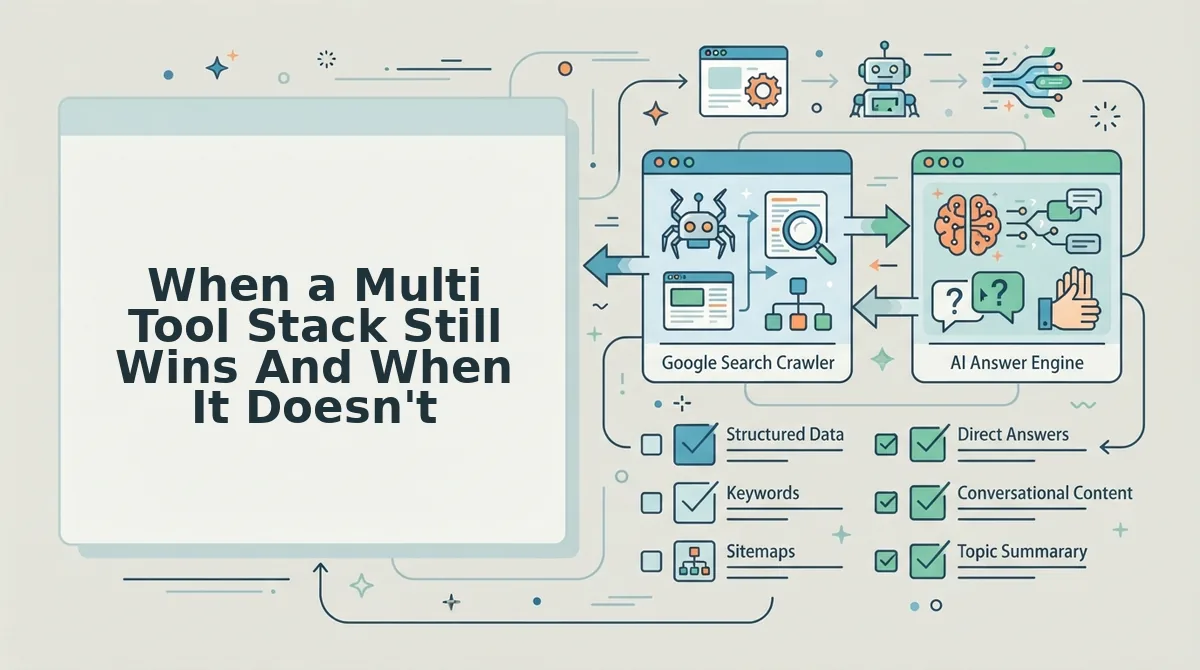
When a Multi Tool Stack Still Wins And When It Doesn't
A multi-tool stack still wins for enterprise compliance, backlink-heavy strategies, and multi-brand agencies, while a single platform content engine is the obvious choice for teams publishing 4+ articles per month with limited headcount or budget. The decision hinges on whether your bottleneck is depth or throughput.
Scenarios where a multi-tool stack still makes sense
- Enterprise compliance and approval workflows. Large organizations often require legal review, brand governance, and role-based permissions that specialized tools handle better than an integrated platform. If every article needs three approval stages before publishing, the flexibility to plug in a dedicated compliance tool outweighs the time saved by consolidation.
- Backlink analysis and competitor displacement. Dedicated SEO suites like Ahrefs or Semrush provide backlink graphs, referring domain tracking, and competitor gap analysis at a depth that integrated content engines do not replicate. If your strategy depends on acquiring links rather than publishing volume, keep the specialized research stack.
- Multi-brand agencies with distinct client needs. Agencies managing ten clients with different CMS platforms, tone guidelines, and reporting requirements benefit from a modular stack where each component can be swapped per client. A single platform works best when one brand voice and one publishing pipeline dominate the workload.
Scenarios where consolidation is the obvious choice
- Publishing cadence of 4+ articles per month. At this volume, the 12-tab workflow becomes a genuine bottleneck. Every handoff between research, drafting, optimization, and publishing adds friction that compounds across the month. A single platform with an autopilot 30-day content calendar generator removes the coordination overhead entirely.
- Small teams with no dedicated SEO editor. When a founder or content manager is also the writer, editor, and publisher, there is no bandwidth for managing five tool subscriptions. A single login that handles crawl, draft, image, and publish keeps one person productive without context switching.
- Fixed or shrinking content budgets. Stacking Surfer, Clearscope, a keyword tool, an image generator, and a publishing plugin multiplies monthly spend. Consolidating into one platform typically reduces total cost per published article, which matters when every dollar must map to shipped content.
If you publish fewer than four articles per month and your strategy leans heavily on backlink acquisition or multi-brand management, a multi-tool stack remains defensible. If you publish weekly or more, run a small team, and need content that ranks on Google and gets cited in AI answers, consolidation is not a preference, it is a throughput decision. The question is whether your current stack ships content or just moves it between tabs.
One Article Two Workflows: A Side by Side Walkthrough
The same article takes roughly 12 tabs, 9 handoffs, and a full workday in a multi-tool stack, versus one login, one flow, and about 90 minutes in a single platform content engine. The walkthrough below documents both paths step by step so you can see exactly where the time and friction go.
Prerequisites: For the multi-tool path, you need a keyword research tool, a SERP analysis tool, a content optimizer, a writing environment, an image tool, and CMS access. For the single-platform path, you need a BloGoose account and your website domain.
Path A: The 12-tab multi-tool workflow
- Open your keyword research tool and run a query. Type your target topic into Ahrefs or Semrush, export the keyword list, and note search volume and difficulty. You should see a CSV download ready for the next step.
- Open a SERP analysis tool and inspect the top 10 results. Paste the target keyword into a SERP checker, review headings, word counts, and content gaps. Expect to spend 20-30 minutes manually comparing competitor outlines.
- Open a content optimizer and paste your draft outline. Upload the competitor notes into Surfer or Clearscope, generate a content score target, and export the recommended terms list. You should see a list of LSI keywords and a target word count.
- Open a writing environment and draft the article. Write in Google Docs or an AI chat window, manually weaving in the recommended terms. This step typically takes 60-90 minutes for a 1,500-word piece.
- Open an image generation tool and create visuals. Generate a featured image and any inline graphics, download them, and rename files for SEO. You should have 2-3 image files saved locally.
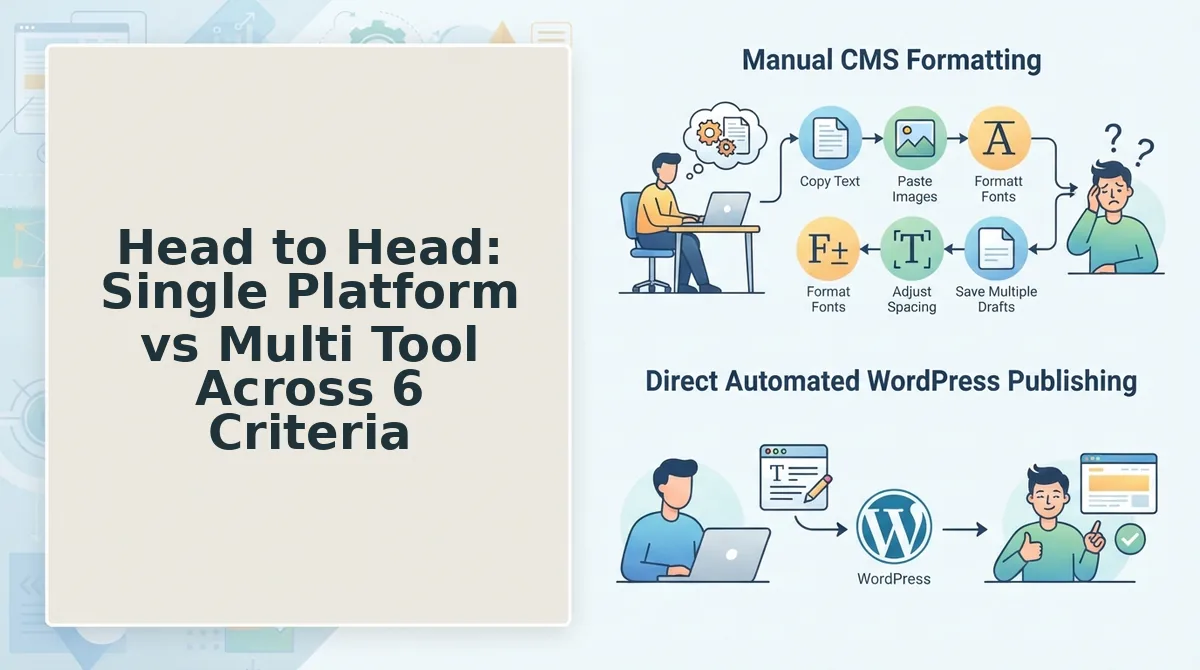
- Open your CMS and manually paste the content. Log into WordPress, create a new post, paste the draft, upload images, set the meta title and description, and configure internal links. Expect 15-20 minutes of formatting cleanup.
- Run a final optimization pass. Reopen the content optimizer, check the final score, adjust headings or keyword density, and re-paste into the CMS. You should see a green score before publishing.
Total: 12 tabs, 9 handoffs, roughly 4-6 hours per article depending on experience.
Path B: The single-platform BloGoose workflow
- Enter your website domain into the BloGoose setup wizard. Type your domain and click Start. BloGoose automatically locates your XML sitemap, crawls published pages, and extracts brand voice rules. You should see a confirmation that the crawl is complete.
- Review the generated 30-day content calendar. Open the calendar view and confirm the pillar topics and supporting articles BloGoose proposes. Adjust any topic, then click Approve. You should see your publishing schedule populated.
- Select an article and let the engine build context. Click on the next scheduled article. BloGoose compiles up to 8 Markdown context files from your sitemap crawl and runs live SERP research. You should see a research summary with competitor gaps identified.
- Review the generated draft. Open the draft editor and read the article. Brand voice rules are already applied, AEO structure is baked in, and internal links are suggested. Make any edits, then click Next. You should see a draft that matches your site's tone without re-prompting.
- Generate images automatically. Click Generate Images in the draft view. BloGoose creates a featured image and inline visuals matched to your brand style using automated blog image generation. You should see images attached to the article without downloading or renaming files.
- Publish directly to WordPress. Click Publish. BloGoose pushes the article, images, meta tags, and internal links to your WordPress site via AI blog generator direct WordPress publishing. You should see the live post on your site within minutes.
Total: one login, one flow, roughly 60-90 minutes per article from crawl to published post. The difference is not the quality of the output, it is the number of handoffs where time, context, and brand voice get lost. If your publishing calendar demands weekly output, the single-platform path is the only one that scales without hiring a coordinator.
Still weighing the tradeoffs? The FAQ below answers the most common questions about single platform content engines versus multi-tool SEO stacks.
FAQ: Single Platform Content Engine vs Multi Tool SEO Stack
A single platform content engine consolidates research, drafting, optimization, and publishing into one workflow, while a multi-tool stack chains separate tools for each step. The right choice depends on your publishing cadence, team size, and tolerance for tool-switching overhead.
What do I lose when I consolidate my SEO stack?
You lose granular control over individual tool selection and the ability to swap in best-in-class point solutions for niche tasks like backlink analysis or enterprise compliance. In exchange, you gain a unified brand voice, faster publishing, and fewer integration failures across the workflow.
Do I need separate tools for AEO and GEO?
No. AEO (Answer Engine Optimization) and GEO (Generative Engine Optimization) are optimization layers, not separate software categories. A single platform content engine can bake citation-friendly formatting, structured answers, and entity clarity into every draft, eliminating the need for a standalone AEO tool. Learn more about how to get cited in AI answers and chatbots.
How much does a single platform content engine cost vs. a multi-tool stack?
A single platform typically costs $100 - $500 per month depending on article volume and CMS integrations. A multi-tool stack, combining an SEO suite, AI writer, image generator, and publishing plugin, often totals $300 - $800 per month before accounting for the time spent managing integrations and context switching.
Why does my multi-tool workflow feel slower even though each tool is fast?
Because the bottleneck is handoff friction, not tool speed. Every export, reformat, and re-prompt between tools adds 5-15 minutes per article. Across a 10-article month, that is 1-2 full workdays lost to coordination that a single platform eliminates by design.
Can a single platform content engine handle my existing WordPress site?
Yes, if the platform supports direct WordPress publishing. A content engine that crawls your existing site first can extract your brand voice, match your URL structure, and publish finished drafts straight to your CMS without manual copy-paste or formatting cleanup.
The Decision Framework: Choose Based on Publishing Cadence Not Feature Count
The single platform versus multi-tool debate is not a feature contest. It is a throughput equation. If you publish sporadically or need specialized capabilities like backlink analysis or enterprise compliance workflows, a multi-tool stack still earns its complexity.
Here is the decision in two sentences: Match your tooling to your cadence, not your ambition. A lean stack that ships weekly beats a feature-rich stack that ships monthly.
Next step: run one article through a single platform content engine and compare the total time from brief to published post against your current workflow. If the gap is more than an hour per article, the consolidation math is already decided. Check BloGoose pricing to see where your volume lands.
Publishing cadence is the only metric that compounds. Choose the stack that protects it.