
How to Build SEO Guidelines from Your Existing Content
Most content teams are drowning in five-tool stacks, robotic AI mush, and manual publishing loops, and the irony is that the fix is already sitting on their own domain. SEO has changed more in the last 2 years than the previous 10 combined (Ahrefs, 2025), yet most teams still write guidelines from scratch instead of mining the pages that already rank. If you want to build SEO guidelines from existing content, you're in the right place.
Here's the agreement: your site already contains the patterns, voice, and structural signals that Google rewards, you just haven't extracted them into a reusable system. The promise: by the end of this article, you'll know exactly how to crawl your site, audit what's working, and turn those findings into a rank-ready guidelines stack. The preview: we'll cover why a crawl-first approach beats blank-page brainstorming, the 8 files every guidelines system needs, and how to extract rules from pages that already perform.
One surprising finding along the way: your sitemap may reveal that half your content is invisible to Google, and that discovery alone can reshape your entire SEO strategy before you write a single tone-of-voice rule. Platforms like BloGoose automate this crawl-and-extract workflow, but the principles below work whether you use a tool or do it manually.
Why Crawl Your Site Before Writing Any Guidelines
A site crawl is the process of systematically scanning every URL on your domain, via the XML sitemap, internal links, and server responses, to inventory what exists, what's indexed, and what's broken. Crawling before drafting guidelines is like reading your own medical chart before prescribing a diet: you can't fix what you haven't diagnosed.
Start simple: drop your domain into any crawler (or a platform like BloGoose that automates this step) and pull the XML sitemap. Count the URLs listed, then check how many are actually indexed in Google. A sitemap with 200 URLs but only 40 indexed signals index bloat, pages that exist but earn no search visibility. That gap should shape your guidelines before tone of voice, because no amount of brand polish fixes pages Google ignores.
Next, move to the intermediate layer: inspect the technical stack behind those URLs. Crawling reveals the actual CMS stack. WordPress, a custom API, or a headless setup, so your guidelines match the publishing environment instead of assuming a workflow your team can't execute. If your site runs on WordPress, your guidelines should reference block patterns, category logic, and plugin constraints. If it's a custom API, your rules need to define structured fields, not just prose style.
At the advanced level, crawl data becomes a crawl budget audit. Every low-value page, tag archives, thin category stubs, orphaned posts, consumes crawl capacity that could go to money pages. Your guidelines should include a rule: before publishing anything new, identify one page to consolidate, redirect, or noindex. That single instruction, drawn from crawl evidence, often outperforms a dozen style preferences.
Here's the self-contained answer to the query "why crawl before writing SEO guidelines": Crawling your site first reveals the gap between what you publish and what Google indexes, exposes the CMS constraints your guidelines must respect, and identifies crawl-budget waste that silently suppresses rankings. Teams that skip this step write guidelines for an idealized site, not the one they actually operate. The crawl turns assumptions into evidence, so every rule you write fixes a real, observed problem instead of a hypothetical one.
The 8 Files Every SEO Guidelines System Needs
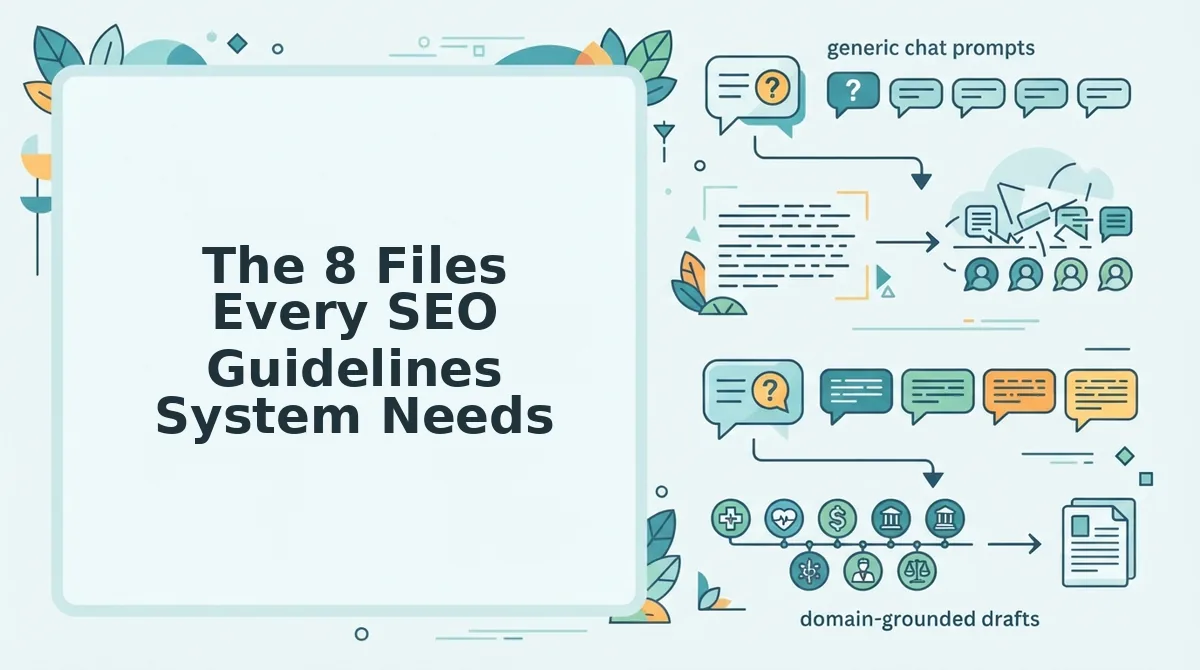
A complete SEO guidelines system is a set of eight Markdown files that together define how your site writes, structures, and ranks content. Each file answers one question your team will repeatedly face, and together they eliminate the guesswork that causes inconsistent publishing.
- style-guide.md, tone, formatting, and voice rules. This file defines how sentences should sound and look on the page: sentence length, heading capitalization, em-dash usage, and the emotional register your audience expects. Without it, every writer invents their own style, and readers feel the inconsistency within three paragraphs.
- target-keywords.md, primary, secondary, and long-tail clusters. This file maps every keyword your site targets, grouped by search intent and mapped to a specific URL. It prevents two pages from competing for the same term and ensures every new article slots into an existing cluster. Learn how to manage target keywords in a Markdown file without letting the list go stale.
- competitor-analysis.md, who you outrank and how. This file records which competitors rank above you for priority terms, what they do differently, and which gaps you can exploit. It turns vague envy into a tactical checklist. A competitor analysis Markdown file should be updated quarterly, not treated as a one-time research project.
- writing-examples.md, your best pages as templates. This file links to 5-10 of your highest-performing pages and annotates why they work: the hook, the structure, the internal links, the CTA placement. New writers copy proven patterns instead of improvising, which is the fastest way to scale quality without homogenizing it.
- internal-links-map.md, anchor targets and cluster logic. This file lists every pillar page, the exact anchor text to use when linking to it, and which supporting posts should point where. It keeps your site's link equity flowing deliberately and prevents orphan pages that crawl bots never find.
- seo-guidelines.md, meta patterns, intent map, and credibility rules. This is the operational core: title tag formulas, meta description length rules, search-intent mapping for each template, and the E-E-A-T signals your niche requires. Use the SEO guidelines Markdown checklist to audit every draft before it ships.
- brand-voice.md, audience sophistication and messaging fit. This file defines who you're writing for (founders, growth leads, solo operators), how technical you can get, and which claims you can and cannot make. It's the difference between content that sounds like your company and content that sounds like every AI-generated article on the internet.
- features.md, product capabilities for unique angles. This file catalogs what your product actually does, so every article can anchor advice in real functionality instead of generic platitudes. When your content references specific capabilities, it earns citations and backlinks that pure opinion pieces never will.
These eight files work as a system because each one feeds the others: the keyword file tells you what to write, the style file tells you how, and the examples file shows you what good looks like. Next, we'll cover how to extract those guidelines from pages that already rank.
How to Extract Guidelines from Pages That Already Rank
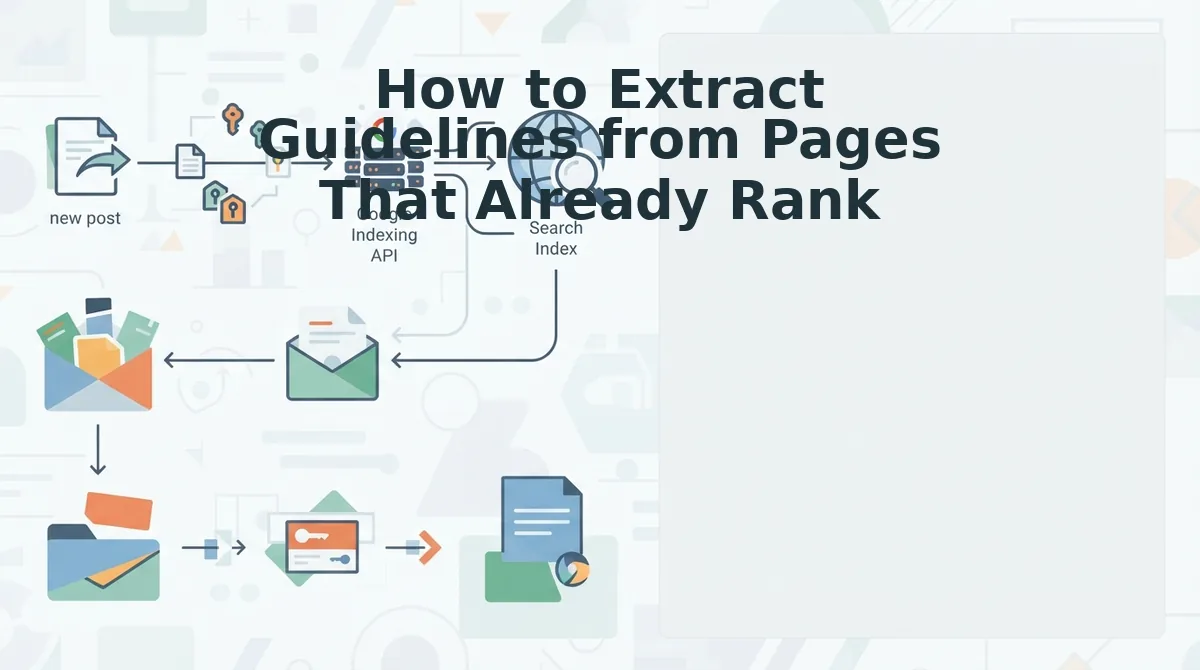
Reverse-engineer your existing wins by crawling your sitemap, inspecting top-performing pages for structural patterns, and codifying those patterns into editable Markdown files. This workflow turns live ranking data into a reusable guidelines system without manual documentation.
Prerequisites: Access to your domain's XML sitemap, a crawler (Screaming Frog, Sitebulb, or BloGoose's setup wizard), and a spreadsheet or Markdown editor.
- Open your crawler and enter your domain. Paste your homepage URL into the crawl field and start the crawl. The tool should automatically locate your XML sitemap and begin indexing published pages. You should see a crawl progress bar and a growing list of URLs within 30-60 seconds.
- Click the Pages tab and sort by organic traffic or impressions. Filter to pages with measurable search performance over the last 90 days. Select the top 10-20 pages that consistently rank for target queries. You should see a list of URLs ordered by traffic, with your highest-performing pages at the top.
- Open each top page and inspect the title tag, meta description, and H1. Record the character counts, keyword placement, and phrasing patterns. Note whether titles use brackets, numbers, or question formats. You should see recurring patterns emerge across at least 60% of your top pages.
- Click the Headings tab and map the H2/H3 hierarchy. Document how subheadings are structured, whether they use questions, action verbs, or keyword phrases. Count the average number of H2s per page. You should see a consistent heading depth and style across ranking pages.
- Select the Internal Links report and note anchor text patterns. Identify how top pages link to each other and to pillar content. Record the typical anchor text length and whether it uses exact-match or partial-match keywords. You should see a clear internal linking convention you can replicate.
- Upload your findings to a Markdown file generator. Use a tool that can generate a Markdown style guide from your website, or manually compile your notes into eight files: title tags, meta descriptions, headings, internal links, brand voice, formatting, keyword targets, and publishing checklist. You should see a complete, editable guideline set ready for your content team.
- Type your CMS stack into the guidelines header. If you haven't already identified your platform, detect your CMS stack for content automation so future drafts match your publishing environment. You should see the CMS name recorded at the top of your guidelines file, ensuring every future article follows the correct template.
Extracting guidelines from pages that already rank is the fastest way to build a search-optimized content system. A publisher drops their domain into a setup wizard, the engine locates the XML sitemap, inspects published pages, and generates eight editable Markdown files, no manual documentation work. The result is a living style guide built from proven wins, not guesswork, which you can apply to every new article before it goes live.
Keeping Guidelines Alive: The Refresh Loop
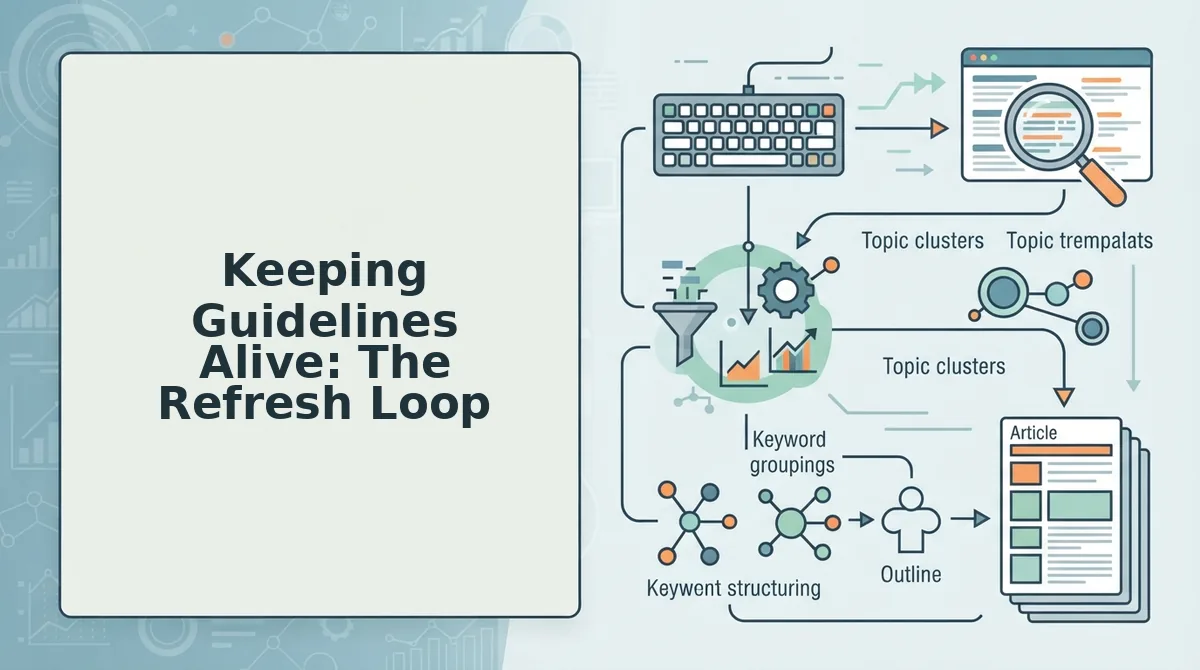
A refresh loop is a scheduled cadence for reviewing and updating your SEO guidelines so they stay aligned with your site's actual performance. Think of it like a car's maintenance schedule: you don't rebuild the engine every month, but you do check the oil, rotate the tires, and replace worn parts on a fixed interval.
Start simple with a monthly crawl. Run your crawler across the sitemap and compare the output against your guidelines. Look for new content patterns, pages that deviate from your title tag rules, headings that drift from your established hierarchy, or internal links that break your anchor text conventions. Flag anything that contradicts the guidelines and decide whether the page or the guideline needs to change.
Move to an intermediate step with a quarterly refresh of keyword targets and competitor analysis. Search intent shifts, new competitors enter your space, and Google updates its algorithms. Review your target keyword list against current ranking data and adjust your guidelines to reflect what's actually driving traffic now. A content refresh at this stage keeps your guidelines from fossilizing around outdated assumptions.
At the advanced level, add a post-publish audit to every new article. After a draft goes live, run an SEO content audit that checks whether the published piece actually followed your guidelines, title tag length, heading structure, internal link placement, and brand voice consistency. If the audit finds drift, update the guidelines immediately rather than waiting for the next quarterly cycle. This turns your guidelines from a one-time asset into infrastructure that improves with every publish.
FAQ: Building SEO Guidelines from Existing Content
Building SEO guidelines from existing content means reverse-engineering your top-performing pages to extract the patterns that already work, title tag formats, heading structures, internal linking rules, and brand voice, then codifying those patterns into a reusable document. Here are the most common questions publishers ask.
How do I build SEO guidelines from my existing content?
Crawl your sitemap, identify the top 10-20 pages by organic traffic, and document their title tags, meta descriptions, heading hierarchies, and internal link patterns. Compile these findings into editable Markdown files that your content team can follow for every new article.
What should an SEO guidelines document include?
Include eight core files: title tag rules, meta description templates, heading structure conventions, internal linking guidelines, brand voice parameters, formatting standards, target keyword lists, and a publishing checklist. Each file should be editable and version-controlled.
How do I extract brand voice from my website?
Inspect your top-performing pages for recurring phrasing, sentence length, tone markers, and vocabulary choices. Tools that automate brand voice in AI blog posts can accelerate this by analyzing published content and generating a voice profile automatically.
How do I keep SEO guidelines updated as my site grows?
Run a monthly crawl to detect new content patterns, refresh keyword targets quarterly, and audit every published article against your guidelines. This refresh loop ensures your guidelines evolve with your site instead of becoming outdated. For broader visibility, pair this with strategies to get cited in AI answers.
Your existing content already contains the guidelines, you just need a system to extract them
The crawl-first method turns what you have already published into a reusable SEO guidelines system, and the 8-file structure keeps every writer and AI tool aligned to the same standard. Together, they close the loop this article opened: you do not need to invent brand rules from scratch. You need to mine them from pages that already rank.
Here is the synthesis that matters most: guidelines extracted from proven content outperform guidelines written from assumptions. Your top-ranking pages encode audience language, formatting preferences, and topic depth that no brainstorming session will surface.
Next steps, in order:
- Run one crawl of your sitemap and tag the 10 highest-performing URLs.
- Draft the 8 files using only patterns found in those pages, not preferences you hope will work.
- Set a 90-day refresh checkpoint to re-extract rules as rankings shift.
If that workflow sounds like a full-time job, it is because manual extraction is. An AI SEO content engine automates the crawl, the pattern detection, and the guideline generation, then feeds those rules directly into every draft. For teams ready to remove the spreadsheet middleman entirely, an automated blog publishing engine applies the same guidelines at publish time, so consistency stops being a review bottleneck.
Your content already knows what works. The only question is whether you will build the system to listen to it.