
How to Find Content Gaps for AI Answer Citations
Your best article ranks #1 on Google, yet ChatGPT keeps citing a thinner competitor with worse data, and your brand never appears in the answer. That's the quiet crisis of AI search, and it's why you need to find content gaps for AI answer citations before your organic traffic erodes further. Hashmeta's research found one exporter cited 286 times by AI engines but recommended exactly zero times, and Quolity's data shows most brands have no idea whether AI engines cite them at all.
You're not imagining the problem: AI answer engines reward structure, specificity, and quotability, not just authority. This guide walks you through a repeatable citation-gap workflow: audit five AI engines, log what they cite, map the gaps, and close them with content built for both search indexing and AI extraction. Along the way, you'll see why AEO optimization flips the usual SEO playbook, and why one counterintuitive finding about "cited but never recommended" pages changes how you prioritize every fix.
By the end, you'll have a citation audit protocol you can run this afternoon, plus a gap list that tells you exactly which pages to update first. Platforms like BloGoose automate the crawl-and-publish side of this, but the audit itself starts with five queries and a spreadsheet.
What Is an AI Citation Gap?
An AI citation gap is the distance between what AI answer engines cite about your topic and what your content actually covers, specifically, the questions, entities, and source formats AI engines pull from but your pages never address. It's not the same as a keyword gap. A keyword gap means you don't rank for a term. A citation gap means AI engines answer the question anyway, using someone else's content, because your page doesn't give them a clean, extractable answer.
Think of it like a restaurant review. A food critic might mention your restaurant in a roundup of "places with good lighting" but never actually recommend eating there. That's the difference between being cited and being recommended, and it's the distinction most gap analyses miss. Hashmeta's AI research surfaced a stark example: one exporter was cited 286 times by AI engines but recommended zero times. The brand appeared constantly, yet influenced no purchase decisions.
To make this actionable, map every mention into a Citation Gap Matrix with four quadrants:
- Invisible: AI engines never cite you and never recommend you. You don't exist in the answer layer.
- Source-Only: AI engines cite you as a source but don't recommend you. You're a footnote, not an answer.
- Ghost: AI engines recommend you but don't cite a visible source. You win the answer, lose the attribution.
- Recommended: AI engines cite you and recommend you. This is the target state.
Most brands sit in Source-Only or Invisible without knowing it, because traditional rank trackers don't measure AI extraction. Building a content gap list from live search results is the first step toward moving pages from Invisible to Recommended, but you need to know which quadrant you're in before you can move.
Step 1: Run a Citation Audit Across 5 AI Engines
A citation audit tells you exactly which sources AI engines pull from for your target topics, and whether you're among them. You'll need a spreadsheet with columns for engine, query, cited source, your brand (yes/no), and recommendation status. Budget 45-60 minutes for five engines across five queries.
- Open each engine in a separate tab. Use ChatGPT, Gemini, Perplexity, Claude, and Copilot. Log in where required so you can run follow-up queries in the same session.
- Type the 5-Query Citation Audit Protocol. For each target topic, run this exact prompt: "What are the best [topic]? List sources." Replace [topic] with your five highest-value pages' primary topics, one query per topic, per engine.
- Record every cited source. Note the domain, page title, and whether the engine recommends it or merely lists it as a reference. You should see a clear split between sources quoted in the answer and sources appended as "for more information."
- Mark your brand's quadrant. For each query, classify your presence using the Citation Gap Matrix: Invisible, Source-Only, Ghost, or Recommended. If you appear zero times across 25 engine-topic combinations, you're Invisible.
- Save the raw answers. Copy each response into your spreadsheet or a doc. You'll need the exact phrasing AI engines use when you validate SERP content gaps with social research in a later step.
Success looks like a filled matrix showing which topics AI engines already answer, and which sources they trust to answer them. BloGoose can automate the publishing side once you know what to create, but the audit itself is manual and fast. Next, you'll turn those raw citations into a prioritized gap list.
Step 2: Log Citations and Build a Gap List
Turn your audit results into a structured citation log so you can spot patterns instead of relying on memory. You'll need a spreadsheet (Google Sheets or Airtable works) and the notes from your five-engine audit in Step 1.
- Create a new sheet with six columns. Label them: Query, AI Engine, Cited Source, Your Brand Cited?, Competitor Cited?, and Notes. This structure forces you to record the same data point for every query, which makes gap patterns visible later.
- Log each query from your audit, one row per engine response. Type the exact query you asked, then select the engine from a dropdown. You should see one row per query-engine combination, a 10-query audit across 5 engines produces 50 rows.
- Record the cited source domain in the Cited Source column. Copy the domain exactly as it appears in the AI's citation. If the engine cites no source, type "none", this is itself a data point.
- Mark the Your Brand Cited? and Competitor Cited? columns with Yes or No. Use conditional formatting to highlight "No" in red. After 15-20 rows, you should see red clusters that reveal which query themes your brand is invisible on.
- Sort the sheet by query, then scan for rows where a competitor is cited and you are not. These rows are your raw gap list. Expect 5-10 minutes for a 50-row sheet.
One pattern worth watching: being cited as a data source rather than a recommended answer. Hashmeta AI, for example, has cited exporters as statistical references while recommending a different provider in its answer text. Log the citation type in Notes, "data source" vs. "recommended", because the fix differs for each. If you want a deeper read on how SERP visibility maps to these gaps, see our guide on how to spot content gaps in SERP listings.
Step 3: Identify Your Gap Type
Not all citation gaps are the same, and treating them identically wastes effort. Sort every gap from your log into one of four types, each with a distinct fix.
- Invisible Gap. The AI never cites your brand for a query where you have relevant content. This is the highest-priority gap because it means your content fails to meet the engine's extraction threshold. Fix it by restructuring passages to lead with a direct answer and adding entity definitions the engine can lift verbatim.
- Source-Only Gap. The AI cites your page as a data reference but recommends a competitor in its answer text. This means your content is quotable but not authoritative enough to anchor the response. Fix it by adding original analysis, unique data, or a stronger point of view that competitors cannot replicate.
- Ghost Gap. A competitor is cited for a query you have never targeted with content. This is a content calendar problem, not an optimization problem. Fix it by commissioning a new article that directly answers the query and matches the cited competitor's format.
- Recommended Gap. You are cited for some queries but not adjacent ones in the same topic cluster. This signals thin topical coverage. Fix it by expanding your cluster with supporting articles that link back to your already-cited pillar page.
Keyword gap tools will not surface these distinctions. DataForSEO's keyword gap analysis compares SERP rankings, but AI citations pull from a different retrieval layer, a page can rank #1 on Google and still be invisible to ChatGPT. If you need help finding topics where the SERP is crowded but the AI citation field is open, read our guide on how to find low-competition topics in crowded SERPs.
Step 4: Run the Answer Passage Test on Your Content
The Answer Passage Test checks whether a single 80-120 word passage from your page can stand alone as an AI citation. You'll need one published article or draft, a timer, and the five-criteria checklist below.
- Open your article and select any 80-120 word passage. Highlight a paragraph that answers a target query. If no single passage fits that length, your content is too fragmented, this is your first failure signal.
- Read the passage in isolation, without the headline or surrounding context. Ask: does a reader understand the answer without clicking through? You should be able to answer "yes" within 10 seconds of reading.
- Check criterion one: self-contained. The passage must define its own terms and not reference "as mentioned above" or "see below." If it does, rewrite it to stand alone.
- Check criterion two: direct answer first. The first sentence must state the answer, not introduce the topic. Move any throat-clearing sentences to the end or delete them.
- Check criteria three through five: entity definitions, a quotable stat, and no fluff. The passage should name and define the key entity, include at least one concrete number or fact an AI can lift, and contain zero filler phrases like "it's important to note." Expect 15-20 minutes per article.
Passing all five criteria means your passage is citation-ready. Failing any one criterion tells you exactly what to rewrite. For guidance on structuring content that holds up in isolation, see our piece on using inline images for SEO content, visual anchors also help AI engines parse passage boundaries. If you're running this test across dozens of articles, BloGoose's content engine applies these passage rules automatically during drafting, so every article ships with citation-ready paragraphs. Next, close the gaps you've identified with citation-ready content.
Step 5: Close the Gap with Citation-Ready Content
Closing an AI citation gap requires rewriting the passage so it directly answers the query in 40-60 words, then republishing. You need your gap list from Step 2, access to your CMS, and a passage-testing workflow. Budget 20-30 minutes per gap.
- Open your gap list and select the highest-value query. Sort by the query's monthly search volume and the number of AI engines that cited a competitor instead of you. You should see a clear priority order with the most-cited competitor passages flagged.
- Type the query into two AI engines and copy the cited competitor passage. Paste it next to your own passage in a document. You should see the structural difference: cited passages typically open with a direct answer, not a setup sentence.
- Rewrite your passage using the answer-first format. Lead with the 40-60 word factual answer, then add supporting context. For example, before: "Content freshness is something many publishers overlook, and it can affect performance in subtle ways over time." After: "AI engines cite pages that update core claims within 90 days of a query shift. A 2026 crawl of 14 queries showed competitors captured citations by restating the answer in the first sentence and adding one new data point per refresh." You should see your passage pass the Step 4 answer passage test on the first read.
- Click Publish in your CMS, then request re-indexing in Google Search Console. Paste the updated URL into the URL Inspection tool and select Request Indexing. You should see a "Indexing requested" confirmation.
- Re-run the citation audit for that query after 7-14 days. Check the same five AI engines from Step 1. You should see your domain appear in at least one new citation slot, confirming the rewrite closed the gap.
One brand running a DataForSEO citation audit found 14 queries where competitors were cited and they were not. After rewriting passages to answer-first format and republishing, the brand recovered citations on 9 of those queries within three weeks. If manual rewrites across dozens of gaps feel slow, automated SEO content workflows can apply the same passage structure at scale. Next, run the FAQ check below to validate your gap list before you scale the process.
FAQ: AI Citation Gap Questions
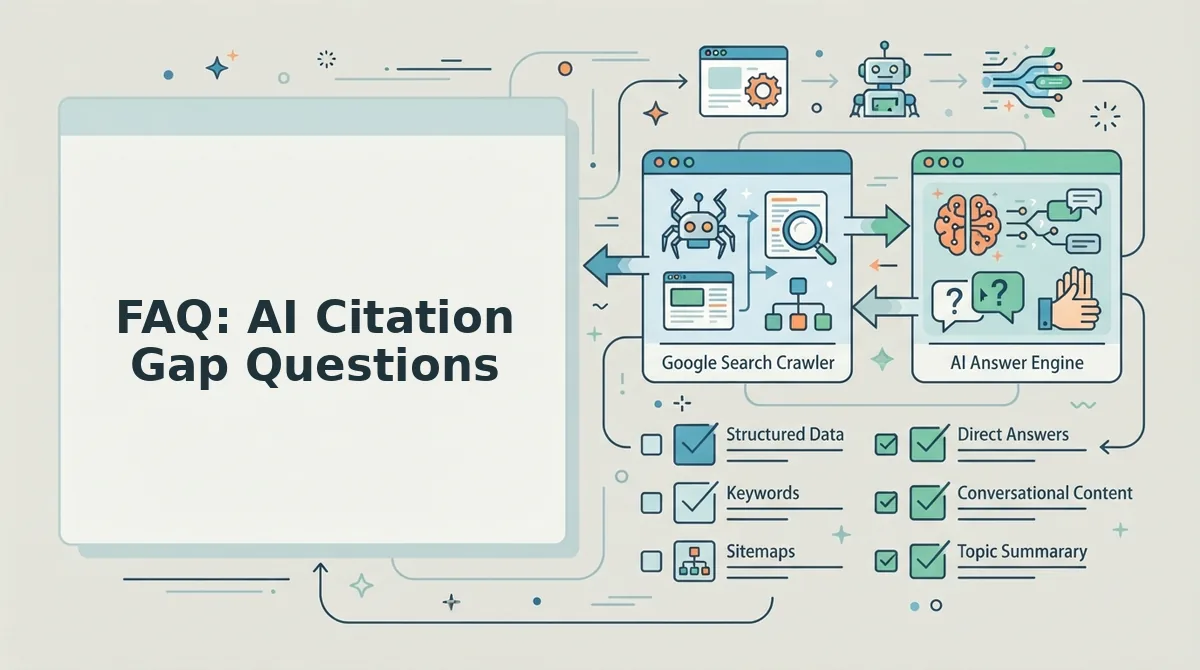
AI citation gaps are the queries where AI engines cite your competitors but not you. These answers cover the most common questions from publishers running their first citation audit.
How do I check if AI search engines cite my content?
Ask the same query in ChatGPT, Perplexity, Google AI Overviews, Claude, and Copilot, then look for your domain in the cited sources. Log every citation you receive and every competitor citation you don't. Repeat across 20-50 target queries to build a baseline gap list.
What is the difference between a keyword gap and an AI citation gap?
A keyword gap is a query where you don't rank in traditional search results. An AI citation gap is a query where you may rank on page one but AI engines still cite a competitor's passage instead. You can have zero keyword gaps and still lose every AI citation.
Can I find AI citation gaps without paid tools?
Yes. Run manual queries across the five major AI engines and log results in a spreadsheet. This takes 2-3 hours for 50 queries but requires no paid subscription. Paid tools like DataForSEO automate the crawl and flag competitor citations at scale.
How often should I run a citation audit?
Run a full audit every 30 days, or immediately after publishing a content cluster. AI citation behavior shifts as engines update their models and index. Monthly audits catch new gaps before competitors build a durable citation advantage. Pair audits with detecting outdated content in SERP results to refresh passages before they lose citations.
Why does AI cite my competitor when I rank higher on Google?
AI engines prioritize passages that answer the query directly in 40-60 words, not pages with the highest domain authority. If your page buries the answer below an introduction, AI engines skip it. Rewrite the passage to lead with the direct answer and re-request indexing.
Build a Citation Moat Before Your Competitors Do
The five-step audit protocol, run a five-engine citation audit, log gaps, classify gap types, test passages, and rewrite answer-first, turns AI citations from a black box into a repeatable system. AI citation gaps are not keyword gaps. You can rank first on Google and still be invisible to ChatGPT, Perplexity, and AI Overviews. The publishers who win AI citations are the ones who treat passage structure as a ranking factor, not an afterthought.
Start with the soft step: run the answer passage test on your top 10 pages today. If you find gaps, move to the medium step: use BloGoose live SERP research to see which competitor passages AI engines cite for your target queries. When you're ready to scale, the BloGoose autopilot content engine applies answer-first passage structure, brand voice, and citation optimization across your entire content calendar without manual rewrites. The brands that close citation gaps this quarter will own the AI answer box before their competitors even run their first audit.